Last updated: 18 November 2026
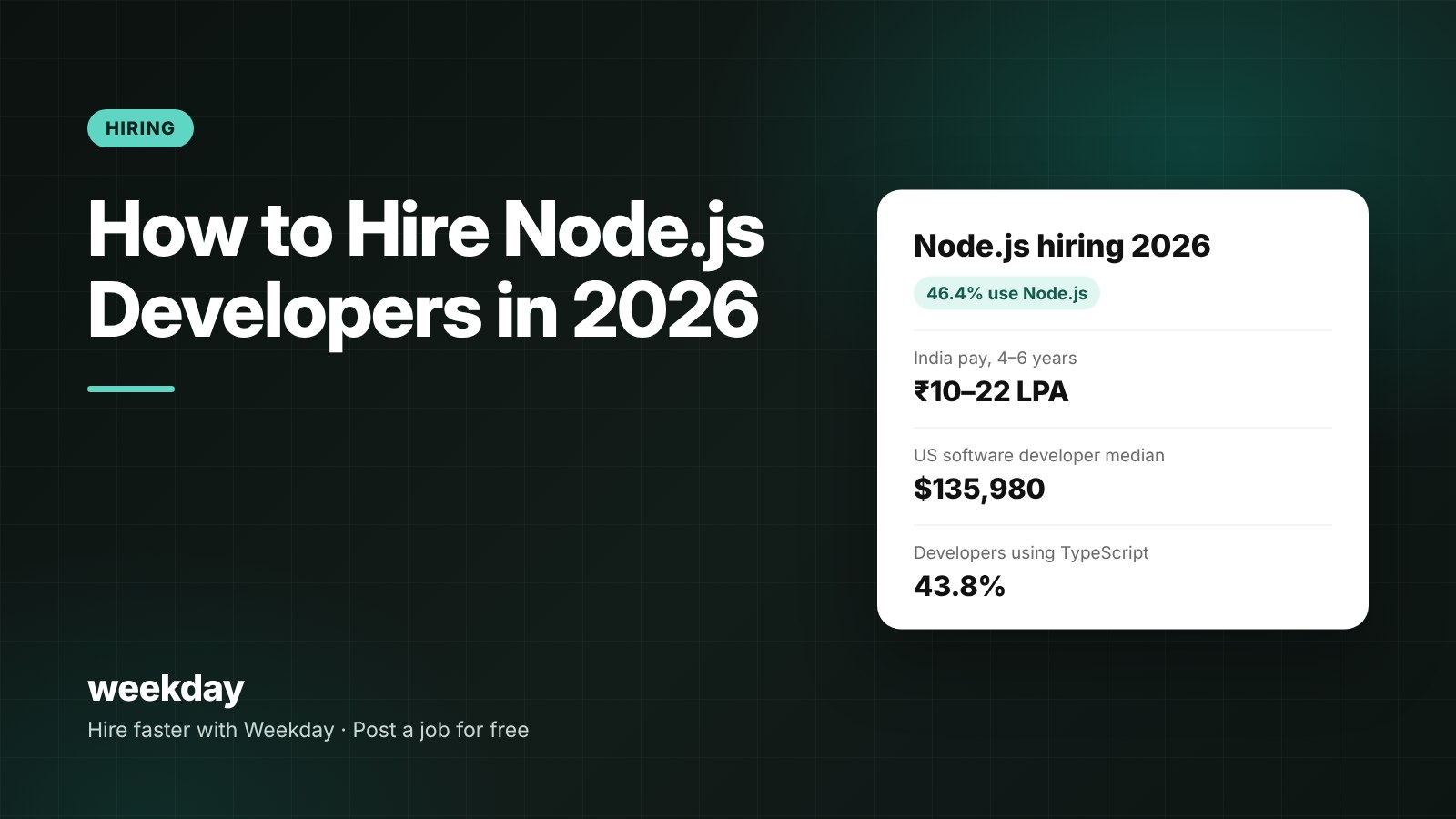
Quick answer: To hire a Node.js developer, first decide if the job is mostly APIs, real-time features or full stack work. Ask for TypeScript, async skills and testing, not a specific framework. Budget about ₹10–22 LPA for 4–6 years in India, and use the $135,980 US software developer median as a reference. Test with a live task that calls a slow API and handles failure well.
Node.js is everywhere in modern web teams. In the 2026 Stack Overflow Developer Survey, 46.4% of respondents to the web frameworks question used Node.js. JavaScript was used by 62.0% of respondents and TypeScript by 43.8% (Stack Overflow 2026).
That popularity cuts both ways. Many people list Node.js on their CV, so you get plenty of applicants. Few of them have built a backend that stays fast and correct under real traffic. This guide helps you find those few.
Step 1: Decide what kind of Node.js work you have
| Type of work | Example | What to look for |
|---|---|---|
| APIs and backend services | Orders, payments, user accounts | Express, NestJS or Fastify; SQL and data modelling; testing |
| Real-time features | Chat, live dashboards, notifications | WebSockets, queues, Redis, handling many open connections |
| Full stack (JavaScript end to end) | Whole features in a MERN or Next.js app | React or Next.js plus Node.js APIs |
| Integrations and serverless | Webhooks, third-party APIs, scheduled jobs | Cloud functions, retries, idempotency, logging |
Weekday's full stack salary guide notes that MERN and Next.js stacks have the most openings, especially at startups. So if you hire for that stack, expect strong competition for the same people.
Step 2: Ask for skills, not framework names
A job post that demands "NestJS 10+ with 5 years" rules out good engineers who used Express. Weekday's advice from hiring for 100+ startups: widen the top of your funnel and do not filter on one exact framework unless the stack is truly niche (Weekday).
Look for these instead:
- Async done right: promises, async/await, error handling, and knowing what blocks the event loop.
- TypeScript: Weekday's salary guide lists TypeScript across front end and back end as a skill that leads to bigger offers.
- Data: SQL design and performance, plus one NoSQL store.
- Testing: unit and API tests as a habit, not an afterthought.
- Security basics: input validation, auth, secrets handling.
- Running in production: Docker, CI/CD, logs and metrics.
Step 3: Set a realistic budget
India
Node.js developers in India are usually hired as backend or full stack engineers. Weekday's 2026 full stack guide is the closest benchmark:
| Experience | Pay (annual CTC) |
|---|---|
| Fresher (0–1 year) | ₹3.5–7 LPA |
| Early career (1–3 years) | ₹5–12 LPA |
| Mid-level (4–6 years) | ₹10–22 LPA |
| Senior (7–9 years) | ₹18–35 LPA |
| Lead / principal (10+ years) | ₹30–50 LPA+ at product companies |
Two things push pay up. First, scale: the guide says Node.js or Go backends at high-traffic product companies are often the best paid. Second, city: for 3–5 years of experience, Bangalore pays about ₹12–22 LPA, Delhi NCR ₹9–17 LPA and tier-2 or remote roles ₹6–12 LPA.
United States
BLS does not track Node.js developers on their own. Backend Node.js roles map best to software developers, whose median wage was $135,980 in May 2025 (BLS). Front-end-heavy web roles map closer to web developers, at a $92,650 median (BLS). The gap is large, so be clear which job you are hiring for.
Step 4: Find developers who have shipped Node.js in production
- Engineers at high-traffic product companies. They have dealt with slow queries, memory leaks and outages that tutorials never cover.
- React developers moving to the back end. Many strong Node.js engineers started on the front end. If they have built and owned APIs, consider them.
- Authors of npm packages and open-source fixes. Their code and review history are public.
- Passive candidates through a personal message. Mention their actual work. In India, Weekday has seen founder outreach on WhatsApp get nearly 2x the response of other channels.
Weekday's Node.js resume guide shows what strong candidates highlight, which helps you screen faster.
Step 5: A practical Node.js interview
- Project walk-through (30 minutes). Ask about the hardest bug they fixed in production. Good answers include how they measured the problem.
- Live coding (60–90 minutes). Build an endpoint that calls a slow third-party API. It must handle timeouts, retries and bad responses, and return a clean error. This one task shows async skill, error handling and judgment.
- Code review (45 minutes). Show a short pull request with an unhandled promise, a missing input check that allows injection, and a loop that blocks the event loop. Strong candidates find all three.
- Design round for seniors (60 minutes). Design a job queue for sending 1 million emails, or a rate limiter for a public API. Listen for failure handling and monitoring.
Weekday's Node.js interview questions work for the first screen. Keep any take-home short: Weekday has seen long take-home tasks lose most of the candidate funnel.
Green flags: handles errors without being reminded, explains the event loop with a real example, writes tests first or right after.
Red flags: wraps everything in try/catch and ignores the error, cannot explain why their API was slow, adds a new npm package for every small problem.
Step 6: Close quickly
- Short process: Weekday has seen 30% of candidates drop off when interviews are slow to schedule. Aim to finish in a week or so.
- Notice periods: in India, usually 30 days at startups and 60–90 days at large IT services firms and MNCs (Weekday).
- Founder call: for startups, a final call with a founder helps close strong candidates.
Hiring in India or the US?
| India | United States | |
|---|---|---|
| Typical pay | ₹10–22 LPA at 4–6 years; more at high-traffic product companies (Weekday) | Software developer median $135,980; web developer median $92,650 (BLS, May 2025) |
| Talent pool | Large, strong in MERN and Next.js | Large, very competitive at senior levels |
| Time to start | Add a 30–90 day notice period | Usually shorter |
How Weekday helps
Weekday's AI sourcing agent finds Node.js developers who match your stack and level, including passive ones, and reaches out on email, WhatsApp and phone. Weekday reports a 50%+ response rate on outbound (Weekday; a platform figure, not a promise for every role). One example: HumanBit cut the time to build a qualified pipeline for specialised roles from 10–20 days to 3 days with Weekday (case study).
Hiring Node.js developers this quarter?
See matching backend and full stack engineers in India or the US, and let Weekday's agents handle outreach.
Book a demoFrequently asked questions
How much does it cost to hire a Node.js developer in India?
Using Weekday's 2026 full stack guide: about ₹3.5–7 LPA for freshers, ₹10–22 LPA at 4–6 years and ₹18–35 LPA at 7–9 years.
How much does a Node.js developer cost in the US?
Backend roles map to software developers, with a $135,980 median in May 2025 (BLS). Front-end-heavy roles map closer to web developers at $92,650.
Should a Node.js developer know TypeScript?
For most new projects, yes. 43.8% of 2026 Stack Overflow survey respondents used TypeScript.
Express or NestJS: does it matter?
Less than people think. Test async handling, data modelling, testing and security instead.
How long does it take to hire a Node.js developer?
Two to three weeks from first call to offer is a good target. In India, add the notice period.
Sources
- Stack Overflow Developer Survey 2026, Technology
- US Bureau of Labor Statistics: Software Developers, Web Developers
- Weekday: full stack developer salary 2026, hiring engineers from India, HumanBit case study, notice period guide