
Last updated: 18 November 2026
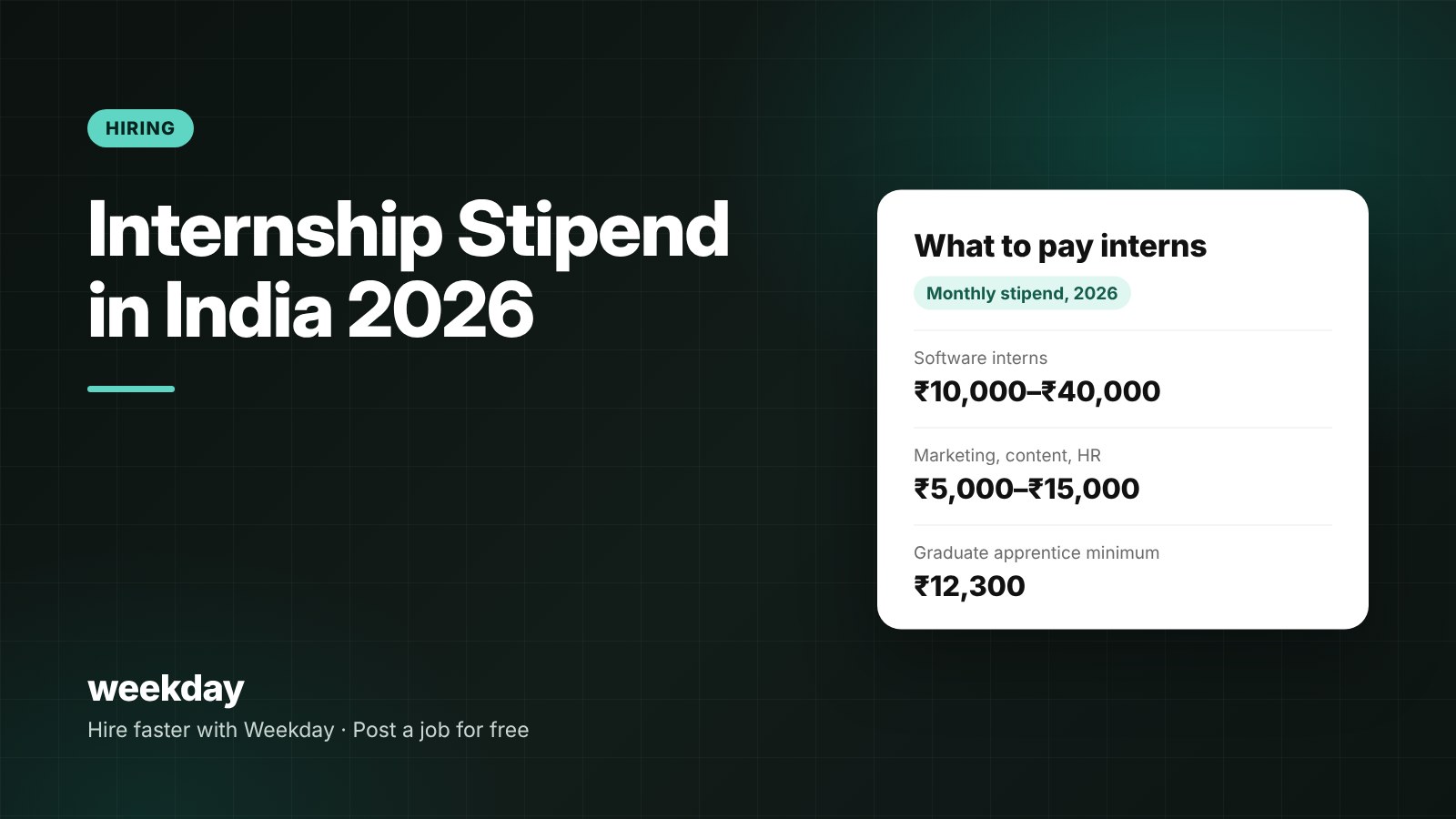
Quick answer: Most internships in India pay between ₹5,000 and ₹40,000 a month. Non-tech roles like marketing, content and HR sit at ₹5,000–₹15,000. Data roles sit at ₹10,000–₹30,000 and software roles at ₹10,000–₹40,000 (Weekday, November 2026). Use government numbers as a floor check: the PM Internship Scheme pays ₹5,000 a month, and graduate apprentices must get at least ₹12,300 a month since September 2025.
Interns have more choice than most employers think. On 16 November 2026, Weekday listed 4,188 live internships in India. 931 of them were posted in the previous seven days, and 94.2% were remote (Weekday internship report).
That last number changes how you should set a stipend. With almost every internship remote, a student in Indore can apply to a startup in Bangalore and one in Gurgaon on the same day. Your stipend is compared with offers from across the country, not just your city.
This guide shows what other employers pay, the government benchmarks to know, and a simple way to set your own number.
Internship stipend by role
Weekday's November 2026 internship report gives these indicative monthly ranges. They are typical, not fixed: plenty of good internships sit outside them.
| Internship type | Usual monthly stipend |
|---|---|
| Marketing, content, HR, operations | ₹5,000–₹15,000 |
| Sales / business development | ₹8,000–₹20,000, sometimes plus incentives |
| Design (UI/UX, graphic) | ₹8,000–₹25,000 |
| Data / analytics | ₹10,000–₹30,000 |
| Software development | ₹10,000–₹40,000; well-funded startups and large tech firms can pay more |
Stipend by company type (tech and AI roles)
For technical interns, who you are matters as much as the role. Weekday's AI/ML internship guide shows this split:
| Employer | AI/ML intern stipend (monthly) |
|---|---|
| Early-stage startups and small firms | ₹10,000–₹25,000 |
| Growth-stage startups and mid-size tech firms | ₹20,000–₹40,000 |
| Large tech and well-funded AI companies | Often ₹40,000 and above |
Example: a seed-stage startup offering an ML intern ₹15,000 a month is competing for the same students as growth-stage firms in the ₹20,000–₹40,000 band. If the budget is tight, offer a shorter, more focused project at a higher monthly rate instead of a long one at a low rate.
Government benchmarks to know
Two government numbers are useful as a floor check, even if your internship is not part of either scheme.
PM Internship Scheme
Under the pilot announced in October 2024, interns get ₹5,000 a month for 12 months. The company pays ₹500 of it and the government pays ₹4,500. Interns also get a one-time grant of ₹6,000. The scheme is for people aged 21 to 24 who are not in full-time work or full-time education (PIB).
Minimum stipend for apprentices
Apprentices are a different legal category from interns, under the Apprentices Act, 1961. Their minimum stipends were raised from 11 September 2025 (DGT, Ministry of Skill Development):
| Apprentice category | Old minimum | New minimum (per month) |
|---|---|---|
| School pass-outs, class 5 to 9 | ₹5,000 | ₹6,800 |
| School pass-outs, class 10 | ₹6,000 | ₹8,200 |
| Class 12, or national/state certificate holder | ₹7,000 | ₹9,600 |
| Diploma holder (technician apprentice) | ₹8,000 | ₹10,900 |
| Graduate or degree apprentice | ₹9,000 | ₹12,300 |
The same notice says employers may pay more than these minimums to make apprenticeships attractive. A practical reading: if you pay a full-time graduate intern less than ₹12,300 a month, you are below what the law requires for a graduate apprentice doing similar hours.
How to set your stipend in 5 steps
- Start from the role band. Use the tables above. A software intern starts at the ₹10,000–₹40,000 band, a content intern at ₹5,000–₹15,000.
- Adjust for hours. A part-time intern working 20 hours a week can get roughly half of the full-time number.
- Adjust for location. An on-site intern in Bangalore or Mumbai pays city rent. If you need them in the office, pay towards the top of the band or add a travel or housing allowance.
- Adjust for the work. If the intern ships production code or handles customers, pay like you would for real work, because it is.
- Budget the total, not the monthly number. Use the formula below.
Example: 3 software interns × ₹20,000 × 6 months = ₹3,60,000. Raising each stipend to ₹25,000 costs ₹90,000 more over six months, and can decide whether your first choice says yes.
Paid vs unpaid internships
From the employer side, unpaid internships shrink your pool. Students with rent or family costs cannot take them, so you are choosing from fewer people. Weekday's report finds paid internships usually come with real work and better mentoring, because the company has a reason to invest. Unpaid can make sense only in narrow cases, such as a short, part-time project at an NGO or a research lab.
One rule has no exceptions: never ask an intern to pay anything. Not for registration, training, a laptop or a certificate. Weekday's report flags fee-based "internships" as a scam pattern, and a real employer does not want to look like one.
What to put in the internship offer
- Monthly stipend, payment date and payment method (bank transfer)
- Start date, duration and weekly hours
- Location: remote, hybrid or on-site
- Who the intern reports to and what they will work on
- Certificate or letter at the end
- Whether a pre-placement offer (PPO) is possible, and how it is decided
- Confidentiality and ownership of work
Weekday's offer letter format can be adapted for interns. Ask your accountant how to treat stipend payments for tax deduction at source before the first payout.
Plan for the conversion
An internship is the cheapest trial you will ever run for a full-time hire. Decide before the internship starts what a "yes" looks like, for example "ships two features that reach users". Tell the intern. Then compare their full-time offer with fresher pay in the market. Weekday's fresher jobs report and salary guides, such as the full stack salary guide (₹3.5–7 LPA for freshers), help you set that number.
Hiring interns from the US?
For comparison, bachelor's-level interns in the US earned an average of $23.35 an hour, based on summer 2025 data in NACE's 2026 compensation guide (NACE). At 40 hours a week, that is about $4,000 a month ($23.35 × 40 × 52 ÷ 12). Compare that with the ₹10,000–₹40,000 monthly band for software interns in India before you set a remote intern's stipend.
How Weekday helps
Weekday's AI sourcing agent finds interns and freshers who match your role, checks their expectations, and reaches out on email and WhatsApp until they reply. Your first role is free, with 200 reach-outs included (Weekday).
Hiring interns or freshers this season?
Paste your internship description and launch a free AI sourcing agent. No credit card.
Post a free jobFrequently asked questions
What is a normal internship stipend in India in 2026?
Indicatively ₹5,000–₹15,000 a month for marketing, content, HR and operations; ₹10,000–₹30,000 for data; and ₹10,000–₹40,000 for software (Weekday, November 2026).
How much stipend should a startup pay a software intern?
Usually ₹10,000–₹40,000 a month. For AI/ML interns, early-stage startups pay about ₹10,000–₹25,000 and growth-stage firms ₹20,000–₹40,000.
What is the stipend under the PM Internship Scheme?
₹5,000 a month for 12 months (₹4,500 from the government, ₹500 from the company), plus a one-time ₹6,000 grant.
What is the minimum stipend for apprentices?
From 11 September 2025, ₹6,800 to ₹12,300 a month depending on qualification. Graduate apprentices get at least ₹12,300. These rules cover apprentices, not ordinary interns.
Should interns be unpaid?
Rarely. Paid internships attract a bigger, stronger pool. Never charge an intern a fee.





