
Last updated: November 2026 · Salary data from Weekday salary pages
Java runs a lot of the software you use without noticing: bank systems, insurance platforms, large e-commerce backends and Android's roots. A Java developer builds and maintains these systems, usually on the backend, using Java and the Spring framework.
This roadmap shows what to learn and in what order, a month-by-month plan, projects that get interviews, and what Java-heavy employers pay in India.
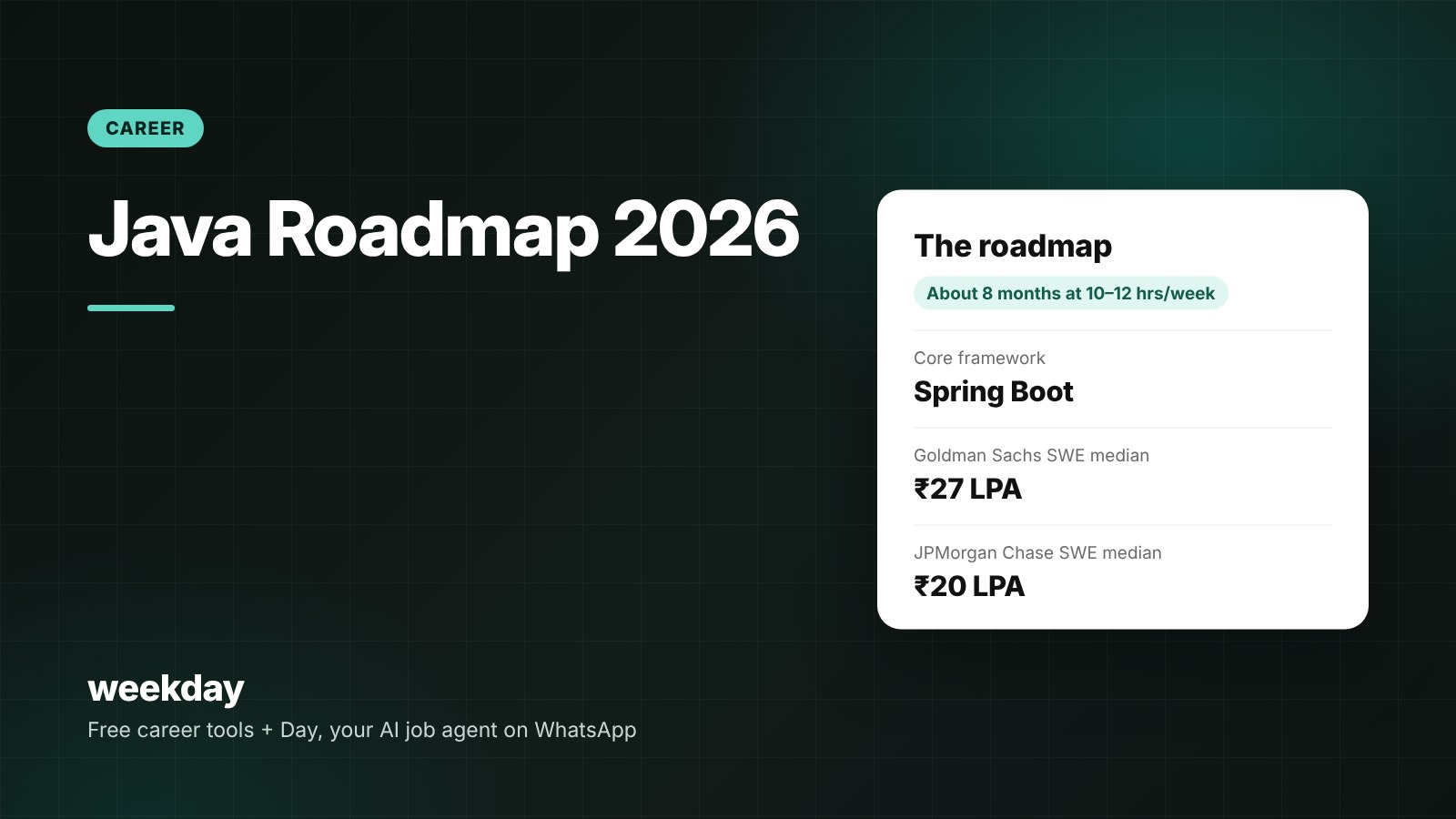
The roadmap in one line: core Java and OOP → collections and exceptions → Java 8+ features → Git and Maven → SQL and JDBC → Spring Boot REST APIs → JPA/Hibernate → testing → microservices, Docker and cloud basics → DSA and projects. Our suggested plan fits this into about 8 months at 10 to 12 hours a week.
Why Java in 2026?
Java is used by 29.4% of developers, and Spring Boot by 14.7%, in the Stack Overflow Developer Survey 2025. It is not the newest language, but it is everywhere in large companies, and that means steady hiring. Banks, payment companies, IT services firms and enterprise software companies all run large Java codebases that need people.
The Java roadmap: 10 steps
Step 1: Core Java and OOP
- Syntax, data types, loops, methods, arrays and strings
- Classes and objects; the four OOP ideas: encapsulation, inheritance, polymorphism, abstraction
- Interfaces vs abstract classes
static,final, access modifiers
You are ready when: you can model a small library system with classes for Book, Member and Loan, and explain why you designed it that way. Our OOP interview questions help.
Step 2: Collections, generics and exceptions
- List, Set, Map, Queue; ArrayList vs LinkedList; HashMap internals
- Generics and why they make code safer
- Checked vs unchecked exceptions, try-with-resources
How a HashMap works inside comes up often in Java interviews. See our core Java interview questions.
Step 3: Java 8 and newer features
- Lambdas and functional interfaces
- Streams: filter, map, reduce, collect
- Optional, the new date-time API, records and text blocks in newer versions
Practise with our Java 8 interview questions.
Step 4: Multithreading and JVM basics
- Threads, Runnable, ExecutorService, synchronized, locks
- Concurrent collections such as ConcurrentHashMap
- JVM memory: heap vs stack, garbage collection at a high level
Step 5: Git and build tools
Learn Git (branches, pull requests, merge conflicts) and Maven or Gradle (dependencies, building a JAR). Every Java team uses both daily.
Step 6: SQL and JDBC
Learn SQL properly: joins, indexes, transactions. Then connect Java to a database with JDBC once, so you understand what frameworks do for you later. Our SQL interview questions cover the basics.
Step 7: Spring Boot
- Building REST APIs: controllers, services, repositories
- Dependency injection and configuration
- Spring Data JPA with Hibernate
- Validation, exception handling and Spring Security basics (login, roles, JWT)
This is the step that makes you employable. Prepare with our Spring Boot interview questions.
Step 8: Testing
Write unit tests with JUnit 5 and mock dependencies with Mockito. Add a few integration tests for your APIs. Teams notice candidates who test their code.
Step 9: Microservices, Docker and cloud basics
- Splitting an app into a few services that talk over REST or a message queue
- Packaging a Spring Boot app in a Docker container
- Deploying to one cloud and reading logs
Our DevOps roadmap covers Docker and cloud in more depth.
Step 10: DSA and system design basics
Product companies and many banks test data structures and algorithms in Java. Practise a few problems a week from Step 2 onwards with our DSA interview questions.
Java developer vs Java full stack developer
| Java (backend) developer | Java full stack developer | |
|---|---|---|
| Main work | APIs, business logic, databases | Backend plus the screens users see |
| Extra skills | Deeper Spring, performance, messaging | HTML, CSS, JavaScript and React or Angular |
| Good for | Banks, large enterprises | Startups and smaller teams |
For the frontend half, follow Steps 1 to 4 of our full stack developer roadmap.
Month-by-month plan
| Month | Focus | Output by the end |
|---|---|---|
| 1 | Core Java, OOP | A console app with clean classes |
| 2 | Collections, exceptions, Java 8 | 50 practice problems solved in Java |
| 3 | Multithreading, JVM, Git, Maven | A multithreaded file processor on GitHub |
| 4 | SQL, JDBC | A small app that reads and writes to PostgreSQL or MySQL |
| 5–6 | Spring Boot, JPA, security | A REST API with login and roles |
| 7 | Testing, Docker, cloud | Tests passing and the API live on a public URL |
| 8 | DSA, projects, applications | 3 projects live, resume ready, applying every week |
3 projects that get interviews
- Bank account API. Accounts, deposits, transfers with proper transactions, and tests that prove money is never lost.
- Movie ticket booking backend. Shows, seats and bookings, with handling for two people trying to book the same seat.
- Order service with microservices. An order service and an inventory service that talk through a queue, both in Docker.
Each one shows a skill interviewers probe: transactions, concurrency and service design.
What Java-heavy employers pay
Weekday's salary pages do not have a separate "Java Developer" title yet, so here is the median Software Engineer salary at large banks and enterprise software companies, common employers for Java developers (fixed pay, all experience levels, read on 20 November 2026):
| Company | Median | Typical range |
|---|---|---|
| Goldman Sachs | ₹27 LPA | ₹23–34 LPA |
| Wells Fargo | ₹21.4 LPA | ₹18–24.7 LPA |
| Morgan Stanley | ₹20.9 LPA | ₹13.6–26.4 LPA |
| JPMorgan Chase | ₹20 LPA | ₹12–28 LPA |
| SAP | ₹20 LPA | ₹14–25 LPA |
| Visa | ₹19 LPA | ₹13–23.9 LPA |
| Deutsche Bank | ₹19 LPA | ₹11–21 LPA |
| Oracle | ₹14.5 LPA | ₹10–20 LPA |
| Mastercard | ₹14.3 LPA | ₹9.3–21 LPA |
| Barclays | ₹14 LPA | ₹8.7–20 LPA |
| IBM | ₹12.8 LPA | ₹7.1–20 LPA |
| Amdocs | ₹10.8 LPA | ₹8–14 LPA |
Fresher medians on the same pages include ₹24.2 LPA at Goldman Sachs, ₹20.9 LPA at Visa, ₹11.3 LPA at Oracle and ₹7 LPA at IBM. Global banks pay well for strong Java and DSA skills. Use the in-hand salary calculator to see any package per month.
How Java interviews work
- Online test: DSA problems, Java MCQs
- Core Java round: OOP, collections, HashMap internals, exceptions, multithreading
- Spring Boot round: REST design, dependency injection, JPA, transactions
- Project deep dive and HR round
Prepare with our Java interview questions, and see Java developer fresher resume examples for your resume.
Mistakes that slow people down
- Jumping to Spring before core Java. Spring errors make no sense without OOP and collections.
- Only watching tutorials. Build the projects above, even small versions.
- Skipping SQL. Most Java backend bugs involve the database.
- Ignoring tests. JUnit on your resume, with real tests on GitHub, stands out.
Ready to apply?
See open Java developer roles on Weekday, from startups to banks and GCCs, with filters for experience and city.
Frequently asked questions
How long does it take to become a Java developer?
Our suggested plan takes about 8 months at 10 to 12 hours a week, from core Java to Spring Boot, testing, Docker and three projects.
Is Java still in demand in 2026?
Yes. Java is used by 29.4% of developers in the Stack Overflow 2025 survey, and banks, payment companies and enterprises run large Java systems.
Should I learn Java or Python first?
Pick based on the jobs you want. Java suits backend roles at banks and large companies. Python suits data, AI and scripting work.
Is Spring Boot necessary for Java jobs?
For most backend Java roles, yes. Spring Boot is the common way to build Java web services.
What do Java developers earn in India?
It depends heavily on the company. On Weekday, the median Software Engineer salary is ₹27 LPA at Goldman Sachs and ₹20 LPA at JPMorgan Chase, against ₹10.8 LPA at Amdocs.





