
Last updated: 25 November 2026
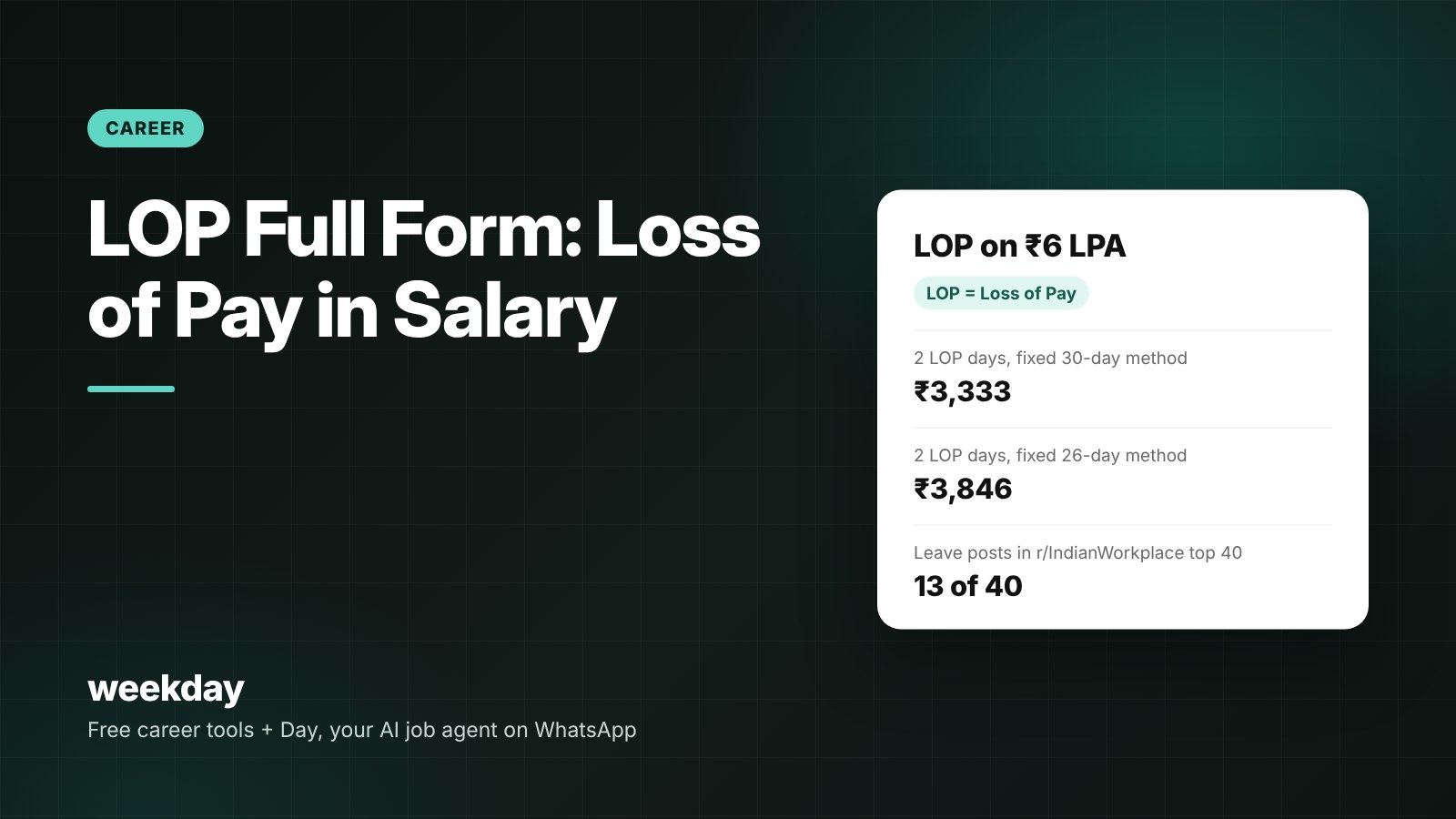
Short answer: the full form of LOP is Loss of Pay. It's the salary cut for days you were absent without paid leave. The formula is simple: monthly salary ÷ days in the pay period × LOP days. But the "days" part changes by company. Two LOP days on a ₹6 LPA salary can cost you anywhere from ₹3,226 to ₹4,545, depending on whether your payroll divides by calendar days, 30, 26 or working days. Leave is also what Indian employees argue about most online: in Weekday's scan of top Reddit posts from the last 30 days, leave and working hours was the #1 theme in r/IndianWorkplace (13 of its 40 top posts).
You open your payslip and see "LOP: 2 days" and a smaller credit than usual. Or HR tells you an extra leave "will be LOP". Either way, you want to know two things: what exactly got cut, and was it calculated right. This guide answers both with worked examples.
LOP full form and meaning
LOP = Loss of Pay. Some companies call it LWP (Leave Without Pay) or unpaid leave. It's the same thing: you're not paid for those days.
LOP usually happens when:
- You've used up your paid leave (casual, sick or earned leave) and take another day off.
- You're absent without approval, or your leave request was rejected and you didn't come in.
- Your company's policy turns repeated late marks or missed attendance punches into half-day or full-day LOP.
- Your company applies a "sandwich" rule, where a weekend or holiday between two leave days also counts as leave.
LOP is different from salary proration when you join or leave mid-month. Proration pays you only for the days you were employed. LOP cuts pay for days you were employed but didn't work and didn't have paid leave.
Why LOP is on everyone's mind right now
Weekday analysed 400 top Reddit posts, 420 LinkedIn posts and 400 X posts from the last 30 days (Nov 2026). Leave and working hours came up in 60 of the 400 Reddit posts, with 16,871 comments between them. In r/IndianWorkplace, it was the single biggest theme: 13 of the 40 top posts.
Three threads show the pattern:
- A post with 618 upvotes asked whether it's normal for Diwali holidays on 10 and 11 November to be unpaid (thread). Unpaid "holidays" are LOP by another name.
- Another described a manager refusing sick leave because six other team members were already off that day (thread). If you take the day anyway, it may be marked LOP.
- A third asked whether 15–16 leaves a year is "too much" in corporate life, and drew 178 comments (thread).
The common thread: people know leave is a right on paper but don't know what happens to their pay when leave runs out or gets refused. That's exactly what LOP decides.
How LOP is calculated
LOP deduction = (Monthly salary ÷ Days in the pay period) × Number of LOP days
The monthly salary is usually your monthly gross (sometimes only the fixed components). The "days in the pay period" is set by your company's payroll policy. These are the common methods:
| Method | Divide monthly salary by | What it means for you |
|---|---|---|
| Calendar days | 28, 29, 30 or 31 (actual days in that month) | Per-day pay changes every month. An LOP day in February costs more than one in December. |
| Fixed 30 days | 30, every month | Same per-day pay all year. Simple to check. |
| Fixed 26 days | 26 (assumes paid Sundays off) | Higher per-day pay, so each LOP day costs more. |
| Working days | Working days in the month, e.g. 22 | The biggest cut per LOP day. |
| Yearly basis | Annual salary ÷ 365 | Same per-day pay all year. Some payroll tools now offer this. |
Payroll guides from Keka and Kredily describe these methods, and note that your company's policy decides which one applies. Your offer letter or HR policy should say which. If it doesn't, ask HR.
Worked example: LOP on a ₹6 LPA salary
To keep the maths clean, assume monthly gross = CTC ÷ 12 = ₹50,000. (Your real gross is a little lower, because CTC includes employer PF.) You take 2 LOP days.
| Method | Per-day pay | Cut for 2 LOP days |
|---|---|---|
| Calendar days, 31-day month | ₹1,613 | ₹3,226 |
| Calendar days, February (28 days) | ₹1,786 | ₹3,571 |
| Fixed 30 days | ₹1,667 | ₹3,333 |
| Yearly basis (÷ 365) | ₹1,644 | ₹3,288 |
| Fixed 26 days | ₹1,923 | ₹3,846 |
| Working days (22) | ₹2,273 | ₹4,545 |
Same two days off, a gap of ₹1,319 between the cheapest and costliest method. If you take one LOP day every month on the fixed 30-day method, that's ₹20,000 a year gone.
Worked example: LOP on a ₹12 LPA salary
Monthly gross = ₹1,00,000. Again, 2 LOP days.
| Method | Per-day pay | Cut for 2 LOP days |
|---|---|---|
| Calendar days, 31-day month | ₹3,226 | ₹6,452 |
| Calendar days, February (28 days) | ₹3,571 | ₹7,143 |
| Fixed 30 days | ₹3,333 | ₹6,667 |
| Yearly basis (÷ 365) | ₹3,288 | ₹6,575 |
| Fixed 26 days | ₹3,846 | ₹7,692 |
| Working days (22) | ₹4,545 | ₹9,091 |
How LOP changes your in-hand salary
LOP comes off your gross, so a few other numbers move with it.
- Income tax: under the new regime in FY 2026-27, salaried people pay no income tax up to ₹12.75 lakh a year (₹75,000 standard deduction plus the Section 87A rebate). At ₹6 LPA and ₹12 LPA you're inside that, so there's no tax saving to soften the LOP.
- PF: employee PF is 12% of basic. If LOP lowers your basic, your PF falls a little, which means a slightly smaller hit to in-hand. But since 17 September 2026 the EPF wage ceiling is ₹25,000 a month. If your company calculates PF on the capped ₹25,000 and your basic stays above it, LOP doesn't change your PF at all.
Here's the in-hand impact for 2 LOP days on the fixed 30-day method, assuming basic is 50% of gross:
| ₹6 LPA | ₹12 LPA (PF on capped ₹25,000) | ₹12 LPA (PF on full basic) | |
|---|---|---|---|
| Gross cut | ₹3,333 | ₹6,667 | ₹6,667 |
| Basic after LOP | ₹23,333 | ₹46,667 | ₹46,667 |
| Employee PF change | ₹3,000 → ₹2,800 (−₹200) | ₹3,000 → ₹3,000 (no change) | ₹6,000 → ₹5,600 (−₹400) |
| Income tax change | None (nil tax) | None (nil tax) | None (nil tax) |
| Drop in in-hand pay | ₹3,133 | ₹6,667 | ₹6,267 |
To see your own number, put your CTC into Weekday's in-hand salary calculator, then subtract the LOP amount from your monthly gross. Our CTC vs in-hand guide explains each line on the payslip.
How to check your payslip for LOP mistakes
- Find the LOP line. Payslips usually show "LOP days" or "paid days" next to the month's total days.
- Work out the divisor. Divide your monthly gross by the per-day amount they deducted. If you get 30, 26, 22 or the month's calendar days, you know their method.
- Match the dates. Compare LOP days with your approved leave in the HR portal. Missed punches and pending approvals are the usual cause of wrong LOP.
- Raise it fast. Most payroll teams can reverse LOP in the next month's salary if you flag it with proof.
How to avoid LOP
- Know your balance. Check casual, sick and earned leave before you plan time off.
- Get approval in writing. A WhatsApp "ok" from your manager won't always count. Apply in the HR system.
- Ask for comp-off. If you worked a weekend or holiday, ask for a compensatory day off before taking LOP.
- Offer WFH instead. For mild illness or a home emergency, a WFH day can save you a full day's pay.
- Read the holiday list. If a "holiday" is unpaid, it's LOP. Ask HR whether it's a declared holiday or a forced leave day.
- Don't waste earned leave. Unused EL can often be carried forward or encashed. See our guide to leave encashment.
If you think LOP was applied unfairly, for example on sick leave you were entitled to, check with your HR or a lawyer before you escalate.
See what LOP does to your take-home
Enter your CTC in Weekday's free in-hand salary calculator to see your monthly gross, PF and take-home under the new tax regime. Then subtract your LOP days using the formula above.
Frequently asked questions
What is the full form of LOP in salary?
LOP stands for Loss of Pay. It's the amount cut from your salary for days you were absent without paid leave. Some companies call it LWP, or Leave Without Pay.
How is LOP calculated?
LOP = (monthly salary ÷ days in the pay period) × LOP days. Companies divide by calendar days, a fixed 30 or 26 days, or working days. For a ₹50,000 monthly salary, 2 LOP days cost ₹3,333 on the 30-day method and ₹3,846 on the 26-day method.
Is LOP calculated on gross salary or basic?
Most companies calculate LOP on monthly gross salary, though some use only the fixed components. Your HR policy or payroll team can confirm which.
Does LOP affect PF?
It can. Employee PF is 12% of basic, so if LOP lowers your basic, PF falls a little. If your PF is calculated on the ₹25,000 wage ceiling and your basic stays above it, LOP doesn't change PF.
Are weekends counted in LOP?
It depends on your company. Under a sandwich rule, a weekend or holiday between two leave days also counts as leave, so it can become LOP if you have no balance. Check your leave policy.
Sources
- Weekday analysis of 400 top Reddit posts, 420 LinkedIn posts and 400 X posts from the last 30 days (Nov 2026); r/IndianWorkplace threads on unpaid Diwali holidays, denied sick leave and 15–16 leaves a year (paraphrased)
- Keka: What is LOP in salary and Keka: yearly-based LOP
- Kredily: What is LOP
- Business Today: ₹12.75 lakh tax-free under the new regime in FY 2026-27
- Keka: EPFO wage ceiling raised to ₹25,000 from 17 Sep 2026
- Weekday in-hand salary calculator





