
Last updated: 18 November 2026
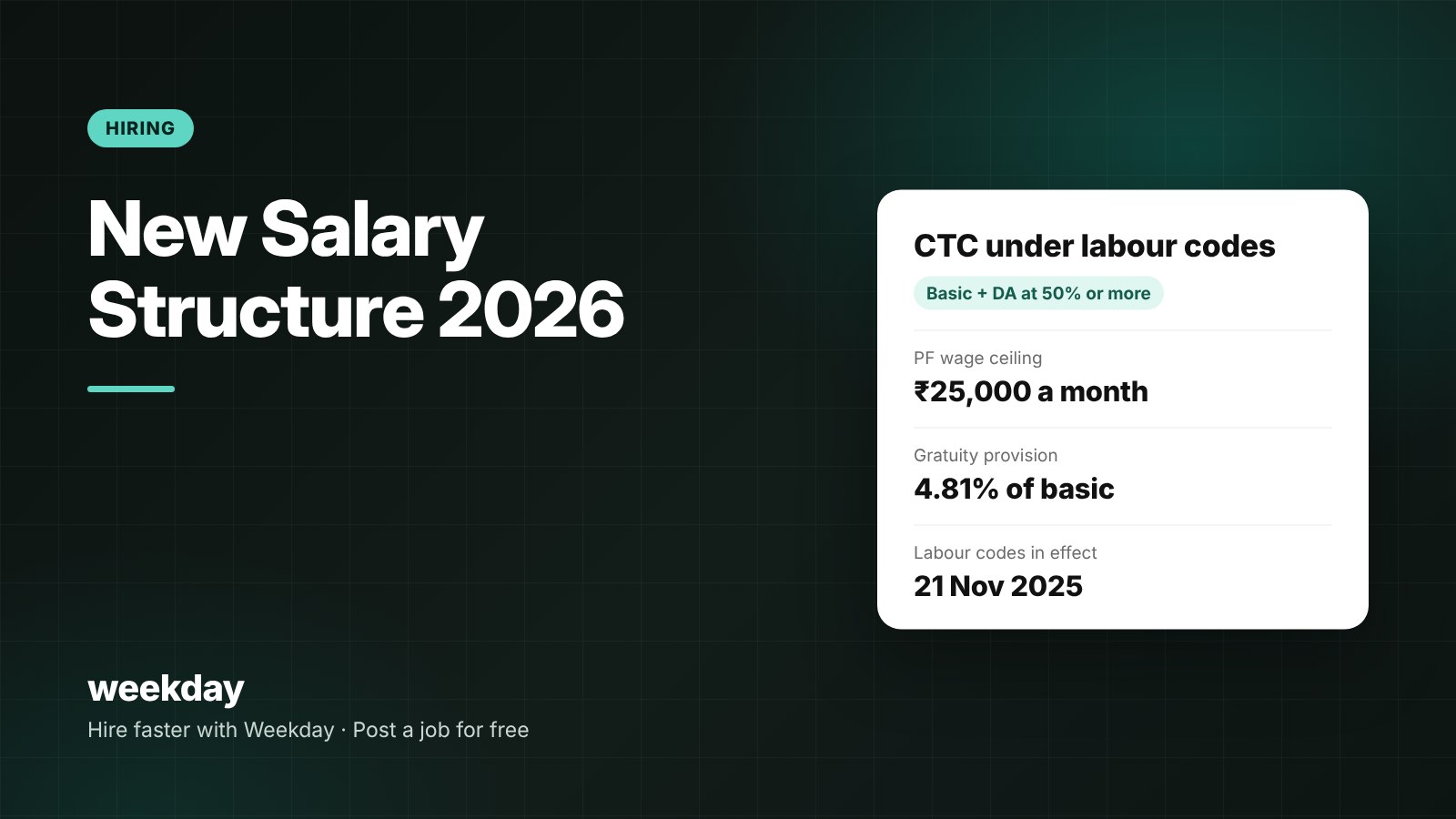
Quick answer: Under the labour codes, "wages" means basic pay, dearness allowance and retaining allowance. If excluded items such as HRA, conveyance, bonus and employer PF add up to more than half of total pay, the extra counts as wages anyway. So most employers now keep basic + DA at 50% or more of pay. Then recheck PF (the EPF wage ceiling rose to ₹25,000 a month from 17 September 2026), budget gratuity on the higher basic, and update your offer letter template.
The four labour codes came into effect on 21 November 2025 (PIB). A year later, many companies are still issuing offers on older CTC templates built around a low basic. This guide explains what changed for salary structures and gives you a step-by-step way to fix yours. It is general guidance, not legal or tax advice. Check final structures with your payroll and legal advisers.
What changed: the single definition of wages
The Code on Wages defines wages as all remuneration, including basic pay, dearness allowance and retaining allowance. It lists items that are not wages, such as statutory bonus, employer contributions to PF and pension, conveyance, house rent allowance, overtime, commission, gratuity and retrenchment pay (Code on Wages, section 2(y)).
The key part is the proviso. If the excluded payments in clauses (a) to (i) exceed one-half of total remuneration, the amount above one-half is added back to wages. Gratuity and retrenchment pay, clauses (j) and (k), are not part of this 50% test. The Ministry of Labour's FAQs confirm that this single definition of wages applies across all four codes (Labour Codes FAQs).
Example: total monthly pay is ₹1,00,000 and basic + DA is ₹35,000. If the other ₹65,000 sits in excluded items, that is ₹15,000 above the 50% line. Wages for statutory benefits become ₹50,000, not ₹35,000. Setting basic + DA at 50% from the start keeps your payroll simple and predictable.
Which benefits depend on wages
| Benefit | How it works now | What to check |
|---|---|---|
| Gratuity | 15 days' wages for each year of service, based on wages last drawn. Fixed-term employees qualify after one year of continuous service (PIB). | Higher basic means a higher gratuity provision. Include fixed-term staff. |
| Provident Fund | Employees and employers each contribute 12% of PF wages in most establishments. The statutory wage ceiling went up from ₹15,000 to ₹25,000 a month from 17 September 2026 (Ministry of Labour; BDO). | Decide whether you contribute on the ceiling or on full basic. |
| Pension (EPS) | The EPS wage ceiling stays at ₹15,000 a month (UNI, October 2026). | Your payroll software must split PF and EPS on different ceilings. |
The Ministry said in December 2025 that the codes do not reduce take-home pay if PF deduction stays on the statutory wage ceiling (Business Today). At the new ceiling, that is ₹3,000 a month from the employee and ₹3,000 from the employer (12% of ₹25,000), up from ₹1,800 each at the old ceiling. For the employee view, see Weekday's guides to PF new rules 2026 and basic salary meaning.
A sample salary structure for ₹18 LPA
Here is one compliant way to structure a CTC of ₹18,00,000 a year, with basic at 50% of CTC, HRA at 40% of basic, PF on the statutory ceiling and gratuity budgeted at 4.81% of basic (15 ÷ 26 ÷ 12). Treat it as an illustration, not a template for every role.
| Component | Per year (₹) | Per month (₹, rounded) |
|---|---|---|
| Basic + DA | 9,00,000 | 75,000 |
| House rent allowance (40% of basic) | 3,60,000 | 30,000 |
| Other allowances (balancing figure) | 4,60,710 | 38,392 |
| Gross salary | 17,20,710 | 1,43,392 |
| Employer PF (12% of ₹25,000) | 36,000 | 3,000 |
| Gratuity provision (4.81% of basic) | 43,290 | 3,608 |
| CTC | 18,00,000 | 1,50,000 |
Basic is ₹9 lakh against total pay of about ₹17.57 lakh (gross plus employer PF), a little over half, so nothing gets added back. Even if your advisers treat "other allowances" as excluded, the excluded items stay under 50%.
What the change costs
Compare this with an older structure where basic was 35% of CTC (₹6,30,000). The gratuity provision rises from ₹30,303 to ₹43,290 a year, about ₹13,000 more per employee. At exit, the gap is larger. After five years, gratuity on a basic of ₹75,000 a month is about ₹2,16,346 (75,000 × 15 ÷ 26 × 5). On a basic of ₹52,500 it would be about ₹1,51,442. If you keep CTC fixed, that extra cost comes out of the flexible allowances, so take-home drops slightly. If you calculate PF on full basic instead of the ceiling, take-home drops much more, because 12% of a bigger basic is deducted every month. You can test both versions with Weekday's gratuity calculator and in-hand salary calculator.
Employers are feeling this. In Aon's October 2026 survey of more than 1,200 organisations, 65.4% of employers said they were already compliant with the codes, another 20.9% expected to be ready within six months, and 42.8% expected payroll costs to rise by at least 1% (Aon).
HRA and tax: what changed in 2026
- New tax regime is the default. The standard deduction for salaried people is ₹75,000, and HRA exemption is not available under the new regime (Business Today).
- More 50% HRA cities in the old regime. From 1 April 2026, Bengaluru, Hyderabad, Pune and Ahmedabad joined Mumbai, Delhi, Kolkata and Chennai for the higher 50% HRA exemption (Business Standard).
- Zero tax up to about ₹12.75 lakh gross. Under the new regime, salaried people pay no tax on taxable income up to ₹12 lakh, thanks to the ₹75,000 standard deduction and the rebate (Weekday CTC guide). Many junior employees will care more about PF and allowances than about HRA.
Keeping a separate HRA line still helps employees who stay in the old regime, especially in the eight 50% cities.
An 8-step checklist to restructure salaries
- List every pay component and tag it as wages (basic, DA, retaining allowance) or excluded.
- Run the 50% test for each salary band, not just a sample employee.
- Choose your PF base: the ₹25,000 ceiling or full basic. Write the policy down.
- Recalculate the gratuity provision at 4.81% of wages, including fixed-term staff after one year.
- Update HRA rules for old-regime employees in the eight 50% cities.
- Fix your offer letter template and CTC calculator so new offers are compliant. See Weekday's offer letter format for where the breakup goes.
- Tell employees before payroll changes. Show the old and new take-home side by side.
- Check your state's rules. The central rules were notified in May 2026 (Business Today). By late September 2026, ten states had published rules and the Centre was aiming for all states by 31 October (Business Standard).
Common mistakes
- Raising basic to 50% but leaving PF on full basic, which cuts take-home more than needed.
- Forgetting that fixed-term contracts now carry gratuity after one year.
- Updating payroll but not the offer letter template, so new hires get old structures.
- Explaining the change only in a policy PDF. A one-page before-and-after payslip works better.
Hiring while you rework pay?
Launch Weekday's AI sourcing agent for free. Paste your job description and it scans 400M+ profiles, picks the best matches and reaches out on email and WhatsApp until they reply. Your first role includes 200 reach-outs, with no credit card.
Post a free jobFrequently asked questions
What is the new salary structure in 2026?
It is a CTC breakup where basic pay, DA and retaining allowance make up at least half of total pay, because under the labour codes excluded items above 50% are added back to wages for benefits like gratuity.
Is basic salary 50% of CTC compulsory?
The law sets a 50% test on total remuneration, not a fixed basic. If excluded items go above half, the excess is treated as wages anyway. Most employers simply set basic + DA at 50% or more.
Will the new structure reduce take-home pay?
It can, slightly, because the gratuity provision rises with basic. The Ministry of Labour has said take-home does not fall if PF is deducted on the statutory wage ceiling.
What is the PF wage ceiling now?
₹25,000 a month from 17 September 2026, up from ₹15,000. The EPS pension ceiling remains ₹15,000.
Do fixed-term employees get gratuity?
Yes. Under the labour codes, fixed-term employees become eligible for gratuity after one year of continuous service.
Sources
- PIB: labour codes in effect from 21 November 2025
- Code on Wages, 2019 and Ministry of Labour FAQs on the labour codes
- Ministry of Labour: EPF wage ceiling raised to ₹25,000, BDO alert, UNI on the EPS ceiling
- Business Today: take-home pay and the PF ceiling, central rules notified, new tax regime from 1 April 2026
- Business Standard: Income-tax Rules 2026 and HRA cities, state rules status
- Aon India salary increase study, October 2026
- Weekday: CTC meaning and in-hand salary, gratuity calculator, in-hand salary calculator





