
Last updated: 16 November 2026
- What pharmacovigilance work actually involves
- The PV career ladder and typical pay
- Eligibility by degree
- Certifications and courses: what helps, what to avoid
- 10 drug safety interview questions with answers
- A 90-day fresher route
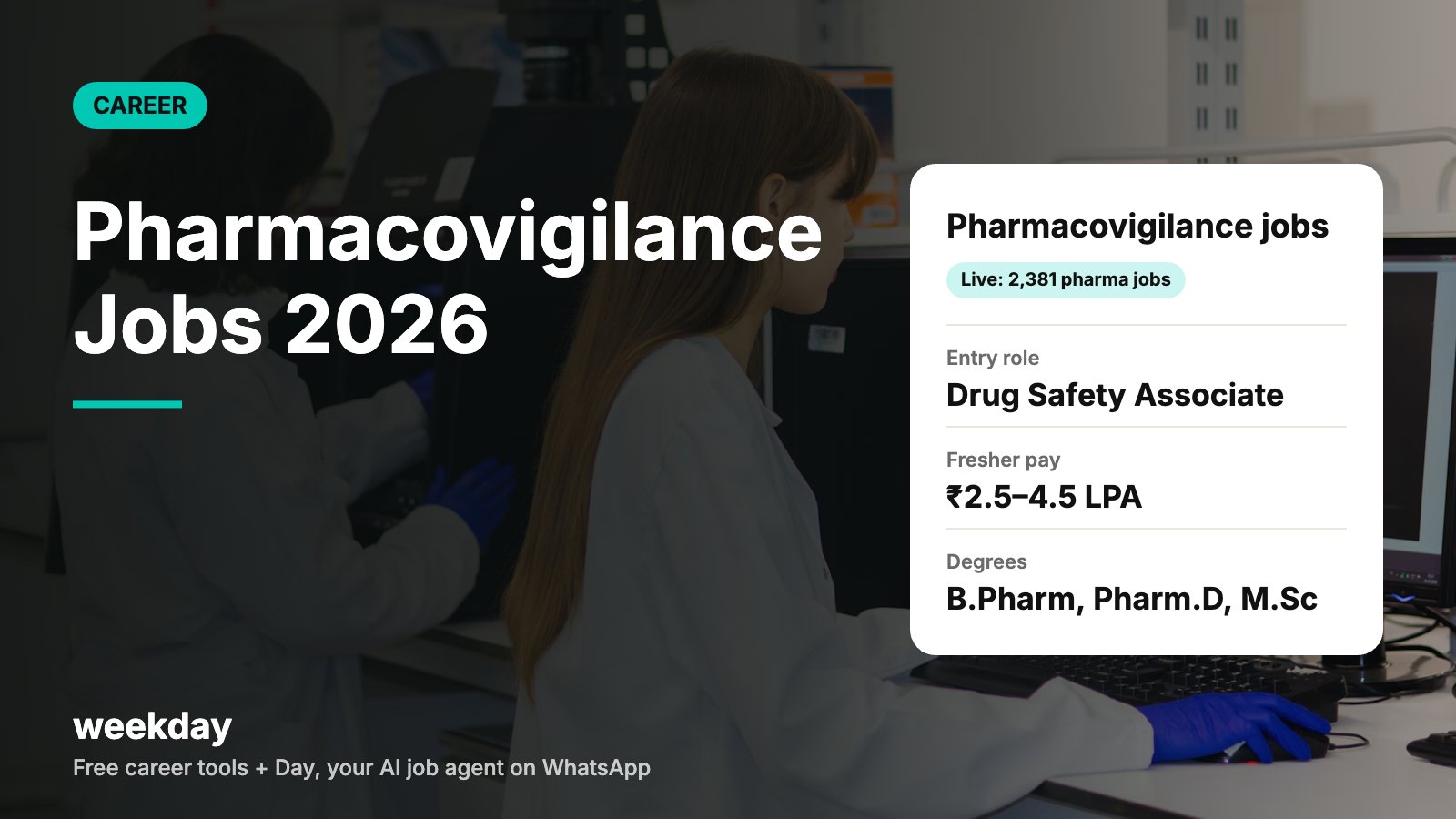
- Pharma jobs (all pharma roles, including PV, regulatory, QA and sales): 2,381 open, 639 new this week
- Medical coding jobs (a close cousin of PV case work): 843 open, 215 new this week
- Fresher jobs across all fields: 8,637 open, 2,350 new this week
- Internships: 4,188 open, 931 new this week
Sources: Weekday job listings (jobs posted in the last 30 days), counted on 16 November 2026. Pay ranges are indicative, based on typical Indian listings.
- Open ChatGPT and go to Plugins.
- Search Weekday Jobs and tap Try in chat (or open Weekday Jobs in ChatGPT).
- Ask in plain words, for example:
- “Find drug safety associate or pharmacovigilance jobs for freshers posted this week”
- “Show pharma jobs in Bengaluru, Mumbai or Hyderabad for B.Pharm graduates with 0–1 years experience”
- “List remote or hybrid pharmacovigilance and medical writing jobs, sorted by pay”
Day, Weekday's free AI job agent, finds jobs that match your skills and pay, and applies when you say yes. On WhatsApp.
Say hi to Day on WhatsAppHow Day works →What is pharmacovigilance?
Every medicine has side effects. Some are known before launch; many are found only after thousands of patients use it. Pharmacovigilance is the system that catches these reports, checks them, codes them in a standard way and sends them to regulators on time. The goal is simple: spot safety problems early and protect patients.
India has a large PV workforce because many global drug companies and service providers run their safety operations from Bengaluru, Mumbai, Hyderabad, Pune, Chennai, Noida and Gurugram. India also runs its own national programme, the Pharmacovigilance Programme of India (PvPI), coordinated by the Indian Pharmacopoeia Commission.
The four core activities
| Activity | What it means in plain words | Who usually does it |
|---|---|---|
| ICSR case processing | An Individual Case Safety Report is one report of a suspected side effect. You check it is valid, enter it in a safety database, code it and write a short narrative. | Drug Safety Associate (entry level) |
| MedDRA coding | Converting the reporter's words (“felt dizzy and threw up”) into standard medical terms from the MedDRA dictionary so cases can be searched and counted. | DSA, quality reviewer |
| Signal detection | Looking across many cases to see if a drug and an event show up together more often than expected, then deciding whether it needs action. | Safety scientist, signal analyst |
| Aggregate reports | Periodic summaries of all safety data for a product, such as PSUR/PBRER or DSUR, sent to regulators on a fixed schedule. | Aggregate report writer, medical writer |
Most fresher jobs are in case processing. You handle reports from patients, doctors, literature articles, clinical trials and call centres. A case is usually valid when it has four minimum elements: an identifiable patient, an identifiable reporter, a suspect drug and an adverse event. Then you judge seriousness (death, life-threatening, hospitalisation, disability, birth defect or other medically important event), code the terms, and write a narrative that a medical reviewer can sign off.
Worked example: one ICSR from start to finish
Source email from a pharmacist: “A 58-year-old woman started Drug X 10 mg on 2 Nov. On 5 Nov she had a rash on both arms and was admitted overnight. Drug stopped; rash settled by 8 Nov.”

Validity: patient (58F) ✔ reporter (pharmacist) ✔ suspect drug (Drug X) ✔ event (rash) ✔ → valid case
Seriousness: hospitalisation → serious
MedDRA coding: reported term “rash on both arms” → coded to the closest Lowest Level Term, which rolls up to the Preferred Term “Rash”
Dechallenge: positive (event resolved after the drug was stopped)
Narrative opening: “This spontaneous case was received from a pharmacist and concerns a 58-year-old female patient who experienced rash (serious, hospitalisation) after starting Drug X…”
PV career ladder and typical pay
PV has a clear ladder. People who learn case processing well usually move to quality review, then to either aggregate reports, signal management or team leadership. Pay below is indicative for India in 2026; large multinationals and specialised roles usually pay more, and smaller service providers less.
| Role | Typical experience | Main work | Typical pay (India) |
|---|---|---|---|
| Drug Safety Associate / PV Associate | 0–2 years | Case intake, data entry, coding, narratives | ₹2.5–4.5 LPA |
| Senior DSA / Case Quality Reviewer | 2–4 years | Review others' cases, handle complex and trial cases | ₹4.5–7 LPA |
| Safety Scientist / Aggregate Report Writer | 4–7 years | PSUR/PBRER, DSUR, risk management plan sections | ₹7–12 LPA |
| Signal Detection Analyst / Signal Manager | 4–8 years | Run and assess signals, write signal reports | ₹8–15 LPA |
| Medical Reviewer (MBBS/BDS/MD) | 0–5 years after degree | Medical assessment of causality and seriousness | ₹6–15 LPA |
| PV Team Lead / Manager | 8+ years | Team, timelines, audits, client calls | ₹15–30 LPA |
Pay ranges are indicative, based on typical Indian listings and offers. Check each role's listed pay before you apply.
Worked example: what ₹3.6 LPA means in hand
Fresher offer: ₹3.6 LPA CTC
Monthly gross ≈ ₹30,000
Less employee PF (12% of a ₹15,000 basic = ₹1,800) and professional tax (about ₹200)
In-hand ≈ ₹28,000 a month before income tax (usually nil at this level under the new regime)

After 2 years as a quality reviewer at ₹5.5 LPA, in-hand rises to roughly ₹42,000–₹44,000 a month, depending on salary structure.
Run your own numbers in the in-hand salary calculator, since basic pay and PF rules change the result.
Eligibility: which degrees get hired
| Degree | Fit for PV | Usual entry role |
|---|---|---|
| B.Pharm | Strong. The most common entry profile. | Drug Safety Associate |
| M.Pharm (Pharmacology, Pharmacy Practice) | Strong. Helps for scientific roles later. | DSA, sometimes literature or aggregate support |
| Pharm.D | Very strong. Clinical training helps with narratives and causality. | DSA, clinical trial safety |
| B.Sc / M.Sc Life Sciences, Biotech, Microbiology, Nursing | Good, especially with strong English and medical terminology | DSA, case intake |
| BDS / MBBS / BAMS / BHMS | MBBS and BDS are hired for medical review; AYUSH degrees are accepted by some employers for case processing | Medical reviewer, DSA |
| Non-science graduates | Rarely hired directly | Consider call centre intake or medical coding first |
Beyond the degree, employers test three things: medical English (can you read a discharge summary?), attention to detail (can you spot that the dose and date don't match?) and typing comfort.
Certifications and courses: be careful
No single certificate is mandatory for a PV job in India. Recruiters mainly look at your degree, your understanding of ICSRs, MedDRA, seriousness criteria and regulatory timelines, and your communication. Short courses can help you learn the vocabulary, and some employers do value a recognised clinical research or PV course, but treat any course as optional.
| Option | Useful for | Watch out for |
|---|---|---|
| Free reading: ICH E2A, E2B, E2C(R2), E2D, E2E guidelines; PvPI material | Understanding definitions and reporting rules | Dense language; read summaries first |
| Short online PV or clinical research course | Structure and vocabulary for interviews | Check the syllabus, trainers' real experience and refund policy |
| University PG diploma in clinical research or PV | Formal credential, campus links | Cost and time; not a guarantee of a job |
| Safety database training (for example Argus or ArisG) | Familiarity with screens | Employers usually train you on their own system after joining |
| MedDRA | Coding skill | The dictionary itself is licensed to organisations; you learn it properly on the job |
Red flag: “100% guaranteed placement” PV courses. Some institutes charge ₹30,000 to ₹1,00,000 or more and promise a job at the end. Often the “placement” is a list of walk-in drives you could have found yourself, or an unpaid internship. Before paying, ask for the names of last batch's employers and verify with two or three past students on LinkedIn. Never pay a recruiter or a company to get a job.
10 pharmacovigilance interview questions, with answers
Answers 1–5
1) What is pharmacovigilance?
The science and activities of detecting, assessing, understanding and preventing adverse effects or any other medicine-related problem. In simple words: making sure medicines stay safe after they reach patients.

2) What are the minimum criteria for a valid ICSR?
An identifiable patient, an identifiable reporter, a suspect drug and an adverse event. If any one is missing, the case is not yet valid and we follow up.

3) What makes an adverse event serious?
It results in death, is life-threatening, needs hospitalisation or prolongs it, causes persistent disability or incapacity, causes a congenital anomaly, or is another medically important event.

4) Serious vs severe: what is the difference?
Severe describes intensity (a severe headache). Serious is a regulatory category based on outcome. A severe headache can be non-serious; a mild event that leads to admission is serious.

5) What is MedDRA and what is its hierarchy?
The Medical Dictionary for Regulatory Activities. It has five levels: System Organ Class, High Level Group Term, High Level Term, Preferred Term and Lowest Level Term. We code to the LLT that best matches the reporter's words.
Answers 6–10
6) What is an expected vs unexpected event?
An event is expected if it is listed in the reference safety information, such as the label or investigator's brochure, in nature and severity. If it is not listed, or is more severe than listed, it is unexpected.

7) What is a SUSAR?
A Suspected Unexpected Serious Adverse Reaction in a clinical trial. These are reported to regulators on an expedited basis, commonly within 7 days for fatal or life-threatening cases and 15 days for others. Exact rules depend on the country.

8) What is day zero?
The date any person in the company or its partner first receives the minimum information for a valid case. Reporting timelines are counted from day zero.

9) What is a signal?
Information suggesting a new possible link between a drug and an event, or a new aspect of a known link, that needs further checking. Signals often come from disproportionality analysis or from clusters of cases.

10) How do you assess causality?
We look at time to onset, dechallenge and rechallenge, other possible causes such as other drugs or illness, and known pharmacology. Common methods are the WHO-UMC system and the Naranjo scale.
Mistakes candidates make, and the fix
| Mistake | Fix |
|---|---|
| Mixing up serious and severe | Learn the six seriousness criteria by heart |
| Reciting textbook definitions with no example | Add one short case example to each answer |
| Claiming “Argus expert” after a 2-day demo | Say “familiar with the screens from training” instead |
| Weak English in the written test | Practise writing three narratives a week from sample reports |
| Ignoring night or weekend shifts in the offer | Ask about shift timing and transport before you accept |
A 90-day fresher route
| Weeks | Focus | Output |
|---|---|---|
| 1–2 | Read ICH E2A and E2D summaries; learn seriousness, validity, expectedness | One-page notes you can revise before interviews |
| 3–4 | Practise MedDRA-style coding with free terminology lists; write narratives from public case reports | 5 practice narratives |
| 5–6 | Fix your resume: degree, projects, internship, any hospital or pharmacy exposure | One-page resume with a PV summary line |
| 7–12 | Apply to 10–15 DSA, PV associate, medical coding and clinical data roles a week; attend walk-ins | 4–8 interviews, first offer |
Copy-ready resume summary for a PV fresher
Pharmacy graduate (B.Pharm, 2026) seeking a Drug Safety Associate role. Trained in ICSR processing, seriousness and causality assessment, and MedDRA hierarchy. Wrote 20 practice narratives from published case reports. Comfortable with medical English, Excel and 40+ WPM typing. Open to rotational shifts.
If PV openings are slow in your city, apply in parallel to medical coding jobs and clinical data roles; they build the same medical vocabulary and many people move across later. Keep your answers to common HR rounds ready too; our HR interview questions guide covers them. And if you want openings sent to you, Day, Weekday’s AI job agent can match you to roles and apply when you say yes.
Skills to list on a PV resume
- Domain: ICSR processing, seriousness and expectedness assessment, causality, MedDRA coding, narrative writing, E2B, literature screening.
- Tools: safety database exposure (only if real), MS Excel, MS Word, Outlook.
- Soft skills: attention to detail, written English, meeting deadlines, following SOPs.
- Use exact words from the job post. Our list of skills for your resume shows how to phrase them.
FAQs
What is the salary of a pharmacovigilance fresher in India?
A Drug Safety Associate fresher usually earns around ₹2.5–4.5 LPA. Pay depends on the company, city and your degree; Pharm.D and M.Pharm graduates sometimes start a little higher.
Can a B.Sc graduate get a pharmacovigilance job?
Yes. Life sciences, biotech, microbiology and nursing graduates are hired as drug safety associates, especially with good medical English and a basic understanding of ICSRs and MedDRA.
Is a pharmacovigilance course mandatory?
No. Most employers hire on your degree and interview performance, then train you on their safety database. A course can help you learn the vocabulary, but it is optional.
Are pharmacovigilance jobs work from home?
Some PV roles are hybrid or remote, especially after you have experience. Most fresher roles start in office or hybrid, because training and data security rules are strict.
Do pharmacovigilance jobs have night shifts?
Some do. Teams that support US or European clients may work rotational or late shifts. Ask about shift timings before accepting an offer.
What is the difference between pharmacovigilance and clinical research?
Clinical research runs trials before and around approval. Pharmacovigilance monitors safety, both in trials and after a medicine is on the market. The two overlap in clinical trial safety.
How do I spot a fake PV placement course?
Be careful if it promises a guaranteed job, asks for a large fee upfront, won't name past employers, or pushes you to pay quickly. Verify with past students on LinkedIn.
Can MBBS or BDS graduates work in pharmacovigilance?
Yes. They are often hired as medical reviewers who assess seriousness and causality and sign off cases, and can move into safety physician or signal roles.
How many pharma jobs are live on Weekday?
On 16 November 2026, 2,381 pharma jobs were live on Weekday, with 639 new that week. This covers all pharma roles, of which PV is one part.





