
Last updated: 23 November 2026
Quick answer: A recruitment budget is the money you plan to spend to fill roles, not the salaries themselves. It covers job ads, sourcing tools, agency fees, referral bonuses, interviewer time and joining costs. Agency fees are usually the biggest line: Weekday's Contingency service charges 15% of annual salary, and most US agency recruiters in r/recruiting threads call 20% to 25% standard. Build the budget role by role, pick a channel for each role, then add a buffer for backfills.
Most founders know their salary budget to the rupee. Very few know what it costs to get those people in the door. That gap is where hiring plans break: a role sits open because nobody approved the agency fee, or the fee shows up as a surprise after the offer. This guide gives you the cost lines, real benchmarks for India and the US, and a sample template you can copy.
What a recruitment budget includes
| Cost line | India benchmark | US benchmark |
|---|---|---|
| Job posts | Naukri: free post for 7 days, single posts from ₹400 to ₹1,650, SMB plans from ₹3,500, plus GST | LinkedIn: one free job at a time, promoted jobs on a daily budget. Indeed: up to 3 free jobs a month |
| Recruiter seats and tools | Varies by plan | One commenter on Reddit put LinkedIn at about $12K per recruiter seat and $2.5K per job slot. Another paid about $25K a year for one seat, 3 job slots and one Lite seat |
| Agency fees | Charged on annual CTC. At ₹30 lakh, 10% is ₹3 lakh and 15% is ₹4.5 lakh | Most agency recruiters in r/recruiting threads call 20% to 25% of base standard. Some say they drop to 15% to stay competitive |
| Referral bonuses | Your call. Set one amount per level so it stays fair | |
| Interviewer time | Hours per hire × hourly cost of the people interviewing | |
| Joining costs | Joining bonus, notice buyout, relocation | Sign-on bonus, relocation |
The job post figures come from Weekday's job posting cost guide, and the India agency math from our guide to how much recruitment agencies charge. The LinkedIn seat numbers are what people in a r/humanresources thread said they paid, and the agency fee views come from a r/recruiting thread on fees. Treat them as ballparks, not quotes.
Step 1: Start from the hiring plan, not last year's spend
List every role you'll hire in the next two quarters. For each one, write the level, the pay band and the target start date. If you don't have a plan yet, our hiring plan guide walks through it.
Then add backfills. Aon's India survey found attrition at 18% in 2026, up from 16.2% in 2025 (People Matters, reporting Aon). For a 20-person team, 18% attrition means about 3 to 4 people leaving in a year. Those are hires too, and they usually come with no warning.
Step 2: Fix the pay band before you pick a channel
Every big cost line is tied to salary. Agency fees are a percentage of it. Joining bonuses are sized off it. So the band is the input to the whole budget.
Most companies skip this step in public. In a Weekday analysis of 148 LinkedIn hiring posts (14 to 23 November 2026), only 23 posts gave a pay figure. We counted any post that listed a rupee, dollar, pound or rupiah amount for salary, stipend or trial pay. The other 125 left candidates guessing, which means more interviews with people your budget can't close.
For India benchmarks by role and city, use Weekday's free cost to hire by role pages.
Step 3: Pick a channel for each role
Not every role deserves an agency fee. A simple split:
- Free channels first for roles with lots of applicants: free job posts, referrals, your own network.
- Paid sourcing for roles where you need passive candidates: AI sourcing tools, recruiter seats.
- Agencies for the one or two roles that block the business if they stay open.
Get fees agreed before any work starts. In one r/recruiting thread, a company head loved an agency candidate and then balked at the $80K fee (25%). In another, a small agency asked for 20% after the placement, and the client pushed for 8% to 10%. Both fights could have been avoided with signed terms on day one.
Step 4: Add internal time
This is the line most budgets miss. If five people each spend two to three hours on one hire, that's a working day or more of senior time. Weekday's cost per hire guide shows how to put a number on it. It also cites SHRM's 2025 data: a median cost per hire of $1,200 for non-executive roles and $10,625 for executive roles in the US.
Sample recruitment budget template (India, 5 hires)
Here's a sample plan for a startup hiring five people with 2 to 3 years of experience. Salaries are India medians from Weekday's cost to hire by role data. Channel choices, the referral bonus, interview hours and hourly cost are sample numbers. Swap in your own.
| Role | Median CTC (2 to 3 yrs) | Channel | Recruiting cost |
|---|---|---|---|
| AI engineer | ₹7 LPA | Agency at 15% | ₹1,05,000 |
| DevOps engineer | ₹6 LPA | Agency at 15% | ₹90,000 |
| Java developer | ₹5.5 LPA | Referral (sample bonus) | ₹25,000 |
| Python developer | ₹5.6 LPA | Free job post with AI sourcing | ₹0 |
| UI/UX designer | ₹5 LPA | Paid Naukri post (top of the single-post range) | ₹1,650 + GST |
| External costs | ₹2,21,650 | ||
| Interviewer time (sample: 12 hours per hire × ₹1,500 an hour × 5 hires) | ₹90,000 | ||
| Buffer for a backfill or a failed search (sample: 15%) | ₹46,748 | ||
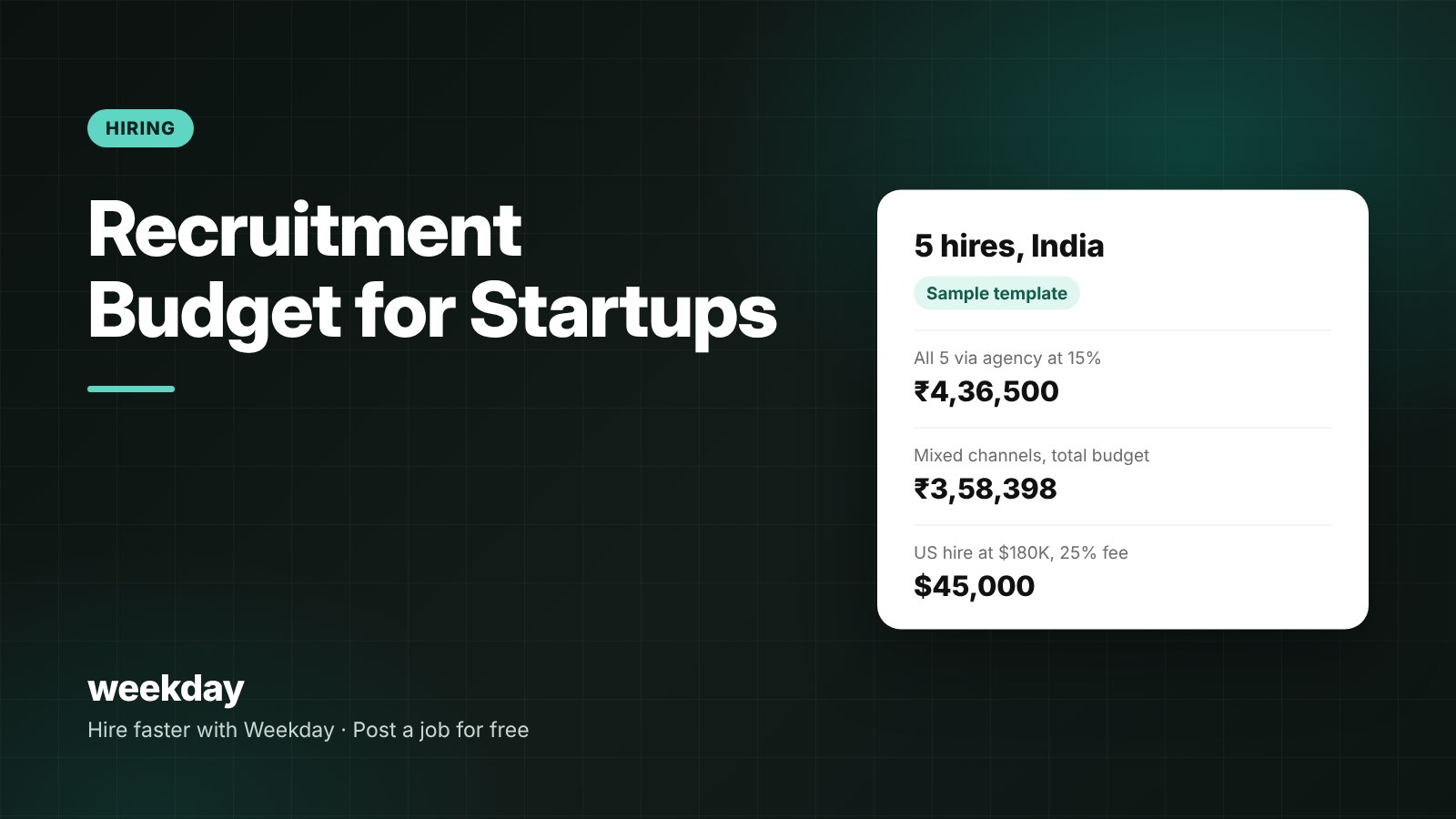
| Total recruitment budget | ₹3,58,398 | ||
For comparison, sending all five roles to an agency at 15% would cost ₹4,36,500 in fees alone (15% of ₹29.1 lakh in total CTC), before interviewer time. Picking a channel per role saves about ₹2 lakh on this plan.
A quick US version
US numbers are bigger, but the shape is the same. Carta's H1 2026 data shows median engineering salaries for new hires at startups now topping $180,000 (Carta). On a $180,000 hire:
- An agency at 25% costs $45,000.
- An agency at 20% costs $36,000.
- Weekday's Contingency at 15% costs $27,000, and nothing if you don't hire through it.
Add recruiter seats, job slots and interviewer time, and two senior engineering hires can easily take a five-figure recruiting budget. That's why US startups lean on referrals and outbound sourcing for early roles.
How to bring cost per hire down
- Post the pay range. Fewer wasted interviews with people you can't afford.
- Use free posts and referrals first. Save agency fees for the roles that block revenue or product.
- Run structured interviews. Fewer rounds, clearer scorecards, fewer hours per hire.
- Keep a warm pipeline. Your second-choice candidate for one role is often your first choice for the next.
- Track time to fill. SHRM's latest benchmarking puts the median time to fill at 39 calendar days for non-executive roles (SHRM). If yours is far above that, the budget is leaking through lost weeks, not just fees.
Founders without a recruiter feel this most. In a r/startups thread, a founder growing faster than planned asked how to hire for several roles without a full-time recruiter. The replies pointed to freelance and fractional recruiters who are paid per hire, and to founders owning the hiring themselves.
Make your first hire of the plan free
Paste your job description and Weekday's AI sourcing agent searches 400M+ profiles, checks salary expectations against your budget, and reaches out on email and WhatsApp. Your first role is free, with 200 reach-outs and no credit card.
Post a free jobFrequently asked questions
What is a recruitment budget?
It's the money you plan to spend to fill open roles: job posts, tools, agency fees, referral bonuses, interviewer time and joining costs. Salaries sit in a separate payroll budget.
How much should a startup budget for recruitment?
Build it bottom-up, role by role. The biggest swing is the channel: an agency at 15% to 25% of salary versus free posts and referrals that cost very little.
What should a recruitment budget template include?
Role, level, pay band, channel, external cost, interviewer time and a buffer for backfills. The sample table above has all of them.
How do I calculate cost per hire?
Add external and internal hiring costs for a period and divide by the number of hires in that period.
Is a recruitment budget the same as a hiring budget?
People use the terms loosely. In most companies, the hiring budget means approved headcount and salaries, and the recruitment budget means the cost to fill those seats.
Sources
- Weekday analysis of 148 LinkedIn hiring posts, Nov 2026 (posts dated 14 to 23 November 2026; counted posts listing a pay figure)
- Weekday: cost to hire by role, job posting cost guide, recruitment agency fees, cost per hire guide
- People Matters on Aon's Salary Increase and Turnover Survey 2026-27
- Carta: State of Startup Compensation, H1 2026
- SHRM recruiting benchmarking
- Reddit threads in r/recruiting, r/humanresources and r/startups linked above (paraphrased, users not named)





