
Last updated: 16 November 2026
- What L1, L2 and L3 analysts do
- Tools: SIEM, EDR, ticketing
- Shifts, salary and certifications
- Home lab projects that impress
- 10 SOC interview questions with answers
- A 90-day fresher route
- Cyber security jobs: 1,270 open, 338 new this week
- Remote cyber security jobs: 402 open, 107 new this week
- IT fresher jobs: 602 open, 138 new this week
- Internships: 4,188 open, 931 new this week
Sources: Weekday job listings (jobs posted in the last 30 days), counted on 16 November 2026. Pay ranges are indicative, based on typical Indian listings.
- Open ChatGPT and go to Plugins.
- Search Weekday Jobs and tap Try in chat (or open Weekday Jobs in ChatGPT).
- Ask in plain words, for example:
- “Find SOC analyst L1 jobs for freshers posted this week in Bengaluru, Pune or Hyderabad”
- “Show remote cyber security jobs that need Splunk or Microsoft Sentinel, 1–3 years experience”
- “List SOC analyst jobs with pay above ₹6 LPA, sorted by newest”
Day, Weekday's free AI job agent, finds jobs that match your skills and pay, and applies when you say yes. On WhatsApp.
Say hi to Day on WhatsAppHow Day works →What does a SOC analyst do?
A Security Operations Centre is a team that monitors an organisation's systems around the clock. Logs from firewalls, servers, laptops, email gateways and cloud accounts flow into a central tool. That tool raises alerts: a strange login, a known malware file, data leaving at 3 a.m. The SOC analyst's job is to look at each alert, decide whether it is real, and act.
Most SOCs in India are either inside large companies and banks, or run by managed security service providers (MSSPs) that monitor many clients. MSSPs hire the most freshers.
| Level | Main work | Typical experience | Typical pay (India) |
|---|---|---|---|
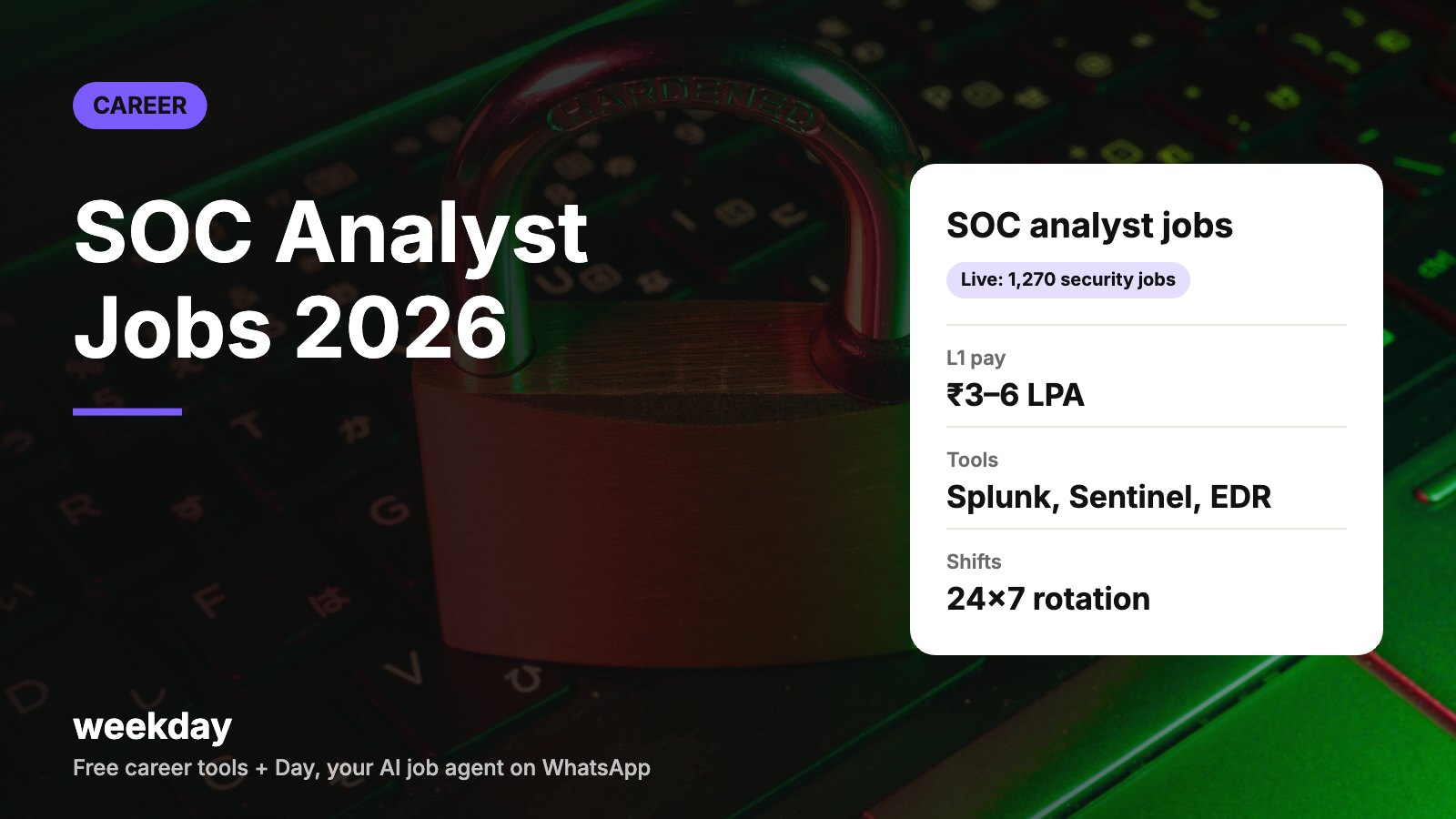
| L1 – Triage analyst | Watch the alert queue, check basic facts, close false positives, escalate real incidents with notes | 0–2 years | ₹3–6 LPA |
| L2 – Incident responder | Deep investigation, scope the incident, contain (isolate hosts, block IPs, disable accounts), tune rules | 2–5 years | ₹6–12 LPA |
| L3 – Threat hunter / senior responder | Proactive hunting, malware analysis, detection engineering, lead major incidents | 5+ years | ₹12–25 LPA |
| SOC lead / manager | Shift planning, metrics, client reporting, process | 8+ years | ₹20–40 LPA |
Pay ranges are indicative for India in 2026, based on typical listings. Product companies and banks often pay above MSSPs. For a wider view, see our cyber security salary in India 2026 guide.
Tools you will use
| Category | What it does | Common names |
|---|---|---|
| SIEM | Collects logs, correlates events, raises alerts, lets you search | Splunk, Microsoft Sentinel, IBM QRadar, Elastic Security |
| EDR / XDR | Watches processes on laptops and servers; can isolate a machine | Microsoft Defender for Endpoint, CrowdStrike Falcon, SentinelOne |
| SOAR | Automates repeat steps such as enrichment and blocking | Built into many SIEMs; standalone tools too |
| Ticketing / case management | Tracks every alert and incident with notes and SLAs | ServiceNow, Jira, built-in SIEM case tools |
| Threat intelligence | Checks if an IP, domain or file hash is known bad | VirusTotal, AbuseIPDB, vendor feeds |
| Frameworks | Common language for attacker behaviour and response steps | MITRE ATT&CK, the NIST incident response cycle |
You do not need to know all of these. Learn one SIEM's search language well (Splunk SPL or Sentinel's KQL), understand what an EDR shows, and know how to write a clear ticket.
Worked example: triaging one alert as L1
Alert: “Multiple failed logins followed by success” for user priya.k at 02:14

1) Check the facts: 37 failed logons (Windows Event ID 4625) from IP 185.x.x.x in 6 minutes, then one success (4624).
2) Enrich: IP reputation → listed for brute-force activity. Geo → not a country the user works from.
3) Context: user is in Pune, normally logs in 9:30–19:00 IST. No VPN record.
4) Decision: likely true positive (password guessing succeeded).
5) Action as L1: raise priority, escalate to L2 with a summary, suggest disabling the account and forcing a password reset, per the playbook.
6) Ticket note: what, when, evidence, actions taken, next step.
Shifts: what 24x7 really means
Attacks don't keep office hours, so SOCs run in shifts. The most common pattern is three 8–9 hour shifts (morning, afternoon, night) or 12-hour shifts on a rotation, with weekends covered by roster. Freshers should expect night shifts for at least part of the first year.
| Pattern | How it works | Ask before joining |
|---|---|---|
| 3-shift rotation | Morning, general and night shifts, rotating weekly or monthly | How often nights come round; night allowance |
| 12-hour shifts | 4 days on, 3–4 days off, or similar | Overtime rules; handover time |
| Fixed night shift | Often for US/UK client coverage | Transport, shift allowance, health checks |
| Hybrid or remote SOC | Some teams allow remote shifts after training | Laptop, VPN and home-network rules |
Skills employers test
- Networking: OSI and TCP/IP models, common ports (22, 25, 53, 80, 443, 3389), DNS, DHCP, how a firewall and proxy work.
- Operating systems: Windows event logs, Active Directory basics, Linux commands and auth logs.
- Attacks: phishing, brute force, malware, ransomware, privilege escalation, lateral movement, data exfiltration.
- Log analysis: read a log line, filter, count, spot the odd one out.
- Writing: short, clear ticket notes and escalation emails.
- Calm under pressure: following a playbook at 3 a.m.
Certifications commonly asked for
Certificates are not strictly required for every L1 role, but many job posts list one or more, and they help when you have no experience. Choose based on cost and what local job posts mention most; prices change, so check the official site before paying.
| Certification | Level | Why people take it |
|---|---|---|
| CompTIA Security+ | Entry | Broad security basics; widely recognised |
| CompTIA CySA+ | Entry to mid | Focused on analyst work and log analysis |
| Microsoft SC-200 (Security Operations Analyst) | Entry to mid | Sentinel and Defender skills |
| Splunk Core Certified User / Power User | Entry | SIEM search skills on the most-listed tool |
| EC-Council CEH | Entry to mid | Often named in Indian job posts, though more offensive in focus |
| Blue Team Level 1 (BTL1) or similar practical labs | Entry | Hands-on defensive skills |
A free alternative to start: vendor learning paths (Splunk, Microsoft Learn) and free blue-team lab platforms. A good home lab plus one recognised certificate is usually stronger than three certificates and no hands-on work.
Home lab projects that impress interviewers
| Project | What you build | What it proves |
|---|---|---|
| Mini SIEM | A Windows VM with Sysmon sending logs to a free SIEM (Wazuh, Elastic or a Splunk free/trial licence) | You can collect and search logs |
| Brute-force detection | Simulate failed logins, write a rule that alerts on 10 failures then a success | Detection logic and tuning |
| Phishing analysis | Analyse 5 sample phishing emails: headers, links, attachments, verdict | Email triage, a daily L1 task |
| Attack simulation | Run safe test techniques (for example Atomic Red Team) and map alerts to MITRE ATT&CK | Framework knowledge |
| Incident report | Write a 1-page report for one simulated incident | Communication |
Put the lab on GitHub with screenshots and a short README. In interviews, walking through one project for five minutes often beats a long list of certificates.
10 SOC analyst interview questions, with answers
Answers 1–5
1) What is a SIEM?
A Security Information and Event Management tool. It collects logs from many sources, correlates them, raises alerts and lets analysts search. Examples: Splunk, Microsoft Sentinel, QRadar.

2) False positive vs false negative?
A false positive is an alert for something harmless. A false negative is a real attack that raised no alert. False negatives are more dangerous; too many false positives cause alert fatigue.

3) Which Windows Event IDs do you check most?
4624 successful logon, 4625 failed logon, 4688 process creation, 4720 user account created, 4732 user added to a security-enabled local group.

4) How would you investigate a phishing email?
Check sender and reply-to, the email headers (SPF, DKIM, DMARC results), links (without clicking, using a sandbox or reputation check), attachments by hash, and how many users got it. Then block indicators and ask affected users to reset passwords if they clicked.

5) What is the CIA triad?
Confidentiality, Integrity, Availability: the three goals of security.
Answers 6–10
6) TCP vs UDP?
TCP is connection-based with a three-way handshake (SYN, SYN-ACK, ACK) and guaranteed delivery. UDP is connectionless and faster, used for DNS queries, streaming and VoIP.

7) What is MITRE ATT&CK?
A public knowledge base of attacker tactics and techniques. SOCs use it to map alerts and find gaps in detection.

8) What are the incident response steps?
Preparation, detection and analysis, containment, eradication, recovery, and lessons learned.

9) An EDR flags PowerShell with an encoded command on a finance laptop. What do you do?
Decode the command, check the parent process, user and network connections, search the SIEM for the same activity on other hosts, and escalate. If it looks malicious, isolate the host per the playbook.

10) Why do you want to work in a SOC?
Give an honest, specific answer: “I enjoy investigation. In my home lab I built a Wazuh setup and wrote a brute-force rule; I want to do this work on real alerts and grow into incident response.”
Mistakes to avoid in SOC interviews
| Mistake | Fix |
|---|---|
| Listing tools you have only watched videos of | Say exactly what you did in your lab |
| Jumping to “it's a hacker” on every scenario | Show a step-by-step triage: facts, enrich, context, decide |
| Refusing night shifts | Ask about rotation and allowance instead |
| No questions at the end | Ask how alerts are tuned and how L1s grow to L2 |
A 90-day fresher route
| Weeks | Focus | Output |
|---|---|---|
| 1–3 | Networking and Windows/Linux basics; ports, DNS, AD, event logs | Notes + 50 practice questions |
| 4–6 | Build the mini SIEM lab; learn basic SPL or KQL searches | GitHub repo with screenshots |
| 7–8 | Phishing analysis and 2 detection rules; one entry certificate if affordable | Two write-ups |
| 9–12 | Apply to 10–15 L1 SOC, NOC and IT support roles a week | Interviews and a first offer |
Copy-ready resume summary for a SOC fresher
Entry-level SOC analyst with hands-on home-lab experience: built a Wazuh SIEM with Sysmon logs from two Windows VMs, wrote detection rules for brute-force and suspicious PowerShell, and analysed 10 phishing emails. Strong on TCP/IP, Windows Event IDs and MITRE ATT&CK. Comfortable with 24x7 rotational shifts.
If L1 SOC roles are slow to reply, IT helpdesk and NOC roles are a common bridge; many analysts move across within a year. Browse IT fresher jobs alongside security roles, prepare for HR rounds with our HR interview questions guide, and let Day, Weekday’s AI job agent send you matching openings.
FAQs
What is the salary of a SOC analyst fresher in India?
An L1 SOC analyst fresher usually earns around ₹3–6 LPA. Pay is higher at banks and product companies and with a certification or strong home lab.
What does SOC stand for?
Security Operations Centre: a team that monitors and responds to security threats 24x7.
Can a fresher become a SOC analyst?
Yes. Many MSSPs hire freshers for L1 roles. A home lab, networking basics and one entry certificate improve your chances a lot.
Which certification is best for a SOC analyst?
There is no single best one. CompTIA Security+, CySA+, Microsoft SC-200 and Splunk certifications are commonly listed. Check local job posts and pick what they mention most.
Do SOC analysts work night shifts?
Usually yes. SOCs run 24x7, so most L1 analysts work rotational shifts including nights, especially in the first year.
Is SOC analyst a remote job?
Some are. On 16 November 2026, 402 remote cyber security jobs were live on Weekday. Freshers more often start in office for training.
What is the difference between L1 and L2 SOC analysts?
L1 triages alerts and escalates. L2 investigates deeply, contains incidents and tunes detection rules.
Do I need coding for a SOC analyst job?
Not for L1. Basic scripting (Python or PowerShell) and a SIEM query language help you grow into L2 and detection engineering.
Is Splunk or Microsoft Sentinel better to learn?
Both are widely used. Splunk appears in many job posts; Sentinel is common where companies use Microsoft 365 and Azure. Learn one well; the concepts carry over.





