Last updated: 18 November 2026
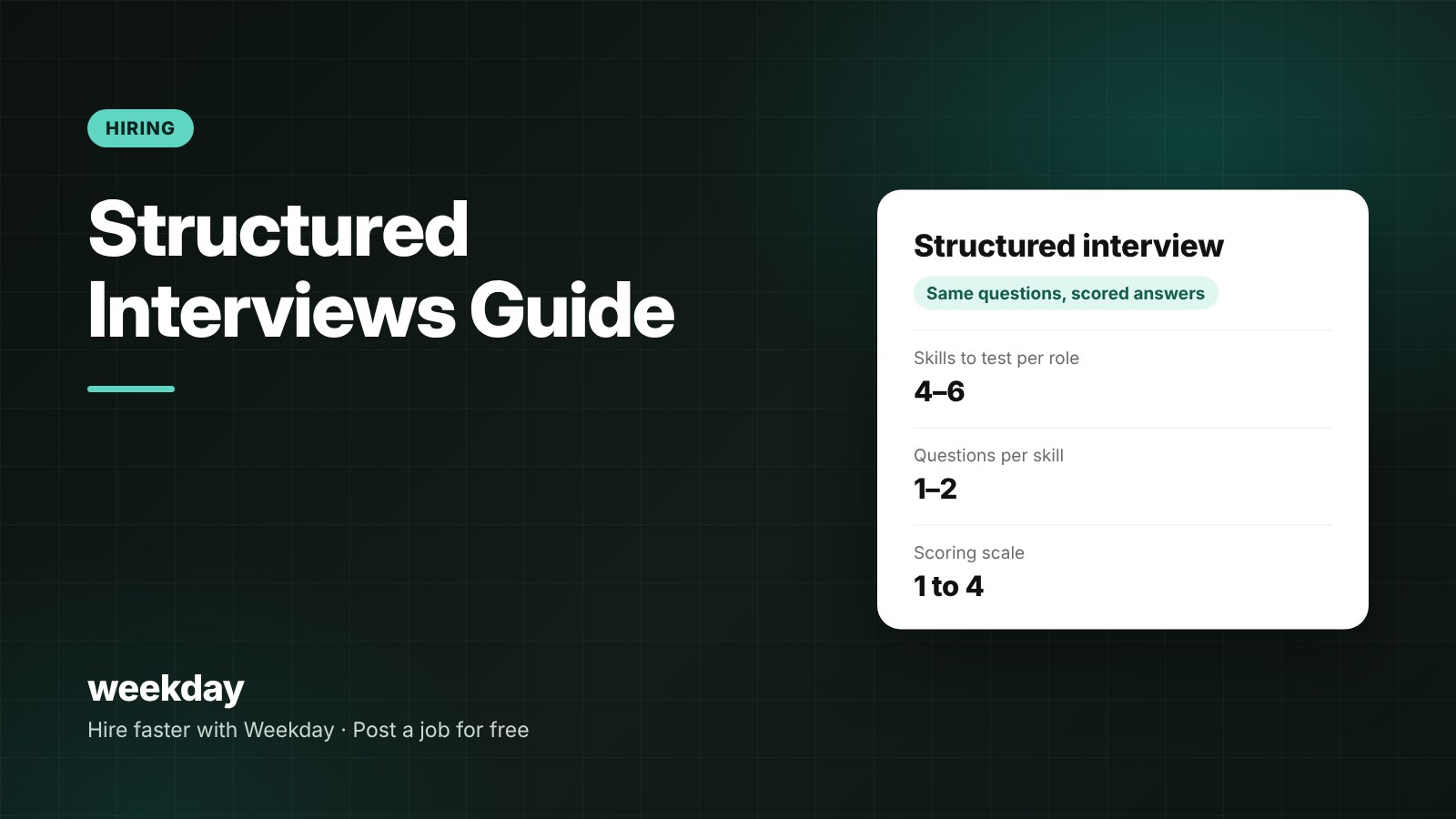
Quick answer: A structured interview asks every candidate for a role the same questions, in the same order, and scores each answer against a written rating guide. To run one: pick 4–6 skills that matter for the job, write 1–2 questions per skill, define what a weak, good and great answer looks like, score each answer on its own, and only then discuss. Research summarised by SIOP suggests structured interviews may be the strongest single predictor of job performance.
Here is how a typical unstructured process goes. One interviewer asks about system design, another chats about cricket, and a third goes with a gut feeling. Then the debrief turns into a debate about who "seemed sharp". Structured interviews fix this with a simple idea: same questions, same scoring, for everyone.
Why structured interviews work
For years, cognitive ability tests were seen as the best single predictor of job performance. A 2022 re-analysis by Sackett and colleagues changed that view. As SIOP summarises it, the work "revealed that structured interviews may in fact be the strongest predictor of job performance—not cognitive ability" (SIOP).
The practical reasons are easy to see:
- Fairer comparisons. When everyone answers the same questions, you compare answers, not conversations.
- Less bias. A written rating guide makes it harder to reward people who are simply similar to the interviewer.
- Faster decisions. Scores collected before the debrief cut long arguments short.
- Easier to train. New interviewers can run a good interview on day one if the questions and guide are written down.
Structured vs unstructured interviews
| Structured | Unstructured | |
|---|---|---|
| Questions | Same for every candidate, set in advance | Different each time, chosen in the moment |
| Scoring | Each answer rated against a written guide | Overall impression at the end |
| Debrief | Compare scores, then discuss gaps | Discuss impressions, often led by the most senior person |
| Risk | Can feel stiff if run badly | Bias, inconsistency and slow decisions |
How to build a structured interview in 6 steps
1. Pick 4–6 skills for the role
Start from the work, not the resume. For a backend engineer, that might be: API design, debugging, data modelling, writing tests, communication and ownership. For a sales hire: discovery, objection handling, pipeline discipline and coachability. Fewer skills, scored well, beat a long checklist.
2. Write one or two questions per skill
Use two types:
- Past behaviour: "Tell me about a time you found a bug in production that others had missed. What did you do?"
- Situations: "Our checkout API slows down every evening. Walk me through how you would find the cause."
Add one or two follow-up prompts per question so every interviewer digs the same way: "What was your specific part?" "What would you do differently?"
3. Write the rating guide
For each question, describe what a 1, 2, 3 and 4 look like. A 4-point scale avoids a lazy "middle" score.
| Score | Example for "debugging a production issue" |
|---|---|
| 1 – Weak | Guesses at causes, no clear method, blames others |
| 2 – Mixed | Some method, but skips checking logs or data |
| 3 – Good | Clear steps: reproduce, check logs and metrics, isolate, fix, add a test |
| 4 – Great | All of 3, plus prevents repeats (alerts, docs) and explains trade-offs |
4. Assign skills to interviewers
Do not let every interviewer ask about everything. Give each round two or three skills. This avoids repeated questions and gives you more evidence per skill.
5. Score before you talk
Each interviewer fills in their scorecard before the debrief and before reading anyone else's. This one rule removes a lot of group bias.
6. Decide with the scores
Start the debrief with the scores. Spend time only where interviewers disagree by two points or more. Set your bar in advance, for example "no 1s and at least a 3 on the two most important skills".
Interview scorecard template
Copy this into a doc or your ATS:
| Field | What to fill in |
|---|---|
| Candidate, role, round, interviewer, date | Basic details |
| Skill 1 + question asked | Score 1–4, plus 2–3 lines of evidence (what they said or did) |
| Skill 2 + question asked | Score 1–4, plus evidence |
| Skill 3 + question asked | Score 1–4, plus evidence |
| Concerns | Anything to probe in the next round |
| Recommendation | Strong yes / yes / no / strong no |
The evidence lines matter most. "Good communicator" is an opinion. "Explained the caching trade-off clearly and checked I followed" is evidence.
Structured interviews for fresher and campus hiring
Structured interviews are especially useful when you interview many freshers in a short time. TeamLease EdTech's Career Outlook survey shows 75% of Indian employers plan to hire freshers in July–December 2026 (People Matters). With freshers, use situation questions and short skill tasks instead of past-experience questions, since most have little work history.
Common mistakes
- Writing questions but no rating guide. Without the guide, scores are still gut feel.
- Letting interviewers skip questions they find boring.
- Reading other people's feedback before scoring.
- Using the same questions for years. Refresh them once candidates start sharing them online.
- Scoring "culture fit" without defining it. Replace it with specific values and behaviours.
For role-specific question banks, see Weekday's guides on software engineer interview questions and assessing engineering skills.
Sample question bank for three roles
Backend engineer
- "Tell me about an API you designed. What would you change now?" (API design)
- "A query that was fast last month now takes 10 seconds. How do you investigate?" (data and debugging)
- "Describe a time you pushed back on a deadline. What happened?" (ownership)
Sales development representative
- "Walk me through how you would research a company before a first call." (discovery)
- "A prospect says 'we already use a competitor'. What do you say next?" (objection handling)
- "Tell me about a target you missed. What did you change?" (coachability)
Customer support executive
- "An angry customer writes in about a double charge. Write your first reply." (written communication)
- "Tell me about a time you could not solve a problem yourself. What did you do?" (escalation judgement)
Write the rating guide for each question before the first interview, and share it with every interviewer on the panel.
Have your interview plan ready? Fill the top of the funnel.
Post your role on Weekday for free. Your first role includes 200 reach-outs to matching candidates, with no credit card.
Post a free jobFrequently asked questions
What is a structured interview?
An interview where every candidate for a role gets the same questions in the same order, and each answer is scored against a written rating guide.
Are structured interviews better than unstructured ones?
Research suggests so. A 2022 re-analysis by Sackett and colleagues, summarised by SIOP, found structured interviews may be the strongest single predictor of job performance.
What is an interview scorecard?
A form where each interviewer scores the candidate on specific skills, with evidence for each score, before the team discusses.
How many questions should a structured interview have?
For a 45–60 minute round, four to six main questions with planned follow-ups is usually enough.
Can startups use structured interviews?
Yes. A one-page question list and scorecard per role is enough to start, and it makes decisions faster.