Last updated: 18 November 2026
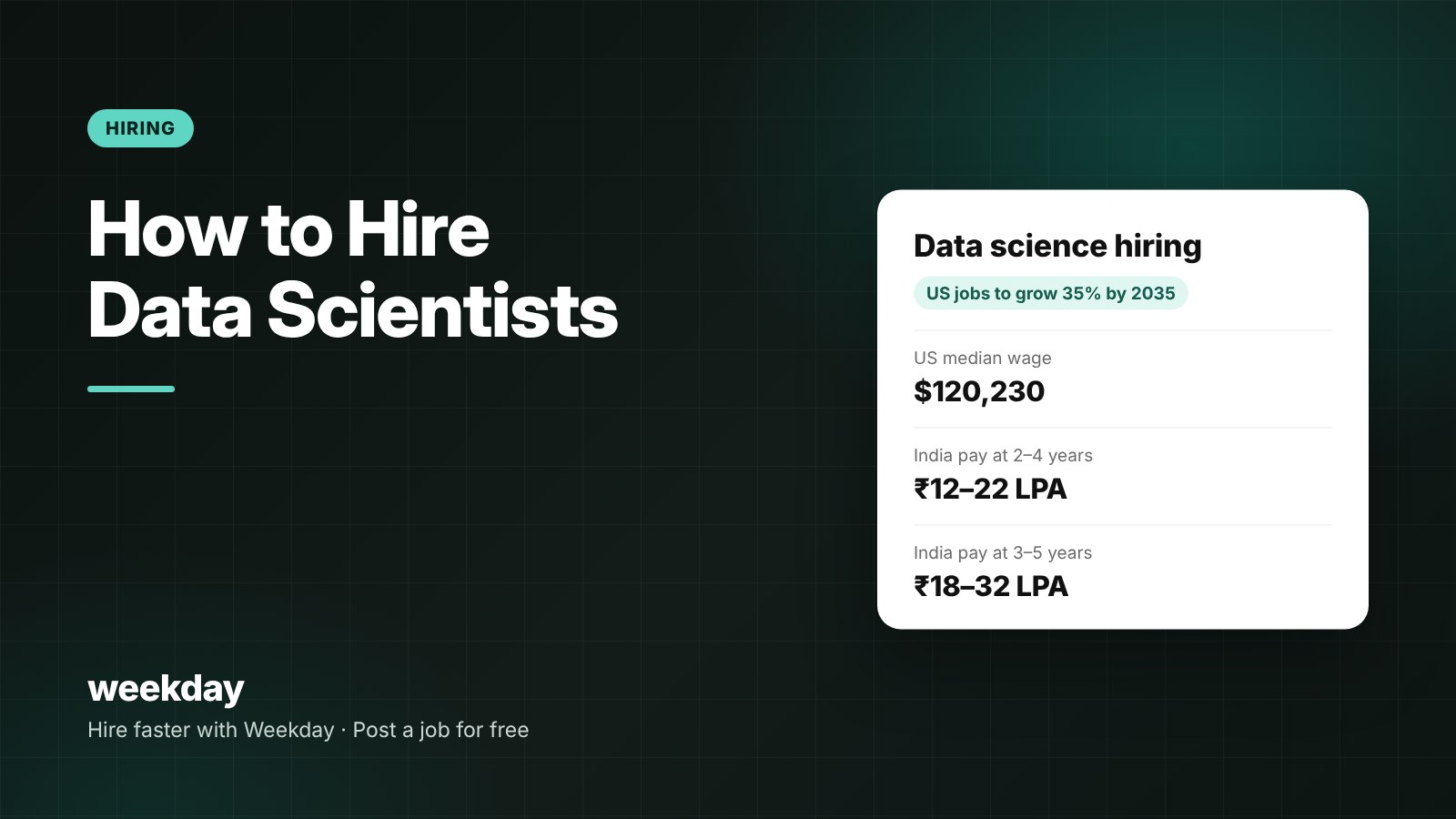
Quick answer: Before you hire a data scientist, check that you do not actually need a data analyst or an ML engineer. Then budget with real numbers: the US median wage for data scientists is $120,230, and in India data scientists earn ₹12–22 LPA at 2–4 years and ₹18–32 LPA at 3–5 years for core data science roles. Test with a SQL task, a business case and a messy-data exercise, and make sure your data is ready before day one.
Data science jobs are still growing fast in the US. The Bureau of Labor Statistics projects employment of data scientists to grow 35% from 2025 to 2035, with about 24,800 openings a year (BLS). That growth means competition for good people. It also means many candidates use the title loosely. This guide helps you hire the right person for the job you actually have.
Step 1: Analyst, scientist or ML engineer?
These three roles overlap, but the work and the pay are different. Weekday's data scientist salary guide compares them at 3–5 years of experience in India:
| Role | Main work | Pay at 3–5 years (India) |
|---|---|---|
| Data analyst | Reporting, dashboards and SQL | ₹8–16 LPA |
| Data scientist | Statistics, experiments and predictive models | ₹18–32 LPA |
| ML engineer | Getting models into production and keeping them there | ₹25–45 LPA |
A quick test: if the main question is "what happened and why?", hire an analyst. If it is "what will happen, and what should we change?", hire a data scientist. If you already have a model and need it to run reliably for millions of users, hire an ML engineer.
Step 2: Set a budget
United States
BLS puts the median annual wage for data scientists at $120,230 in May 2025. The lowest 10% earned less than $67,240 and the top 10% more than $199,130 (BLS).
India
From Weekday's data scientist salary guide (annual CTC):
| Experience | Typical pay |
|---|---|
| Fresher (0–1 year) | ₹5–10 LPA (₹15–25 LPA at top product firms and GCCs) |
| Early career (2–4 years) | ₹12–22 LPA |
| Mid-level (5–7 years) | ₹22–38 LPA |
| Senior (8–12 years) | ₹38–60 LPA |
Employer type matters even more than city. The same guide shows Indian product companies paying ₹28–55 LPA at 3–5 years and GCCs ₹28–62 LPA, while IT services firms pay about ₹10–16 LPA at 5 years. By city, average pay is ₹16–20 LPA in Bangalore and ₹7–11 LPA in tier-2 cities.
Step 3: Get your data ready before you hire
This step is easy to skip, and it decides whether your first data scientist succeeds. Before the offer goes out, check:
- Can a new hire get read access to the main databases in their first week?
- Is there one clear business question for the first 90 days, with an owner?
- Does someone know what each key table means?
If the answer to these is no, your first hire may spend months cleaning pipelines. In that case, a data engineer or a strong analyst may be the better first hire.
Step 4: Find candidates with real impact
- Look for shipped results, not certificates. "Built a churn model that cut cancellations" beats a list of courses.
- Search adjacent industries. A data scientist from a lending company already knows risk models. One from e-commerce knows recommendations and experiments.
- Check analytics firms and GCCs. They train people well. Expect to pay at the upper end to move them.
- Use outbound. Good data scientists with 3–6 years of experience are often not applying. A short message about a real problem gets more replies than a generic post.
Step 5: A practical interview loop
- Screen (30 minutes): one project end to end. What was the business question? How did they measure success? What did not work?
- SQL and data task (60 minutes): joins, window functions and a messy table. Weekday's data scientist guide calls strong SQL and Python "non-negotiable, and tested in almost every interview".
- Business case (60 minutes): "Sign-ups fell 10% last week. How would you find out why?" or "Design an A/B test for our new pricing page." Listen for clear thinking about bias, sample size and what decision the result will drive.
- Modelling exercise (take-home, under 3 hours): a small dataset with missing values and a clear target. Ask for a short write-up, not just a notebook.
- Stakeholder round (45 minutes): they explain their take-home result to a non-technical manager.
Green flags: starts with the business question, checks data quality first, explains results in plain words.
Red flags: jumps to complex models, cannot explain a metric they chose, has never seen a model used in a real decision.
For a ready-made job post, see Weekday's data scientist job description.
Step 6: Close the offer
- Sell the problem: share real examples of questions they will own in the first six months.
- In India, plan around notice periods of 30 days at startups and 60–90 days at large IT services firms and MNCs (Weekday notice period guide).
- Be clear on who they report to. A first data scientist reporting to someone who does not use data is set up for an early exit.
How Weekday helps
Weekday's AI sourcing agent finds data scientists for your brief, including passive candidates, and reaches them over email, WhatsApp and phone. Weekday reports a 50%+ response rate across its platform (Weekday; a platform figure, not a promise for every role). You see interested candidates with their current and expected pay, so you know quickly if your budget works.
A 90-day plan for your new data scientist
- Days 1–30: get access to data, meet every team that will use their work, and document the key tables and metrics. Ship one small analysis that answers a real question.
- Days 31–60: pick the first larger problem with a business owner. Agree on the success metric and the decision the work will drive.
- Days 61–90: deliver a first version, such as a model, an experiment or a forecast, and present it to the business owner in plain words.
Write this plan before the offer goes out. Strong candidates will ask what their first three months look like, and a clear answer helps you close.
Hiring data scientists in India or the US?
See matching candidates and their expected pay, and let Weekday's agents handle outreach.
Book a demoFrequently asked questions
How much does it cost to hire a data scientist?
In the US, the median data scientist wage is $120,230 (BLS, May 2025). In India, data scientists earn ₹12–22 LPA at 2–4 years and ₹22–38 LPA at 5–7 years, with product companies and GCCs paying more (Weekday guide).
Should my first data hire be a data scientist?
Often not. If your data is messy or scattered, a data engineer or a strong analyst usually creates value faster. Hire a data scientist once there is clean data and a clear prediction or experiment problem.
What skills should I test?
SQL, Python, statistics and experiment design, and the ability to explain results to non-technical people.
Is a PhD needed?
For most product and business roles, no. Research-heavy roles are the exception.
How long does hiring a data scientist take?
Aim for two to three weeks from first call to offer, plus notice in India.