Last updated: 18 November 2026
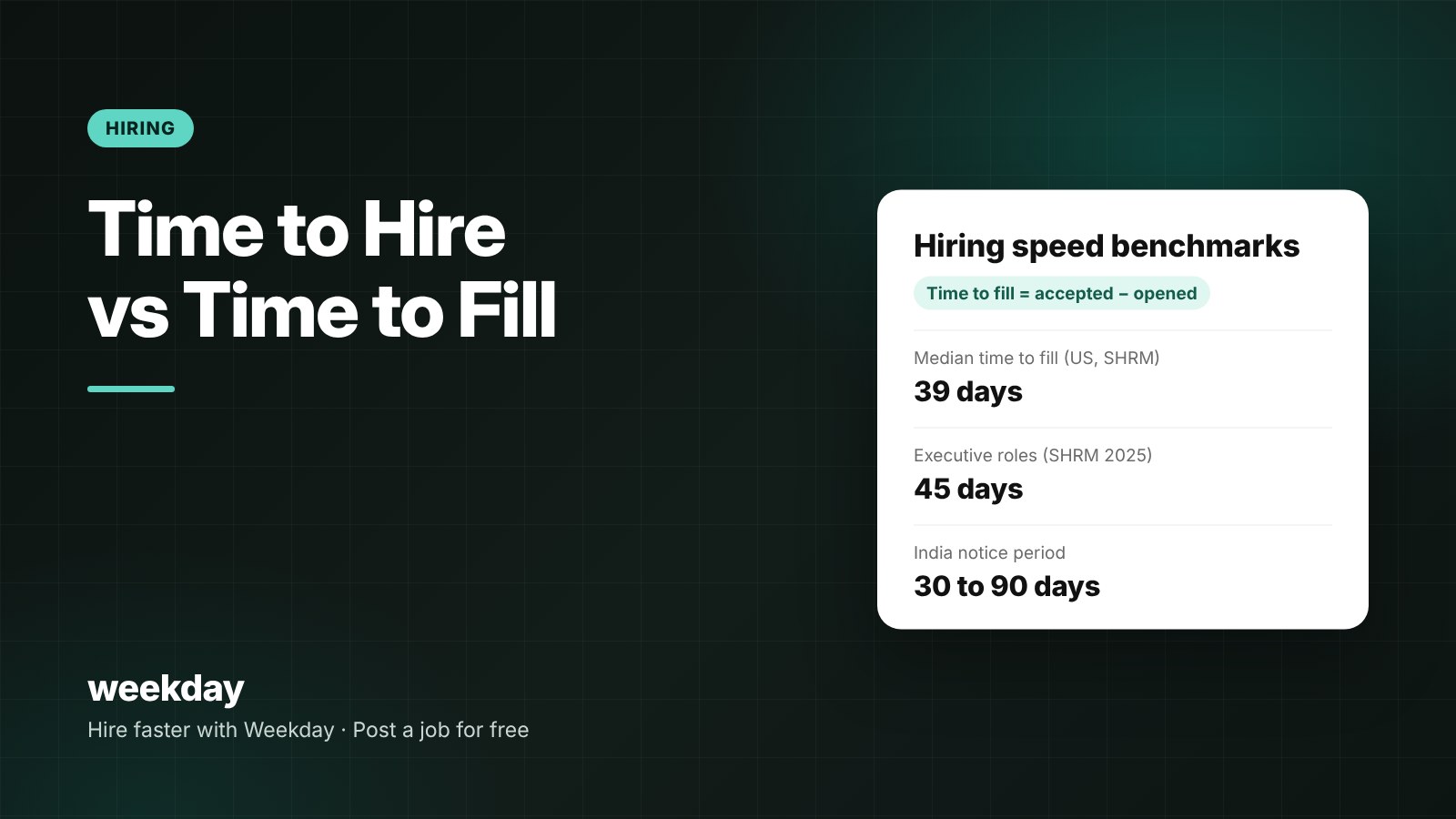
Quick answer: Time to fill counts the days from opening a job to the candidate accepting the offer. Time to hire counts the days from when the hired candidate entered your pipeline to their acceptance. SHRM's 2026 data puts the median time to fill at 39 calendar days for non-executive roles. In India, add the notice period, often 30 to 90 days, to get the real date your new hire starts.
Every week a role stays open costs you. The work waits, the team covers for the gap, and good candidates accept other offers. To fix that, you first need to measure it the same way every time.
Time to fill vs time to hire: what is the difference?
| Time to fill | Time to hire | |
|---|---|---|
| Starts | When the job requisition is opened | When the person you hired first entered your pipeline (applied, was sourced or was referred) |
| Ends | When the candidate accepts the offer | When the same candidate accepts the offer |
| Tells you | How long the business waits for the seat to be filled | How fast your process moves once you find the right person |
| Who owns it | Hiring manager plus recruiting | Mostly the recruiting process and interview speed |
SHRM defines time to fill as "the number of days from the time the job requisition was opened to the time the offer was accepted by the candidate", counted in calendar days including weekends and holidays (SHRM 2025 benchmarking).
The formulas
For a team view, take the median across all hires in a quarter, not the average. One role that stayed open for six months can make an average look much worse than your normal hire.
Example: you open a backend role on 1 September. You source the person you finally hire on 20 September. They accept on 10 October. Time to fill is 39 days. Time to hire is 20 days. The first 19 days were spent finding the right person; the last 20 on the process.
Benchmarks for 2026
- Non-executive roles (US): SHRM's 2026 benchmarking data shows a median time to fill of 39 calendar days (SHRM).
- Executive roles (US): in SHRM's 2025 data, executive time to fill dropped from 60 days to 45 days (SHRM 2025).
- Large organisations: the same 2025 data shows extra-large organisations taking 61 days for non-executive roles and 60 days for executive roles. Bigger is not faster.
There is no equally solid public benchmark for India. Track your own numbers by role family each quarter and compare against yourself.
The India factor: notice periods
In India, offer acceptance is not the finish line. Notice is usually 30 days at startups and 60–90 days at large IT services firms and MNCs, and 90+ days for senior roles (Weekday notice period guide). So add a third number to your dashboard:
A 39-day time to fill plus a 90-day notice period means the seat is empty for more than four months. That is why it helps to plan hiring a quarter ahead, and why buyouts and early release matter in offer talks. Enterpret, a Series A AI startup, estimates notice periods of around two months for its niche AI roles (Weekday case study).
Where the days actually go
Break your hiring process into stages and measure each one. Often, a few stages eat most of the time:
- Building the pipeline. HumanBit, a startup hiring for roles with 3+ years of experience, used to take 10–20 days to build a qualified pipeline for a specialised role. With Weekday, similar pipelines now take 3 days (HumanBit case study).
- Getting the first reply. Edoofa found that on LinkedIn, getting to a first real conversation took 5–7 days. With Weekday, reaching out to 100 people got about 25% to walk in within 3–4 days (Edoofa case study).
- Scheduling interviews. Gaps between rounds add up fast. Two days of waiting before each of four rounds adds more than a week.
- Waiting for feedback. Feedback that arrives a week late often arrives after the candidate has accepted somewhere else.
7 ways to cut time to hire
- Write the brief before opening the role. Agree on must-have skills, salary band and interviewers on day one.
- Start sourcing on day one. Do not wait for applications to dry up before going outbound.
- Book interview slots in advance. Block two fixed slots a week per interviewer for the role.
- Cut rounds. For most roles, a screen, one skills round and one manager round is enough.
- Give feedback within 24 hours. Make it a rule, and track it.
- Decide on the offer in one meeting. Have the band approved before the final round, not after.
- Keep a warm bench. Strong candidates who came second last time can often start the next process at the final round.
Common mistakes
- Mixing time to hire and time to fill in the same report.
- Measuring only the average, which a single slow role can distort.
- Ignoring notice periods in India and planning start dates as if offers were the end.
- Making the process faster by skipping skill checks. Speed is good only if quality of hire holds. See how to measure quality of hire.
A simple time-to-hire dashboard
You do not need special software to start. Track these per role, every month, in a shared sheet:
| Metric | Why it matters |
|---|---|
| Time to fill (median) | How long the business waits |
| Time to hire (median) | How fast your process moves |
| Time to start (India) | When the seat is actually filled, including notice |
| Days to first interview | Shows if sourcing is the bottleneck |
| Days from final round to offer | Shows if approvals are the bottleneck |
| Offer acceptance rate | Fast but rejected offers do not help |
Review it with hiring managers once a month. The stage with the biggest number is where to act first.
Want to cut the days it takes to build a pipeline?
See how Weekday's sourcing and outreach agents bring interested candidates to your inbox within days.
Book a demoFrequently asked questions
What is the difference between time to hire and time to fill?
Time to fill starts when the job is opened. Time to hire starts when the person you hired entered your pipeline. Both end when the offer is accepted.
What is a good time to fill?
SHRM's 2026 median for non-executive roles is 39 calendar days. Use it as a reference, then track your own numbers by role.
How do I calculate average time to hire?
For each hire, subtract the date they entered the pipeline from the date they accepted. Then take the median across all hires in the period.
Does time to fill include the notice period?
No. It ends at offer acceptance. In India, track "time to start" separately to include the notice period.
How can a startup hire faster?
Fix the brief, start outbound on day one, pre-book interview slots, give feedback within 24 hours and keep the process to three rounds.