Last updated: 17 November 2026
- UI vs UX vs product designer
- Skills and tools employers test
- Pay: full-time vs freelance
- A portfolio that gets interviews
- 10 UI/UX interview questions with answers
- How to handle a design test
- Scams and unpaid “test” work
- A 90-day fresher route
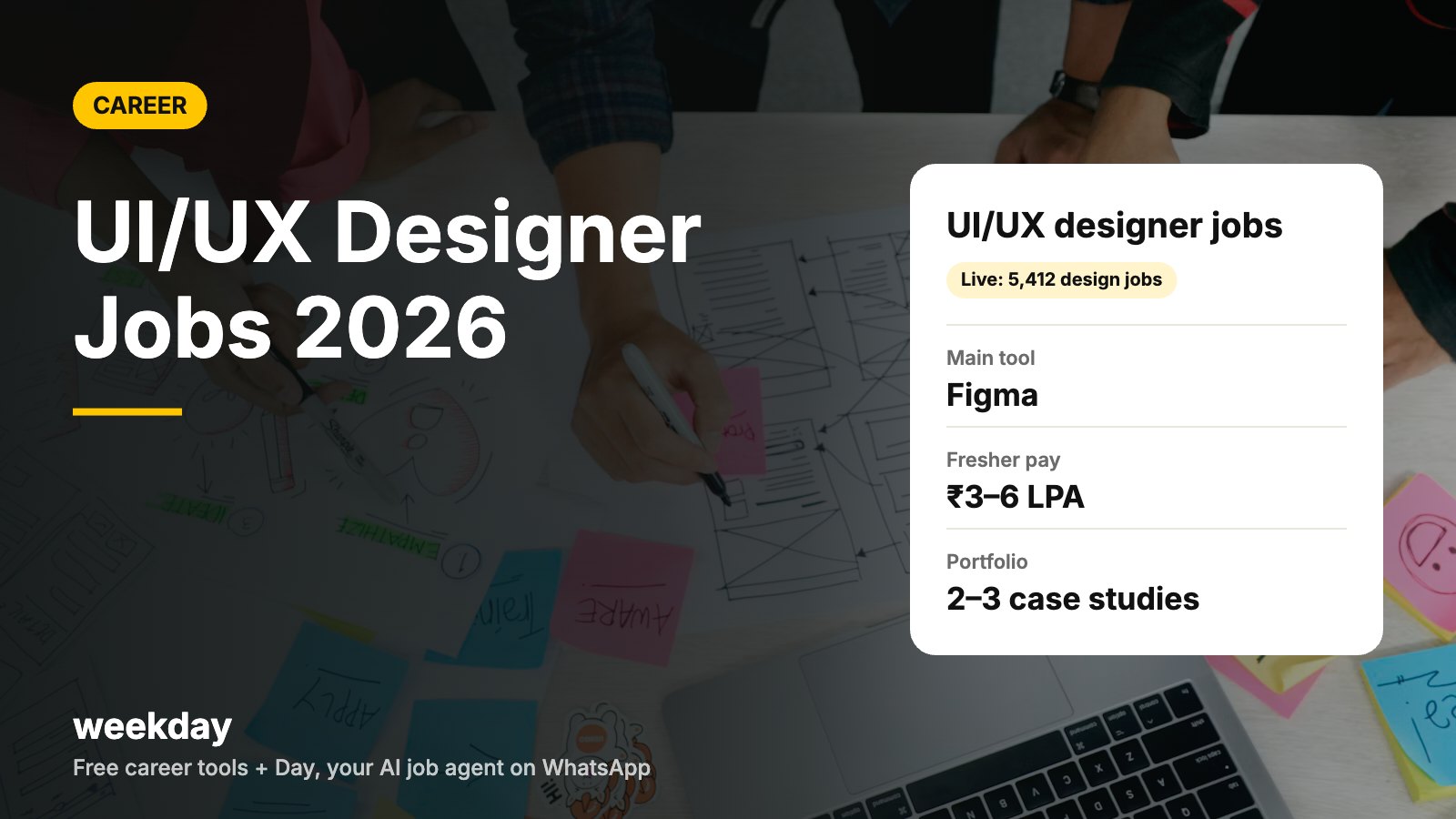
- Design jobs: 5,412 open, 1,395 new this week
- Product designer jobs: 878 open, 169 new this week
- Remote design jobs: 3,076 open, 630 new this week
- Graphic design jobs: 2,216 open, 613 new this week
Sources: Weekday job listings (jobs posted in the last 30 days), counted on 17 November 2026. Pay ranges are indicative, based on typical Indian listings.
- Open ChatGPT and go to Plugins.
- Search Weekday Jobs and tap Try in chat (or open Weekday Jobs in ChatGPT).
- Ask in plain words, for example:
- “Find UI/UX designer jobs for freshers posted this week in Bengaluru, Pune or remote”
- “Show product designer jobs at startups with 2–4 years experience and pay above ₹12 LPA”
- “List remote design jobs that need Figma and user research, sorted by newest”
Day, Weekday's free AI job agent, finds jobs that match your skills and pay, and applies when you say yes. On WhatsApp.
Say hi to Day on WhatsAppHow Day works →What does a UI/UX designer do?
A UI/UX designer decides how a digital product should work and how it should look. That covers apps, websites, dashboards and internal tools. On a normal week you might talk to users, sketch a new flow, build screens in Figma, test a prototype with five people, and sit with developers to make sure the build matches the design.
In India the title varies a lot. Startups often hire one “UI/UX designer” who does everything. Larger product companies split the work into UX research, interaction design, visual design and product design. Agencies and IT services firms hire designers who switch between client projects. Read the job description, not just the title.
UI vs UX vs product designer
| UI designer | UX designer | Product designer | |
|---|---|---|---|
| Main question | How does it look and feel? | Does it make sense and solve the problem? | Does this design move the product and business forward? |
| Daily work | Layouts, colour, type, icons, components, design systems, handoff | Research, user flows, wireframes, information architecture, usability tests | Both UI and UX, plus working with PMs on scope, metrics and trade-offs |
| Key output | Polished screens and a component library | Flows, wireframes, research findings | Shipped features and measured outcomes |
| Where common | Agencies, consumer apps, design-system teams | Larger firms, banks, research-led teams | Product startups and SaaS companies |
| Typical pay band | Similar to UX at the same level | Similar to UI at the same level | Usually higher at mid and senior levels |
If you are starting out, apply to all three titles. Many fresher roles labelled “UI/UX” are mostly UI work with some flows. As you gain experience, product designer roles usually pay more because they own outcomes. Browse product designer jobs and the wider design jobs list to see how companies word these roles.
Skills and tools employers test
| Skill area | What it means | Tools commonly named |
|---|---|---|
| Visual design | Grid, spacing, type scale, colour, hierarchy, accessibility contrast | Figma, Adobe Illustrator for icons |
| Interaction and prototyping | States, transitions, micro-interactions, clickable flows | Figma prototyping, ProtoPie, Framer |
| Design systems | Reusable components, variants, tokens, documentation | Figma libraries and variables |
| User research | Interviews, surveys, usability tests, synthesis | Google Forms, Maze, Lyssna, Dovetail, Miro |
| Information architecture | Navigation, labels, card sorting, sitemaps | FigJam, Miro, Optimal Workshop |
| Handoff and basic front-end | Specs developers can build; knowing what is hard in code | Figma Dev Mode, basic HTML/CSS |
| Analytics | Reading funnels and drop-offs to find problems | Google Analytics, Mixpanel, Hotjar |
Figma is close to a must in India today; most job posts name it. Adobe XD is now rare in new posts. AI features inside design tools are useful for quick explorations and copy drafts, but interviewers still judge your reasoning, so never present AI-generated screens as your own process.
Pay: full-time vs freelance
| Level | Typical full-time pay (India) | Typical freelance pricing |
|---|---|---|
| Intern | Around ₹10,000–₹30,000 a month stipend | Small gigs, often ₹3,000–₹10,000 per screen set |
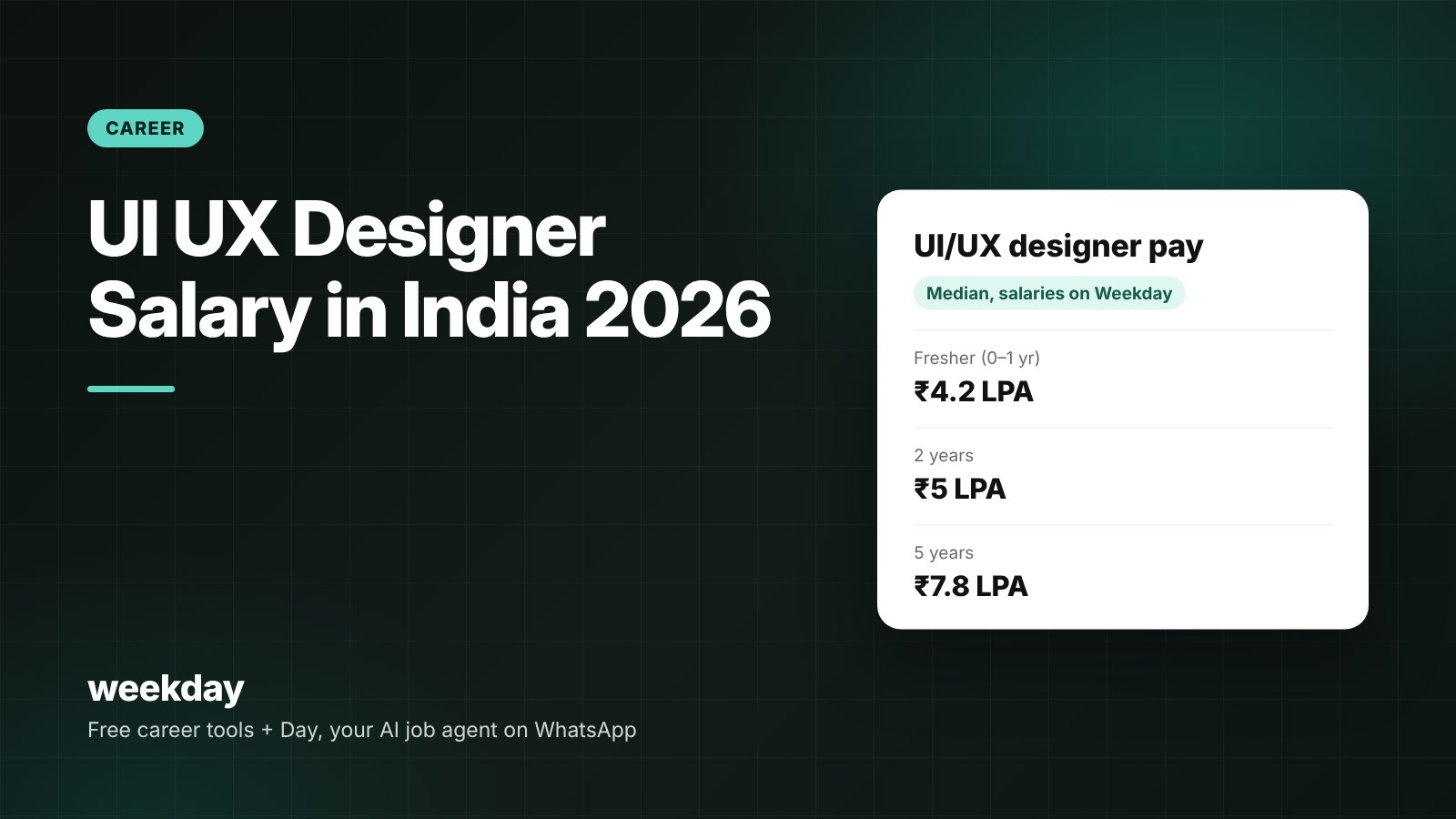
| Fresher / junior (0–2 yrs) | Around ₹3–6 LPA | Around ₹15,000–₹50,000 for a small app or landing page |
| Mid-level (2–5 yrs) | Around ₹8–18 LPA | Around ₹1,000–₹2,500 an hour, or ₹75,000–₹2,50,000 per project |
| Senior / lead (5+ yrs) | Around ₹18–40 LPA, higher at top product firms | Retainers or project fees above ₹2,50,000 |
Indicative ranges for India in 2026, based on typical listings. Product companies and well-funded startups usually pay above agencies and services firms. See also our UI designer salary guide.
Worked example: pricing a freelance app project
Freelance offer: ₹60,000 to design a 12-screen food-ordering app
Your estimate: research 6 h + flows 6 h + wireframes 10 h + UI 24 h + revisions 10 h + handoff 4 h = 60 hours
Effective rate: ₹60,000 ÷ 60 = ₹1,000 an hour

If the client asks for 3 extra revision rounds (another 15 hours) at no cost:
₹60,000 ÷ 75 = ₹800 an hour

Fix: write “2 revision rounds included; extra rounds at ₹1,000/hour” in the proposal before you start.
A portfolio that gets interviews
Recruiters and design leads usually spend a few minutes on a portfolio. They want to see how you think. Two or three deep case studies beat ten shallow ones. For a full walkthrough, read our UI/UX portfolio guide.
| Case study section | What to show | Common mistake |
|---|---|---|
| Problem | Who the user is, what hurts, and why it matters (a number if you have one) | Starting with final screens |
| Your role | What you did vs the team | Saying “we” for everything |
| Research | 2–3 real findings with quotes or data | A persona with no evidence |
| Process | Flows, sketches, options you rejected and why | Only showing the happy path |
| Solution | Key screens with short notes on decisions | 30 screens with no explanation |
| Outcome | Test results, metrics or what you learned | No result at all |
- No client work? Redesign a real flow you use (railway booking, a bank's UPI screen, a college portal). Test the old and new versions with 5 people and report what changed.
- Show one design system piece: a small component library with buttons, inputs and states proves you can work at scale.
- Keep it fast: one link (Behance, a Notion page, Framer or your own site) that loads on a phone.
10 UI/UX interview questions, with answers
Answers 1–5 (fresher and junior)
1) Walk me through a project.
“I redesigned the checkout of a college canteen app. Users dropped off at payment. I interviewed 8 students, found that the UPI step opened a new screen with no order summary, and tested two layouts. The new version cut steps from 5 to 3; in a test with 6 users, task time fell from about 90 to 45 seconds.”

2) What is the difference between UI and UX?
UX is whether the product solves the problem and is easy to use. UI is the visual layer that makes it clear and pleasant. A beautiful app with a confusing flow fails UX.

3) How do you start a new design problem?
Clarify the goal and the user, check existing data, talk to a few users, map the current flow, then sketch several options before going high fidelity.

4) How do you handle feedback you disagree with?
Ask what problem the feedback is trying to solve, share my reasoning with evidence, and suggest testing both if we still disagree.

5) What makes a design accessible?
Enough colour contrast, readable text sizes, clear focus states, labels for icons, touch targets around 44px or more, and not relying on colour alone.
Answers 6–10 (mid-level and career switchers)
6) How do you work with developers?
Involve them early, check what is hard to build, use shared components, write clear specs in Dev Mode, and review the build before release.

7) What is a design system?
A shared set of components, styles and rules so teams design and build consistently and faster.

8) How do you measure if a design worked?
Pick a metric before launch, such as completion rate, time on task, drop-off or support tickets, and compare after release.

9) Tell me about a design that failed.
“My first onboarding redesign added a tutorial carousel. In testing, 4 of 5 users skipped it. I replaced it with inline hints at the moment of need.”

10) Why product design and not graphic design? (career switcher)
“I enjoyed making posters, but I care more about how people use things. I moved into UI/UX by redesigning two apps and testing them with real users.”
Mistakes to avoid
| Mistake | Fix |
|---|---|
| Showing Dribbble-style shots only | Lead with 2 case studies that explain decisions |
| No numbers anywhere | Add test results, task times or survey counts, even small ones |
| Saying “I follow the double diamond” with no example | Tell what you actually did on one project |
| Not asking about the team | Ask how design works with product and engineering |
How to handle a design test
Many companies give a take-home task or a live whiteboard exercise. A fair test is short (a few hours), uses a made-up or old problem, and is clearly for evaluation. Here is a simple approach.
Sample test-assignment approach
Brief: “Design a feature that helps users split bills in a payments app.” Time: 4 hours.

Hour 1: Write down assumptions and questions. Who splits bills? Friends, roommates, office lunches. Note 3 user goals.
Hour 2: Map the flow (create split → add people → choose equal or custom → send requests → track who paid). Sketch 2 options.
Hour 3: Design 4–6 key screens in Figma, including empty, error and success states.
Hour 4: Write a 1-page summary: problem, assumptions, decisions, what you would test next.

Present in 10 minutes: problem, flow, screens, trade-offs, next steps.
Scams and unpaid “test” work
| Sign | Fair hiring | Red flag |
|---|---|---|
| Test scope | A few hours, made-up or old problem | Design their full live app or website “as a test” |
| Use of your work | Used only to evaluate you | Your screens appear in their product later without pay |
| Fees | Never charges you | Registration, “placement” or certificate fee to get the job |
| Contact | Company email, named team, clear process | WhatsApp-only recruiter, no company details |
| Offer | Written offer with pay and role | “Join for free for 3 months, then we will see” |
If a test looks like real client work, ask to have it paid or offer a past project instead. Never pay for a job or a placement guarantee. If you paid someone, save proof and report at cybercrime.gov.in or call 1930.
A 90-day fresher route
| Weeks | Focus | Output |
|---|---|---|
| 1–3 | Figma basics, auto layout, components; read about UX basics | 3 practice screens rebuilt from apps you use |
| 4–7 | Case study 1: redesign a real flow; interview and test with 5 users | Case study 1 written up |
| 8–10 | Case study 2: a new feature or small app; build a mini design system | Case study 2 + component library |
| 11–13 | Portfolio site, resume, LinkedIn; apply to 10–15 roles a week | Interviews |
Copy-ready resume summary
Junior UI/UX designer skilled in Figma, user research and prototyping. Redesigned a canteen-ordering checkout that cut steps from 5 to 3 and halved task time in user tests. Built a 40-component design system with variants and documented handoff. Looking for a junior product or UI/UX role.
Use remote design jobs to widen your search, and let Day, Weekday’s AI job agent send matching UI/UX roles to you on WhatsApp. For the portfolio basics that apply to every creative role, see how to make a portfolio.
FAQs
What is the salary of a UI/UX designer fresher in India?
Freshers usually start around ₹3–6 LPA. Product startups and larger product companies often pay more than agencies, especially for strong portfolios.
Is coding needed for UI/UX jobs?
Usually not. Basic HTML and CSS helps you talk to developers and design things that are easy to build, but most roles do not test coding.
Can I get a UI/UX job without a design degree?
Yes. Many designers come from engineering, commerce, arts or graphic design. Employers hire on portfolio and interviews.
Which tool should I learn first for UI/UX?
Figma. It is named in most design job posts in India. Add FigJam or Miro for research and flows.
What is the difference between a UX designer and a product designer?
A UX designer focuses on research, flows and usability. A product designer does both UX and UI and also works with product managers on scope and metrics.
How many projects should my UI/UX portfolio have?
Two or three deep case studies are usually enough. Quality and clear reasoning matter more than quantity.
Are UI/UX design jobs available remotely?
Yes. On 17 November 2026, 3,076 remote design jobs were live on Weekday, with 630 new that week.
Should I do an unpaid design test?
A short test on a made-up problem is normal. If it is large, or looks like the company's real live work, ask for it to be paid or decline.
Do I need a paid UI/UX course with placement guarantee?
No. Many good courses exist, but no one can guarantee a job. Never pay a fee to be placed; that is a common scam.