
Last updated: 25 November 2026
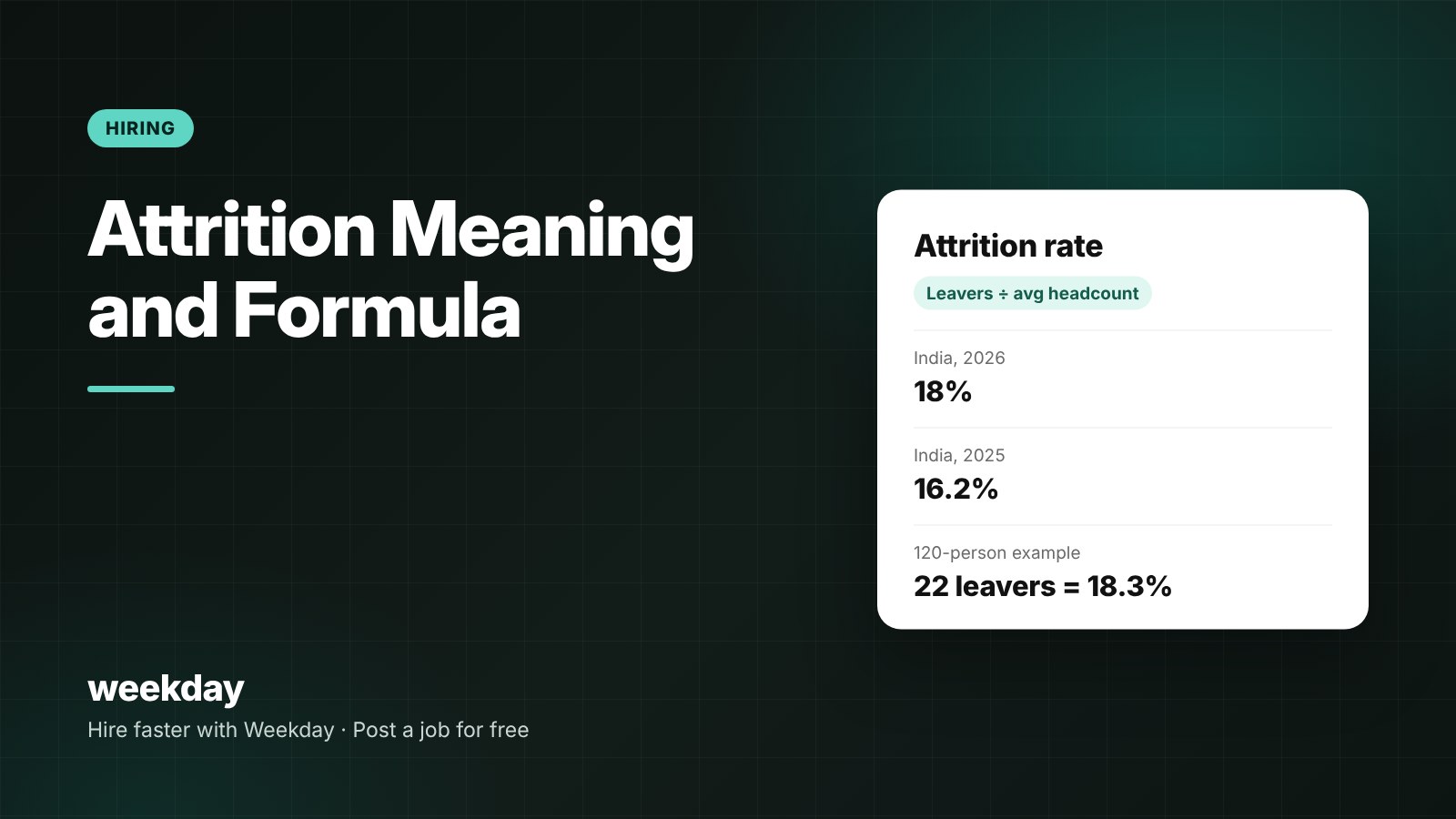
Quick answer: Attrition means employees leaving a company, whether they resign, get let go, retire or finish a contract. Attrition rate = people who left ÷ average headcount × 100. India's attrition rate hit 18% in 2026, up from 16.2% in 2025 and 17.1% in 2024 (Aon, 1,200+ companies). For a 120-person company, 18% means about 22 people leaving in a year, close to 2 a month.
Attrition meaning, in one line: it's the gradual loss of people from your company. Some leave on their own. Some you ask to leave. Either way, the seat is empty until you fill it again, and the work piles up on the people who stay.
This guide covers the formula (with a worked example), the four types of attrition, how attrition differs from turnover, and what India's 2026 numbers mean for your hiring plan.
What does attrition mean in HR?
In HR, attrition is any exit from the company in a given period. That includes:
- Resignations
- Terminations and layoffs
- Retirements
- Contracts that end and aren't renewed
Strictly speaking, attrition means people leave and the role isn't refilled, so your headcount shrinks. In practice, most Indian companies and salary surveys use "attrition rate" for the share of people who left in a year, replaced or not. That's how we use it in this guide.
India's attrition rate in 2026: 18%
Aon's Annual Salary Increase and Turnover Survey covers 1,200+ organisations across 45 industries. Its October 2026 edition shows attrition going back up after a dip (Aon):
| Year | Attrition rate (India, all industries) | Average salary hike |
|---|---|---|
| 2024 | 17.1% | Not covered here |
| 2025 | 16.2% | Not covered here |
| 2026 | 18% | 9% (actual) |
| 2027 | Not yet known | 9.1% (projected) |
Big IT services firms report lower numbers. Here's what they posted for the September 2026 quarter (People Matters). Each company measures it a little differently, so compare with care.
| Company | Attrition, Sep 2026 quarter | How it's measured |
|---|---|---|
| Infosys | 12.7% | Voluntary, last 12 months |
| HCLTech | 12.8% | Last 12 months, excludes involuntary exits |
| TCS | 13.3% | IT services attrition |
| Wipro | 13.8% | Voluntary |
Why it's going up
Two forces push attrition up at the same time. The first is pay. A Blind survey of 2,178 India-based professionals (15–26 October 2026) found 35% got no hike or a pay cut this year, and 59% got 5% or less, up from 34% in 2025 (Blind). People who feel underpaid start looking.
The second is demand. foundit expects white-collar hiring in India to grow 8.16% in 2027, after 3.30% in 2026 (Business Standard). And the openings are already there: Weekday's remote software engineer jobs page listed 26,785 open roles in India on 25 November 2026, with 10,176 added in the previous seven days. A small hike plus a lot of openings is how good people leave.
Attrition rate formula (with a worked example)
Average headcount = (Headcount at the start + Headcount at the end) ÷ 2.
Use the average, not the starting number. If you grew a lot during the year, using the start figure makes attrition look worse than it is.
Worked example: a 120-person company
| Step | Number |
|---|---|
| Headcount on 1 January | 114 |
| Headcount on 31 December | 126 |
| Average headcount | (114 + 126) ÷ 2 = 120 |
| People who left in the year | 22 (14 resigned, 5 let go, 2 contracts ended, 1 retired) |
| Attrition rate | 22 ÷ 120 × 100 = 18.3% |
| Voluntary attrition | 14 ÷ 120 × 100 = 11.7% |
| Involuntary attrition | 7 ÷ 120 × 100 = 5.8% |
This sample company sits right at Aon's 18% average. But the split tells you more than the total. If 14 of 22 exits were resignations, your fix is about pay, managers or growth, not about hiring better.
Monthly attrition
Same formula, one month at a time. Say 2 people left in October and your average headcount was 121. Monthly attrition = 2 ÷ 121 × 100 = 1.65%. Multiply by 12 for a rough yearly figure: about 19.8%. Track this every month so you see a spike in March, not in December.
Early attrition
Early attrition = people who left within 90 days of joining ÷ people who joined in that period × 100. If 3 of 30 new joiners left inside 90 days, that's 10%. A high number here points at hiring and onboarding, not at pay. One r/recruitinghell post titled "Quitting after 1 week" got 1,486 upvotes in November 2026, which tells you how common it is.
Types of attrition
| Type | What it means | Example | What to look at |
|---|---|---|---|
| Voluntary | The employee chooses to leave | A developer resigns for a bigger offer elsewhere | Pay vs market, manager, growth |
| Involuntary | The company ends the job | Termination after a PIP, or a layoff | Hiring quality, business planning |
| Internal | The person moves to another team or role inside the company | A support lead moves to product | Good for the company, but the old team still has a gap to fill |
| Demographic | Exits within one group of people | Women leaving after maternity leave, or freshers leaving in year one | Policies and managers that affect that group |
Two more labels help in reviews. Regrettable attrition is when someone you wanted to keep leaves. Non-regrettable attrition is when a low performer leaves. A 15% rate made mostly of regrettable exits is a bigger problem than an 18% rate made mostly of the other kind.
Attrition vs turnover
| Attrition | Turnover | |
|---|---|---|
| Is the role refilled? | No, or not right away | Yes, you hire a replacement |
| Effect on headcount | Goes down | Stays about the same |
| Common causes | Retirement, role removed, hiring freeze | Resignations and terminations that get backfilled |
| What it tells you | How your team size is changing | How much hiring work exits create |
Many Indian teams use both words for the same thing. That's fine, as long as your reports say clearly which one you mean.
What one exit costs you
Start with what you can count:
- Replacement fee. If you use an agency, 8.33% of annual CTC (one month's pay) is the most common rate in India (Weekday guide to recruiting fees). On a ₹12 LPA engineer, that's about ₹1 lakh.
- The empty-seat gap. Notice periods in India are usually 30 days at startups and 60–90 days at large IT firms and MNCs (Weekday notice period guide). Your new hire may be serving the same notice elsewhere.
- Lost context. Customer history, code knowledge, vendor contacts. Hard to price, easy to feel.
How to bring attrition down
- Check pay against the market. Aon's average hike was 9% in 2026. If your top people got 5%, expect calls from recruiters. Fix the outliers first.
- Track attrition by team and manager every month. One team losing a third of its people can hide inside a healthy company average.
- Run exit interviews and act on them. Our list of 30 exit interview questions shows what to ask and what to do with each answer.
- Watch the first 90 days. Clear goals, a buddy and a 30-day check-in cut early exits.
- Plan backfills before they happen. If you expect 18% attrition, build those hires into your headcount plan. Referrals are often the fastest route; see our guide to referral bonuses in India.
For more ideas, read our employee retention strategies.
Free tool: Not sure if your raises keep up with Aon's 9% average? Run a few cases through Weekday's salary hike calculator before your next review cycle.
Someone just resigned? Backfill fast.
Post the role for free. Weekday's AI agents scan 400M+ profiles, reach the best fits over email and WhatsApp, and send interested candidates to your inbox. Want to see it first? Book a demo.
Frequently asked questions
What is attrition in simple words?
Attrition means people leaving your company, for any reason: they resign, get let go, retire or finish a contract. The attrition rate is the share of your average headcount that left in a period, usually a year.
What is a good attrition rate in India?
There's no single right number. Aon's 2026 survey of 1,200+ Indian companies puts the all-industry average at 18%. Large IT services firms reported 12.7% to 13.8% for the September 2026 quarter. Compare yourself with your sector and track the trend month by month.
How do you calculate monthly attrition?
Divide the number of people who left in the month by the average headcount for that month, then multiply by 100. For example, 2 leavers on an average headcount of 121 is 1.65%. Multiply by 12 for a rough annual figure.
Is attrition the same as turnover?
Not quite. Turnover usually means people leave and you hire replacements. Attrition, in the strict sense, means the seat isn't refilled, so headcount shrinks. Many Indian teams use the two words for the same thing, so say which one you mean in reports.
Sources
- Aon: Annual Salary Increase and Turnover Survey India 2026–27 (14 October 2026)
- People Matters: Blind survey on 2026 pay hikes in India
- Blind: 1 in 3 Indian tech workers got no hike or a pay cut this year
- People Matters: Indian IT hiring and attrition in the September 2026 quarter
- Business Standard: foundit projects 8.16% white-collar hiring growth in 2027
- Weekday: remote software engineer jobs in India (counts as of 25 November 2026)
- Weekday: contingency vs retained vs subscription recruiting fees
- Weekday: notice period guide
- Reddit: r/recruitinghell, "Quitting after 1 week"





