
Last updated: November 2026 · Sources: Weekday analysis of 148 LinkedIn hiring posts, Stack Overflow Developer Survey 2025, Weekday salary pages
A backend developer builds the part of an app you don't see. When you pay on Swiggy and the order shows up in the restaurant's tablet a second later, backend code made that happen: the API, the database write, the queue that pinged the restaurant.
This roadmap tells you what to learn, in what order, which projects get you shortlisted, and what the job pays in India.
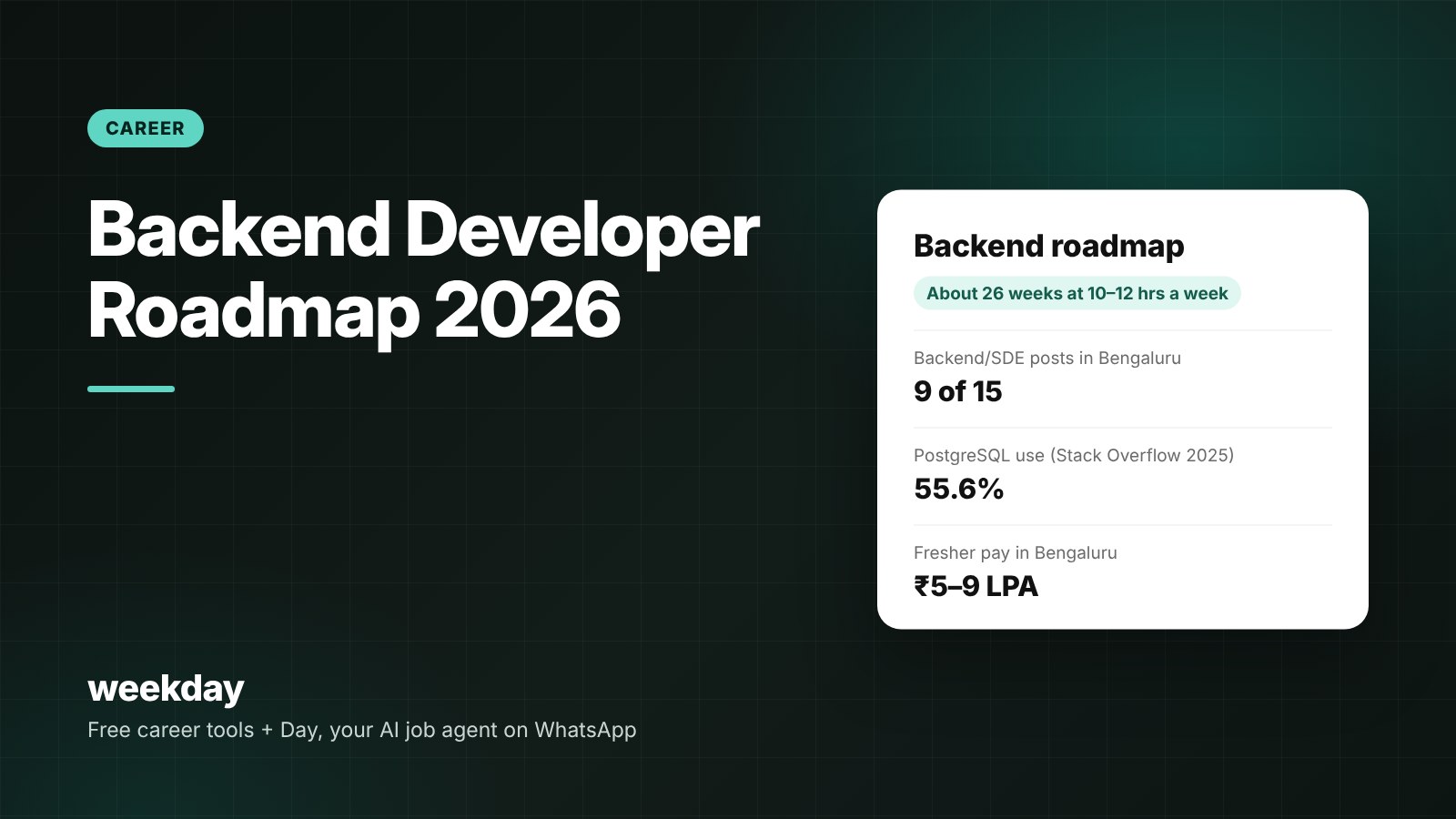
The roadmap in one line: one language → how the web works → one framework and REST APIs → SQL and PostgreSQL → auth → caching with Redis → queues → Docker and one cloud → testing and logs → system design → 3 projects. Our suggested plan fits this into about 26 weeks at 10 to 12 hours a week.
What backend hiring looks like right now
We read 148 LinkedIn hiring posts from 14 to 23 November 2026 and tagged each one by the role names in its job title (a post with several roles can count more than once). This is Weekday's analysis of 148 LinkedIn hiring posts, Nov 2026.
- 15 posts had "backend" or "SDE" in the title. 9 of those 15 were in Bengaluru.
- 5 of the 15 named Java or Spring Boot. 2 named Python or FastAPI.
- Another 19 posts were full stack roles, which need the same backend base.
- Pay ranged from an SDE-1 Java contract role at up to ₹8 LPA to an SDE III backend role (AI agents) at up to ₹1 Cr. Two posts asked for a notice period of 30 days or less.
The takeaway: in our sample, Java with Spring Boot was the language named most often for SDE backend roles, and AI products are now pulling backend engineers in too.
Which language should you pick?
This is the question every fresher asks. A thread on r/developersIndia comparing Python with FastAPI, Node.js with TypeScript and Go drew 47 replies. Here's what developers worldwide use, from the Stack Overflow Developer Survey 2025:
| Backend framework | Share of all respondents using it |
|---|---|
| Node.js | 48.7% |
| Express | 19.9% |
| ASP.NET Core | 19.7% |
| FastAPI | 14.8% |
| Spring Boot | 14.7% |
| Django | 12.6% |
Global usage isn't the same as Indian job posts. Pick by the jobs you want:
- Java + Spring Boot: SDE roles at product companies, banks and GCCs. Matches most backend posts in our sample. See the Java roadmap.
- Python + FastAPI: startups and AI products. Python is used by 57.9% of developers in the same survey.
- Node.js + TypeScript: if you already know JavaScript and want full stack roles.
Pick one and stay with it for six months. Switching languages every month is an easy way to lose a year.
The backend roadmap: 10 steps
Step 1: One language and CS basics (weeks 1–4)
- Syntax, OOP, collections, error handling
- Basic data structures: arrays, hash maps, stacks, queues, trees
- Git: branches, commits, pull requests
You're ready when: you can solve easy DSA problems in your language without looking up syntax. Practise with our DSA interview questions.
Step 2: How the web works (week 5)
- HTTP methods, status codes, headers, cookies
- DNS, TCP, HTTPS in simple terms
- REST and JSON
Revise with our computer networks interview questions.
Step 3: A framework and REST APIs (weeks 6–9)
- CRUD endpoints, validation, error responses
- Pagination, filtering, API versioning
- Reading and writing API docs (OpenAPI/Swagger)
You're ready when: you can build a small "todo with users" API from scratch in a day. See Spring Boot or Node.js interview questions for what gets asked.
Step 4: SQL and PostgreSQL (weeks 10–12)
- Joins, GROUP BY, subqueries, indexes
- Transactions and isolation levels
- Schema design and normalisation
PostgreSQL is used by 55.6% of developers in the Stack Overflow survey, ahead of MySQL at 40.5%. Learn one well. Our DBMS interview questions cover the theory.
Step 5: Auth and security (week 13)
- Sessions vs JWT, OAuth login with Google
- Hashing passwords (bcrypt), never storing them plain
- SQL injection, rate limiting and the OWASP Top 10
Step 6: Caching and NoSQL (weeks 14–15)
- Redis for caching, sessions and rate limits (used by 28% of developers in the survey)
- When MongoDB fits (24%) and when it doesn't
- Cache invalidation: TTLs and write-through
Step 7: Queues and background jobs (weeks 16–17)
- Why you send emails and invoices from a queue, not inside the API call
- Kafka or RabbitMQ basics, retries, dead-letter queues
- Idempotency: a payment request sent twice should charge once
Step 8: Docker and one cloud (weeks 18–20)
- Dockerfile, Docker Compose for app plus database
- Deploy on AWS: EC2 or a container service, RDS, S3
- CI with GitHub Actions
Docker is used by 71.1% of developers and AWS by 43.3% in the survey. Go deeper with our Docker interview questions and the DevOps roadmap.
Step 9: Testing, logs and monitoring (weeks 21–22)
- Unit and integration tests
- Structured logs, metrics, alerts
- Reading a stack trace from production calmly
Step 10: System design (weeks 23–26)
- Load balancers, horizontal scaling, replication, sharding
- Designing a URL shortener, a feed, a notification system
- Monolith vs microservices, and when each makes sense
Use our system design interview questions and microservices questions.
Projects that get you shortlisted
A 2026 grad on r/developersIndia asked how to get off-campus SDE-1 calls and said what many freshers now hear: basic CRUD apps don't stand out anymore. Build these instead:
- URL shortener with rate limits: Redis cache, click analytics, deployed with a public link.
- Wallet or ledger API: transactions, idempotent payments, a queue for receipts. It shows you understand money can't be double-charged.
- Job board API: search with filters, auth, background email alerts and tests.
For each project, write a README with one diagram and three numbers: requests per second you tested, response time, and test coverage.
What backend developers earn in India
- Freshers: entry-level software engineers start at about ₹4.5–8 LPA, and ₹5–9 LPA in Bengaluru, per Weekday's fresher salary guide.
- Experienced: backend roles on Weekday with a disclosed salary have a median of ₹25 LPA, with the middle half at ₹17–55 LPA (31 roles, November 2026), per Weekday's backend hiring guide.
How backend interviews work
- Online test or DSA round: arrays, hash maps, trees, easy-to-medium problems
- Machine coding or LLD: build a parking lot or Splitwise-style service in a fixed time
- System design: mostly for SDE-2 and above
- Project deep dive and HR round
Mistakes that slow people down
- Tutorial loops. Finishing one long course after another without building anything.
- Skipping SQL. Every backend interview asks about joins and indexes.
- Jumping to microservices. Build one clean monolith first.
- No deployed link. A project nobody can open is hard to judge.
Ready to apply?
See open backend developer roles on Weekday at startups, product companies and GCCs, with filters for experience and city.
Frequently asked questions
How long does it take to become a backend developer?
Our suggested plan takes about 26 weeks at 10 to 12 hours a week, covering one language, APIs, SQL, auth, caching, queues, Docker, one cloud, testing, system design and three projects.
Which language is best for backend development in India?
Java with Spring Boot is the most common ask in SDE backend posts. In Weekday's analysis of 148 LinkedIn hiring posts, 5 of 15 backend or SDE posts named Java or Spring Boot and 2 named Python. Python with FastAPI is a strong pick for AI startups.
Can a fresher get a backend developer job?
Yes, but all 3 SDE-1 posts in our sample asked for 2+ years, so freshers should target internships, trainee roles and startups, and show deployed projects.
Is DSA needed for backend developer jobs?
Yes for most product companies. Expect at least one round of easy-to-medium DSA problems before design and project rounds.
What is the salary of a backend developer in India?
Freshers usually start at ₹4.5–8 LPA. Backend roles on Weekday with a disclosed salary have a median of ₹25 LPA.





