Last updated: 13 November 2026
- Live AI jobs on Weekday
- What annotation and AI training work is
- Four types of work, with examples
- Skills you need
- Typical pay ranges
- How to qualify: the assessments
- A sample weekly schedule
- Red flags and scams
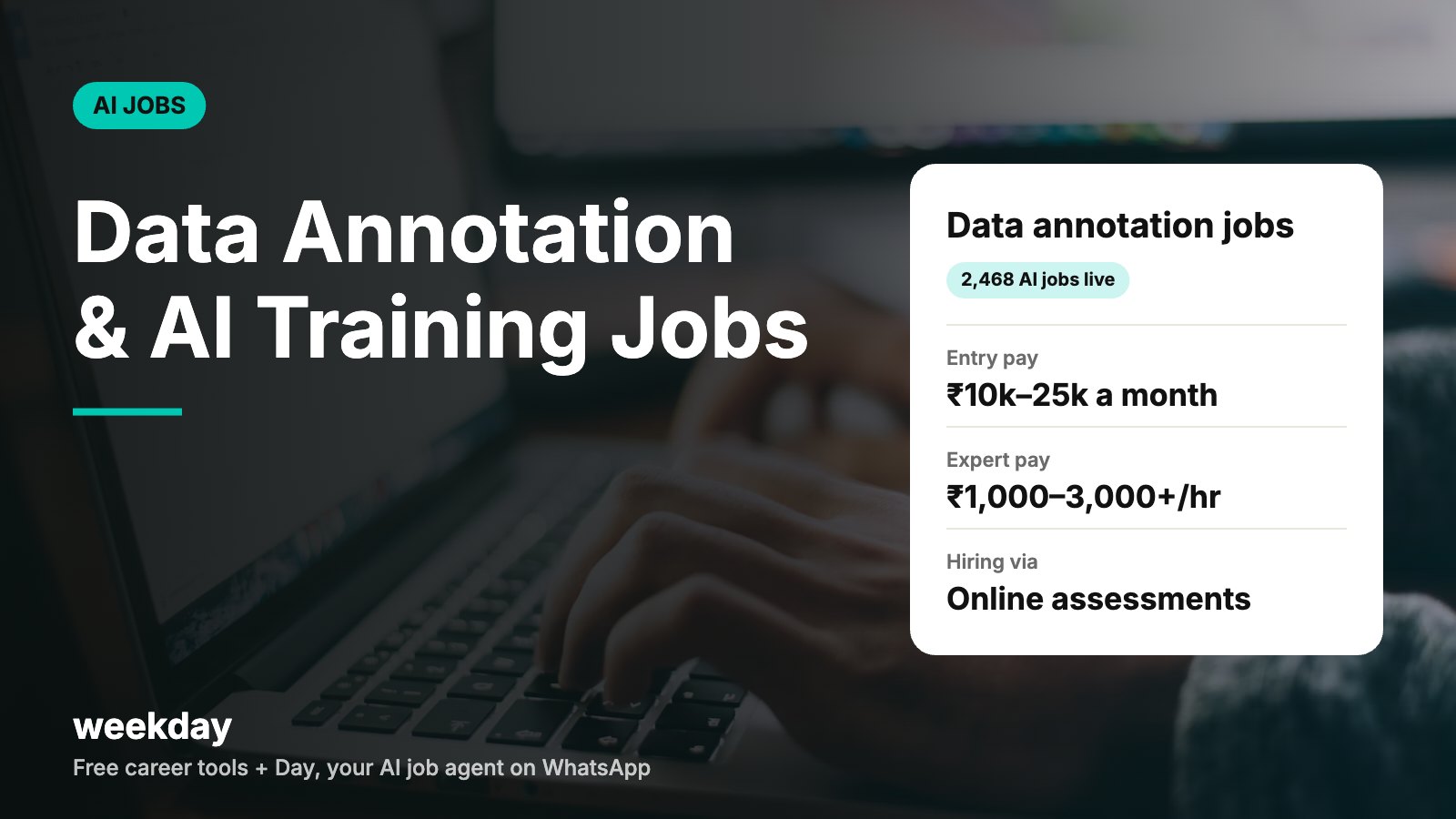
- AI jobs: 2,468 open, 386 new this week.
- Remote AI jobs: 1,624 open, 182 new this week.
- All remote jobs in India: 87,848 open, 16,189 new this week.
- AI training and annotation roles appear inside these collections under titles like data annotator, AI trainer, AI evaluator, prompt writer and subject matter expert.
Sources: Weekday job listings (jobs.weekday.works), counted on 13 November 2026. Counts change daily.
- Open ChatGPT and go to Plugins.
- Search Weekday Jobs and tap Try in chat (or open Weekday Jobs in ChatGPT).
- Ask in plain words, for example:
- “Find remote AI training jobs for maths graduates posted in the last 7 days”
- “Show data annotation jobs for freshers that are work from home”
- “Find part-time AI evaluator jobs for Hindi and English speakers with hourly pay”
Day, Weekday's free AI job agent, finds jobs that match your skills and pay, and applies when you say yes. On WhatsApp.
Say hi to Day on WhatsAppHow Day works →What annotation and AI training work is
AI models learn from examples. Someone has to draw a box around every car in a street photo, mark whether a customer email is a complaint, or read two chatbot answers and say which is more helpful and safe. That someone is a data annotator or AI trainer.
The work has moved up the skill ladder. Five years ago most of it was simple tagging. In 2026 a growing share is judgment work: rating answers, writing better ones, checking facts and testing models with hard questions. Simple tagging still exists, but it is increasingly automated, and expert work is where demand and pay have grown.
Four types of work, with examples
| Type | A typical task | Who it suits | Entry barrier |
|---|---|---|---|
| Labelling | Draw boxes around vehicles in 200 traffic images; tag product photos by category; mark sentiment in reviews | Freshers, careful detail-oriented people | Low: short test on guidelines |
| Transcription and audio | Type out a 3-minute Hindi–English call, mark speakers and timestamps; rate if a voice sounds natural | Fast typists, people fluent in Indian languages | Low to medium: language test |
| RLHF-style rating and writing | Read a prompt and two AI answers, pick the better one, explain why in 3–5 lines; rewrite a weak answer | Graduates with strong English and reasoning | Medium: writing and reasoning test |
| Domain expert evaluation | Check an AI's solution to a JEE-level physics problem; review generated code for bugs; judge a medical answer for safety | Engineers, doctors, CAs, lawyers, postgraduates | High: subject test, sometimes degree proof |
RLHF stands for reinforcement learning from human feedback. In plain words: humans compare and score AI outputs, and the model is tuned towards what humans preferred. You don't need to know the maths to do the rating.
Sample RLHF-style rating with a written reason
Prompt: "Explain GST to a small shop owner in 3 sentences."

Response A: Long, accurate, 9 sentences, uses terms like "input tax credit" without explaining.
Response B: 3 sentences, simple, but says GST is "a fixed 18% on everything".

My rating: A is better, but neither is ideal.
Reason: B breaks the length rule less but contains a factual error. GST has several rate slabs, so "fixed 18% on everything" would mislead a shop owner. A is accurate but ignores the 3-sentence limit and uses jargon. Accuracy matters more than length here, so A wins. Suggested fix for A: cut to 3 sentences and explain input tax credit in one line.
That is what a good rating looks like: a clear choice, the main reason first, the guideline it relates to, and a concrete fix. Reviewers grade your reasons, not just your picks.
Skills you need
| Skill | Why it matters | How to show it |
|---|---|---|
| Following long guidelines | Projects come with 10–40 page instructions; mistakes come from skipping them | Mention QA or process work; score well on the guideline test |
| Written English | Most rating work needs short, clear explanations | A writing sample; clean resume with no errors |
| Indian languages | Demand for Hindi, Tamil, Telugu, Bengali, Marathi and code-mixed data | List languages with level (read, write, speak) |
| Subject depth | Expert roles pay for knowledge AI gets wrong | Degree, marks, years in the field, exam ranks |
| Attention to detail | Accuracy scores decide whether you stay on a project | Data entry, proofreading or audit experience |
| Basic tools | Spreadsheets, annotation tools, sometimes simple coding | Excel/Sheets, any labelling tool, Python for coding tasks |
| Self-discipline | Remote, task-based work with no manager watching | Freelance history or consistent past remote work |
List these plainly on your resume. Our skills for resume guide shows how to phrase them so automated filters pick them up.
Typical pay ranges
Pay varies widely by project, country of the client, language and expertise, and it can change between projects. Treat the ranges below as indicative for India in 2026, not promises. Some global projects pay in US dollars per hour; others in India pay a monthly salary through an outsourcing company.
| Work type | Usual pay style | Indicative range in India |
|---|---|---|
| Image/text labelling (salaried) | Monthly salary, office or remote | Around ₹10,000–25,000 a month |
| Transcription | Per audio minute or per hour | Around ₹100–300 an hour of work |
| RLHF rating and writing (generalist) | Per hour or per task | Around ₹300–1,000 an hour |
| Domain expert evaluation | Per hour | Around ₹1,000–3,000+ an hour for strong experts |
| Team lead / QA reviewer | Monthly salary | Around ₹25,000–60,000 a month |
Worked example: comparing two offers
Rahul, a B.Tech graduate, gets two offers. Offer 1: a salaried labelling job at ₹18,000 a month for 45 hours a week. Offer 2: project-based AI rating at ₹450 an hour, with about 20 hours of work a week available.
| Offer 1 (salaried) | Offer 2 (per hour) | |
|---|---|---|
| Hours a month | About 195 | About 87 |
| Monthly pay | ₹18,000 | ₹39,150 |
| Effective hourly rate | About ₹92 | ₹450 |
| Stability | Fixed salary, PF possible | Work can stop when the project ends |
| Taxes | TDS by employer | Usually paid as freelance income; you handle tax |
Offer 2 pays far more per hour but has no guaranteed hours. Many people take the stable job and do project work on weekends, if their contract allows it. Keep about 3 months of expenses saved before relying on project work alone.
How to qualify: the assessments
Most AI training roles skip the classic interview. You apply, then sit a series of online tests. Fail one and you usually can't retake it for weeks or months, so prepare.
| Stage | What it tests | How long | Tip |
|---|---|---|---|
| Profile screen | Degree, languages, subject, location | Instant | Be specific: “M.Sc Chemistry, 2 years teaching” |
| Language or writing test | Grammar, clarity, short answers | 20–45 min | Write short sentences; proofread |
| Subject test | Your field at university or exam level | 30–90 min | Don't take it if you're rusty; revise first |
| Guideline quiz | Whether you read and follow project rules | 30–60 min | Read the full guide twice; take notes |
| Paid trial tasks | Real tasks scored by reviewers | A few hours | Slow and accurate beats fast and sloppy |
Assessment checklist
Before you start:
[ ] Quiet room, no interruptions for 90 minutes
[ ] Stable internet and a charged laptop
[ ] Guidelines open in a second tab, read twice
[ ] A notepad for rules you might forget

During the test:
[ ] Read each question fully before answering
[ ] Explain reasons in 2–4 clear sentences
[ ] Never paste an answer from an AI tool; most tests check
[ ] Flag ambiguity instead of guessing

After:
[ ] Note what you struggled with
[ ] Revise that topic before the next project test
A sample weekly schedule
Here is a realistic week for someone doing about 20 hours of AI rating work alongside study or another commitment. Most projects let you choose hours, but many set a weekly minimum.
| Day | Hours | Work |
|---|---|---|
| Monday | 3 | Read updated guidelines (projects change often); 2 hours of rating tasks |
| Tuesday | 3 | Rating tasks; review feedback on last week's tasks |
| Wednesday | 2 | Writing tasks: rewrite weak AI answers |
| Thursday | 3 | Rating tasks |
| Friday | 2 | Domain tasks if available; otherwise rating |
| Saturday | 5 | Longest block; two 2.5-hour sessions with a break |
| Sunday | 2 | Catch-up and quality check; log hours and invoices |
| Total | 20 | At ₹450/hr, about ₹9,000 a week or ₹38,000–39,000 a month |
Two habits keep people on projects: read every guideline update before working, and keep your own log of hours and tasks. If a payment dispute ever comes up, your log is your evidence.
Red flags and scams
Real AI training work never asks you to pay. Fake “data entry” and “AI tagging” offers on WhatsApp and Telegram are common in India.
| Red flag | Why it's a scam sign |
|---|---|
| Registration, “security deposit” or software fee | Genuine employers pay you; they don't bill you |
| Task-based “earn ₹500 per like or review” schemes | Often fraud that later asks you to “invest” to unlock earnings |
| Offer without any test or assessment | Real projects test you before they trust you with data |
| Pay far above the ranges above for simple tagging | Bait to collect fees or personal data |
| Contact only by WhatsApp, no company email or website | No way to verify or hold anyone accountable |
| Asking for bank OTP, UPI PIN or remote screen access | Direct theft risk; never share these |
If you're unsure, search the company name with “fraud” or “review”, check the website domain, and ask for a written offer. When in doubt, don't pay and don't share OTPs.
How to find and apply for these roles
- Search remote AI jobs on Weekday and filter by experience and pay.
- Use title variations: data annotator, AI trainer, AI rater, AI evaluator, prompt writer, subject matter expert, linguist.
- Tailor your resume to the type: languages for transcription, writing samples for rating, degree and marks for expert work.
- Prepare for the tests with the checklist above before you click start.
- Apply steadily, 10–15 roles a week. Day, Weekday's free agent on WhatsApp, can apply to matching roles after you approve each one.
Remote work comes with its own rules on hours, contracts and pay. Read what a remote job really means and our work from home jobs guide for other home-based roles.
FAQs
What is a data annotation job?
Work where you label data, such as images, text or audio, so AI models can learn from it. It is usually remote and task-based.
What are AI training jobs?
Jobs where you rate, compare, correct or write AI responses so models improve. They include generalist rating and expert evaluation in subjects like coding, maths and medicine.
How much do data annotation jobs pay in India?
Entry-level salaried labelling usually pays around ₹10,000–25,000 a month. Rating and expert work can pay around ₹300–3,000+ an hour depending on skill and project.
Can freshers do data annotation jobs?
Yes. Labelling and transcription accept freshers who pass a guideline test. Rating work usually wants strong English and reasoning.
Do I need coding for AI training jobs?
No for most labelling and rating work. Yes for code evaluation projects, where you review AI-written code.
What is RLHF?
Reinforcement learning from human feedback: people compare and score AI answers, and the model is tuned towards what people preferred.
How do I pass an AI training assessment?
Read the guidelines twice, write short clear reasons, don't use AI tools to answer, and only take subject tests you have revised for.
Are data annotation jobs real or a scam?
Many are real. Any job asking for a fee, deposit, OTP or screen access is a scam.
Are these jobs full-time or part-time?
Both. Salaried labelling roles are full-time; much rating and expert work is project-based and flexible.
How many AI jobs are on Weekday?
On 13 November 2026 Weekday listed 2,468 AI jobs (386 new that week), including 1,624 remote AI jobs.