
Last updated: 18 November 2026
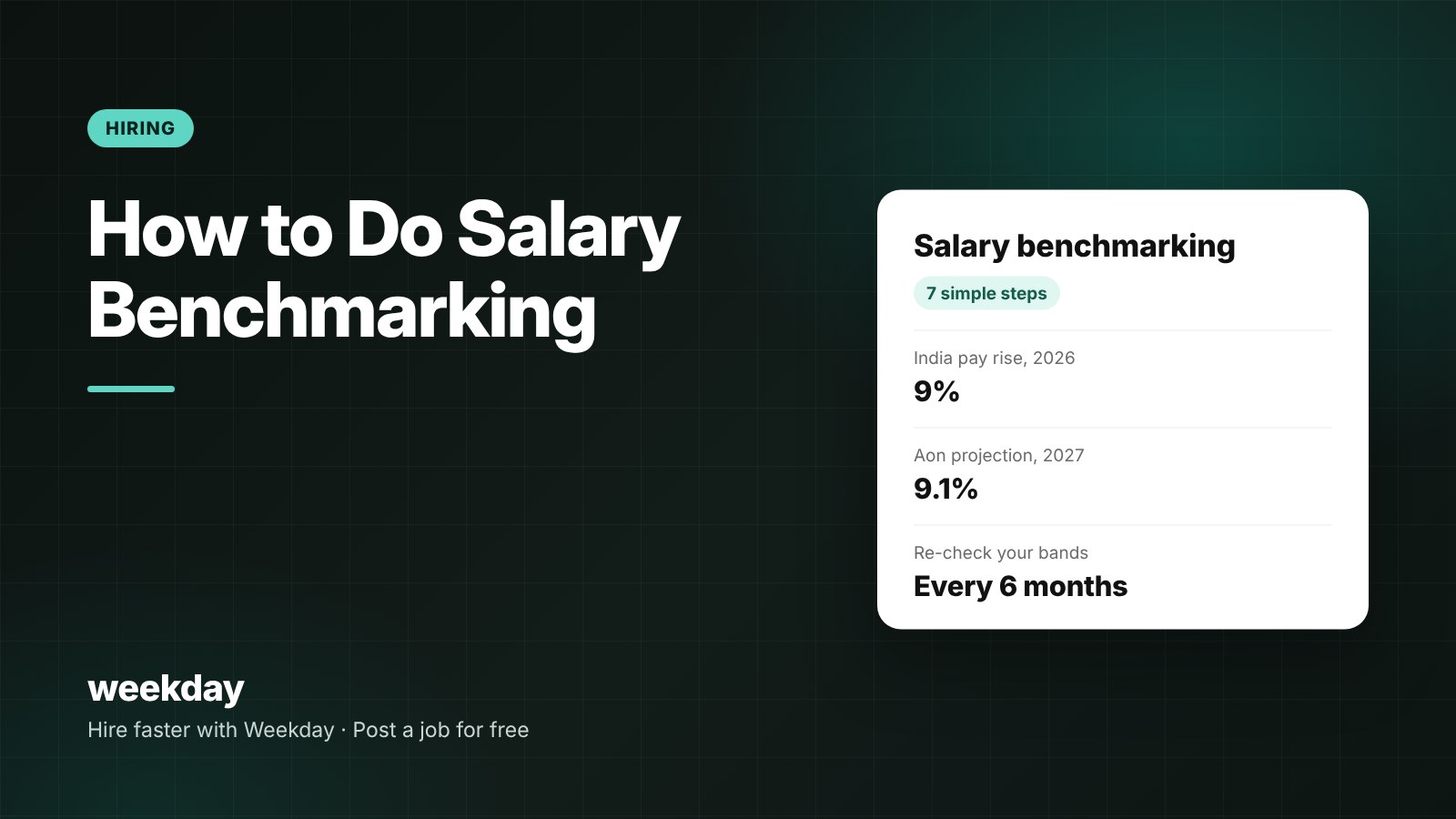
Quick answer: Salary benchmarking means checking what you plan to pay for a role against what similar companies pay for the same work, in the same market. Do it in 7 steps: define the job and level, pick your market, pull at least three data sources, match on the work (not the title), choose a target percentile, turn it into a band, and re-check it on every offer and every six months.
Most founders set pay by asking a friend or copying the last offer. That works until a candidate says no because a competitor offered a lot more, or until two people doing the same job find out they earn very different amounts. Benchmarking fixes both problems with a simple routine.
Why salary benchmarking matters more in 2026
Pay is moving fast, and it is not moving at the same speed for everyone.
- India: salaries rose by an actual 9% in 2026, and Aon projects 9.1% for 2027. Attrition went up to 18% in 2026 from 16.2% in 2025 (Aon, October 2026).
- Gap by employer type: in the same Aon study, technology platform and product companies gave 9.5% in 2026, while technology consulting and services firms gave 6.6%. If you hire engineers from services firms, last year's number is already out of date.
- AI roles: Aon says AI talent premiums rose about 10% from 2025. In the US, Levels.fyi data shows AI engineers earn about 6.2% more than other engineers at entry level and 18.7% more at staff level (Levels.fyi, 2025).
- US pay transparency: 56% of organisations posted pay ranges in job ads in 2025 (Payscale). States such as California, Colorado, Illinois, New York and Washington require a range in job posts (Paycor tracker). If your range is wrong, everyone sees it.
Step 1: Define the job and the level
"Backend engineer" is not a job you can benchmark. "Backend engineer, 3 to 5 years, owns two services, Bangalore or remote India" is.
Write down four things before you look at any data:
- Main work: what the person will build, sell or run.
- Level: years of experience and scope (individual contributor, lead, manager).
- Location: city, remote, or remote with a home-country limit.
- Must-have skills that change pay, such as LLM work for an AI engineer.
Step 2: Pick your market
Your market is the set of companies you lose candidates to. A seed-stage startup in Bangalore does not compete with Google for every hire, but it often competes with funded product startups and global capability centres (GCCs).
Company type changes pay more than most people expect. Here is one example from Weekday's AI engineer salary guide:
| Employer type (India) | Typical AI engineer pay |
|---|---|
| IT services (TCS, Infosys, Wipro, Capgemini) | Freshers ₹4–7 LPA |
| Consulting (Accenture, Deloitte) | Freshers ₹5–10 LPA |
| Indian product companies | Freshers ₹14–28 LPA |
| GCCs | ₹30–65 LPA at 3–5 years |
City matters too. Weekday's data analyst salary guide notes that tier-2 cities such as Jaipur, Indore and Coimbatore usually pay 15–25% less than the metros for the same experience. If you hire remote, decide up front whether you pay one national band or adjust by city.
Step 3: Pull at least three data sources
Every source has a blind spot. Using three lets you see when one is off.
| Source | Good for | Watch out for |
|---|---|---|
| Paid salary surveys (Aon, Mercer and similar) | Clean job matching, large samples, increment trends | Cost, and data can be months old by the time you use it |
| Crowd data (Glassdoor, Levels.fyi, Weekday company salary pages) | Free, company-level detail | Self-reported, mixes levels, small samples for niche roles |
| Posted ranges in US job ads | What competitors say they will pay right now | Ranges are often very wide |
| Live candidate data (current and expected salary from your own pipeline) | What people will actually accept today | Only as good as the number of candidates you talk to |
The last row is the one most teams skip. A survey tells you what companies paid. Your candidates tell you what it takes to move them now.
Step 4: Match on the work, not the title
Titles lie. Weekday's AI engineer guide points out that many people with an "AI engineer" title at services firms earn ₹7–12 LPA, while engineers doing hands-on LLM work at product companies earn far more. Compare people who do the same work at the same scope.
A quick test: if you showed two job descriptions to a candidate, would they see them as the same job? If not, do not compare the pay.
Step 5: Choose your target percentile
Once you have a spread of numbers for a role, decide where you want to sit:
- 50th percentile (median): you pay what the market pays. Fine for roles with plenty of supply.
- 75th percentile: you lead the market. Use it for roles you keep losing, like senior AI or data engineers.
- 25th percentile: you lag the market. Only works if you offer something else people value, such as equity with real upside or a much better role.
Write the choice down per role family. It stops one-off decisions during offer week.
Step 6: Turn the number into a salary band
A salary band is the minimum to maximum you will pay for a level. A simple way to build one:
- Set the midpoint at your target percentile.
- Set the minimum and maximum around it. For example, plus or minus 20%.
- Place new hires below the midpoint unless they bring more than the level needs.
Example (India): Weekday's entry-level software engineer guide puts Bengaluru starting pay at ₹5–9 LPA. If you pick ₹7 LPA as your midpoint, a ±20% band runs from ₹5.6 LPA to ₹8.4 LPA.
Example (US): NACE expects the average starting salary for computer science graduates in the Class of 2026 to be $81,535 (NACE, February 2026). A ±20% band around that midpoint runs from about $65,200 to $97,800.
Bands also help with the US posting laws. You already have the range when the job ad goes live.
Step 7: Check every offer, and refresh twice a year
Benchmarks go stale. Two habits keep them useful:
- Per offer: before you send it, compare the offer with the candidate's current and expected salary and with your band. If most candidates for a role expect more than your maximum, your band is wrong, not the candidates.
- Twice a year: refresh the data. In 2026, Aon released its India salary studies in February and October, which fit well around the April appraisal season.
Common mistakes to avoid
- Using one source, usually the first Glassdoor number you find.
- Mixing CTC and in-hand pay. Indian offers quote CTC; compare like with like (see CTC vs in-hand salary).
- Benchmarking base pay only when competitors pay big bonuses or stock.
- Never checking existing employees against new bands. New hires earning more than the team is a fast way to lose the team.
Where Weekday fits
Weekday's candidate profiles show current salary, expected salary and notice period for people who are actively looking. That means you can see what real candidates for your role expect before you send a single message, and skip outreach your budget cannot win. For passive candidates, Weekday reaches out over email, WhatsApp and phone, and reports a 50%+ response rate across its platform (Weekday; a platform figure, not a promise for every role).
Want live pay data for the roles you are hiring for?
See current and expected salaries for real candidates in your market, then reach the ones who fit your band.
Book a demoFrequently asked questions
What is salary benchmarking?
It is the process of comparing your pay for a role with what similar employers pay for the same work in the same market, so your offers are fair and competitive.
Is compensation benchmarking the same thing?
Almost. Salary benchmarking usually looks at base pay. Compensation benchmarking also includes bonuses, stock and benefits. For startups that pay equity, compensation benchmarking gives the truer picture.
How often should a startup benchmark salaries?
Check every offer against your band, and refresh the data at least twice a year. In India, time one refresh before the April appraisal cycle.
Is Glassdoor enough?
No. It is a useful free source, but it is self-reported and often mixes levels. Use it with at least two other sources, including what your own candidates expect.
Which percentile should we pay?
A simple rule for a startup: pay the median for most roles, and the 75th percentile for the two or three roles you find hardest to fill.
Sources
- Aon India salary increase study, 14 October 2026
- Levels.fyi, AI engineer compensation trends, July 2025
- Payscale 2025 Compensation Best Practices Report
- Paycor, pay transparency laws by state
- NACE Winter 2026 Salary Survey
- Weekday salary guides: AI engineer, data analyst, entry-level software engineer





