Last updated: 18 November 2026
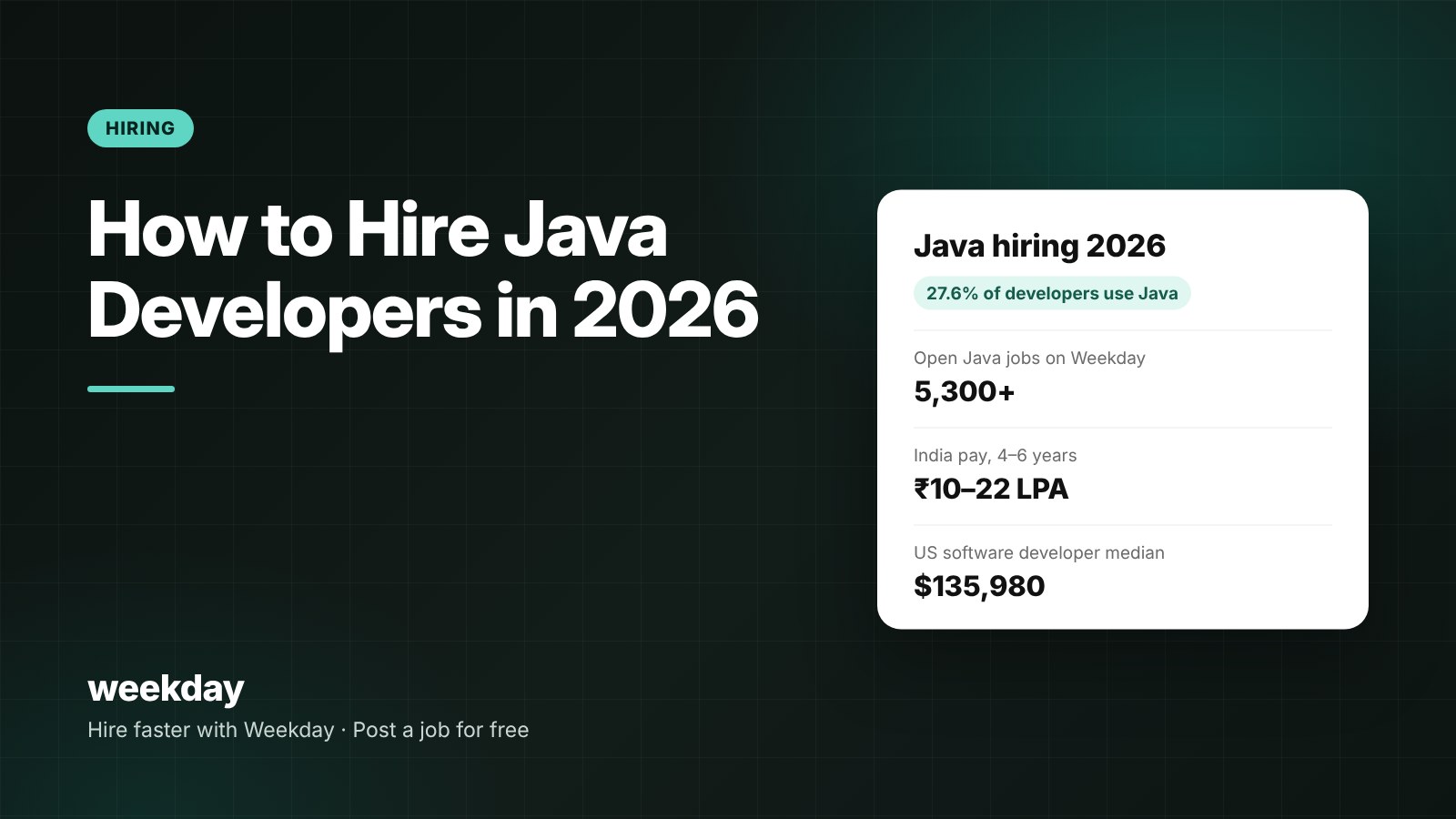
Quick answer: To hire a Java developer, decide which kind of Java work you have (new microservices, legacy upgrades or data systems). Set pay from real data: about ₹10–22 LPA for 4–6 years in India, and a $135,980 median for US software developers. Source from banks, enterprise software firms and IT services teams. Test with a small Spring Boot task and a code review, not trivia about Java keywords.
Java is not the newest language, but it still runs a huge share of business software. In the 2026 Stack Overflow Developer Survey, 27.6% of respondents said they used Java in the past year (Stack Overflow 2026). Banks, insurers, telecoms and large SaaS companies keep hiring for it.
The hiring market is busy. In November 2026, Weekday listed 5,300+ open Java developer jobs. The companies with the most open Java roles on Weekday that month were IBM (127), Citi (65), Oracle (62), ServiceNow (58) and Cognizant (57) (Weekday). If you are a startup, these are the employers you are competing with for the same people.
Step 1: Decide which Java developer you need
"Java developer" covers very different jobs. Pick one before you write the job post.
| Type | What they work on | What to look for |
|---|---|---|
| Backend / microservices | APIs and services for a product | Spring Boot, REST, SQL, messaging (Kafka or RabbitMQ), Docker |
| Enterprise / modernisation | Upgrading old systems, moving monoliths to services or cloud | Experience upgrading Java versions, refactoring, strong testing habits |
| Data and streaming | Pipelines and event processing | Kafka, Spark or Flink, performance tuning |
| Full stack (Java + front end) | Whole features, back end to screen | Spring Boot plus React or Angular |
Weekday's full stack salary guide notes that Java with Spring Boot and React or Angular is common at enterprises, banks and GCCs. If that is your stack, you are hiring from the same pool they are.
Example: "Build our new payments service" needs a backend developer. "Move our 10-year-old billing system to the cloud without downtime" needs a modernisation specialist. The second person is rarer, so start sourcing earlier.
Step 2: Write the job around outcomes
Skip long lists of every Java framework. Write what the person will deliver and what they must already know. A simple structure:
- First 90 days: "Ship the order-tracking service and cut checkout API latency by half."
- Must-haves (3–4): Spring Boot, SQL and data modelling, writing tests, working with a cloud or container setup.
- Nice-to-haves: Kafka, a specific cloud, domain knowledge such as payments.
- Pay range: state it. In Weekday's experience, startups that share salary caps show candidates they are serious (Weekday).
Weekday's Java developer job description template is a good starting point.
Step 3: Set a realistic budget
India
Weekday does not publish a Java-only salary guide, so the closest benchmark is its full stack guide for 2026, which covers backend-heavy developers:
| Experience | Pay (annual CTC) |
|---|---|
| Fresher (0–1 year) | ₹3.5–7 LPA |
| Early career (1–3 years) | ₹5–12 LPA |
| Mid-level (4–6 years) | ₹10–22 LPA |
| Senior (7–9 years) | ₹18–35 LPA |
| Lead / principal (10+ years) | ₹30–50 LPA+ at product companies |
Employer type moves the number more than the language does. The same guide shows IT services medians around ₹5–6 LPA, and ₹18–35 LPA at 4–6 years in product companies and GCCs. For 3–5 years of experience, Bangalore pays about ₹12–22 LPA, Hyderabad ₹10–18 LPA and Pune ₹9–16 LPA.
United States
The Bureau of Labor Statistics reports a median annual wage of $135,980 for software developers in May 2025. The lowest 10% earned under $82,460 and the top 10% over $214,670. BLS projects 10% employment growth for software developers from 2025 to 2035 (BLS).
Tip: fix your band before the first call. If eight of your first ten good candidates expect more than your top number, change the band or the level, not the bar.
Step 4: Find strong Java developers
- Engineers at banks, fintechs and enterprise software firms. They work on large, long-lived Java codebases, the hardest kind to keep clean.
- IT services engineers ready for product work. Many strong Java developers start at services firms. Look for people who led a module, fixed production issues or mentored juniors, not just years of experience.
- Open-source contributors. Contributions to Java libraries show code quality and how someone handles review.
- Passive candidates. The best Java developers are usually employed and not applying. Write to them about the actual problem. Weekday's guide on active vs passive candidates explains how to approach each group.
Step 5: Run a practical Java interview
- Project walk-through (30 minutes): they explain a service they built. Ask what broke in production and how they found it.
- Hands-on task (90 minutes, live): build a small Spring Boot REST endpoint with validation and one test. Or give them a slow endpoint with a database problem, such as an N+1 query, and ask them to fix it.
- Code review (45 minutes): show a short pull request with a thread-safety bug, a missing transaction and a swallowed exception. Strong developers spot them and explain the fix clearly.
- Design round for seniors (60 minutes): design an order or payment service. Listen for data models, failure cases, retries and testing.
Weekday's Java interview questions work well for the screening round.
Green flags: writes tests without being asked, knows which Java version their code ran on and why, explains trade-offs between simple and clever code.
Red flags: cannot explain how their own service is deployed, adds frameworks to solve every problem, ignores error handling.
Step 6: Make the offer and close
- Speed: finish all rounds within a week or so. Weekday has seen 30% of candidates drop off because interviews are not scheduled fast enough.
- Notice periods (India): usually 30 days at startups and 60–90 days at large IT services firms and MNCs (Weekday). Big-company Java developers often sit at the long end.
- Show in-hand pay: Indian offers quote CTC. Showing the monthly take-home avoids confusion. Weekday's CTC vs in-hand guide shows how.
Hiring in India or the US?
| India | United States | |
|---|---|---|
| Typical pay | ₹10–22 LPA at 4–6 years; ₹18–35 LPA at product companies and GCCs (Weekday) | Software developer median $135,980 (BLS, May 2025) |
| Talent pool | Very large, much of it in IT services | Deep, concentrated in enterprise and finance |
| Time to start | Add a 30–90 day notice period | Usually shorter |
How Weekday helps
Paste your Java job description and Weekday's AI sourcing agent scans 400M+ profiles and 10M+ active candidates, picks the best matches, checks pay expectations and notice period, and reaches out on email and WhatsApp until they reply (Weekday). Your first role is free, with 200 reach-outs included.
Need Java developers this month?
Launch a free AI sourcing agent for your first role. No credit card.
Post a free jobFrequently asked questions
How much does it cost to hire a Java developer in India?
Using Weekday's 2026 full stack guide as the closest benchmark: freshers earn about ₹3.5–7 LPA, 4–6 years ₹10–22 LPA and 7–9 years ₹18–35 LPA. Product companies and GCCs pay at the top of these ranges.
How much does a Java developer cost in the US?
BLS does not track Java developers separately. Software developers had a median wage of $135,980 in May 2025.
Is Java still worth hiring for in 2026?
Yes. 27.6% of 2026 Stack Overflow survey respondents used Java, and Weekday listed 5,300+ open Java jobs in November 2026.
Should I hire for Spring Boot experience specifically?
For backend roles, it helps. But a strong Java developer from another framework can learn it quickly. Test fundamentals: data modelling, testing, debugging and API design.
How long does it take to hire a Java developer?
Aim for two to three weeks from first call to offer. In India, add the notice period.