
Last updated: 18 November 2026
Quick answer: First decide where your users are and whether you need native apps or one cross-platform codebase. In India, Android is almost the whole market, so most startups hire an Android or Flutter developer first. In the US, iOS is slightly ahead, so you need both platforms early. Make your first mobile hire a mid-level or senior engineer who has shipped and maintained a live app, test them on a real feature plus mobile system design, and budget about ₹10–22 LPA for 4–6 years of experience in India.
Hiring a mobile developer is different from hiring a web developer. Your app lives on thousands of phones you do not control, releases go through app store review, and a bad build can sit on users' devices for weeks. This guide covers the decisions that matter before you post the role, what to pay, where to look and how to run the interviews.
Step 1: Decide native or cross-platform
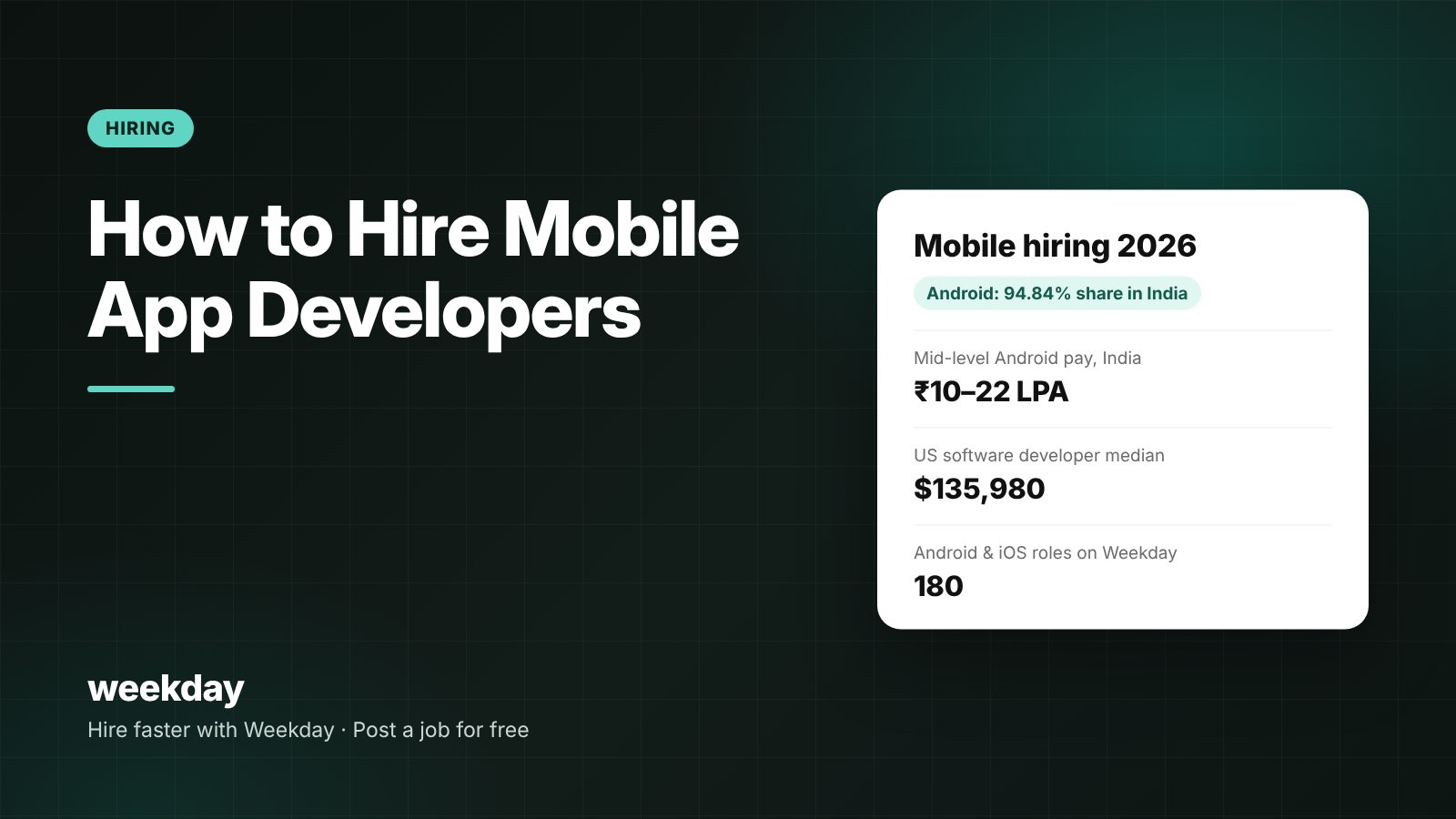
Start with your users. In India, Android had 94.84% of mobile OS share in October 2026 and iOS 5.1% (StatCounter). In the US the split is close to even: iOS 53.59% and Android 46.39% in September 2026 (StatCounter).
| Stack | Language | Best when | Who to hire first |
|---|---|---|---|
| Native Android | Kotlin | India-first consumer app, low-end devices, heavy device features | Senior Android engineer |
| Native iOS | Swift | US-first or premium audience, deep Apple integrations | Senior iOS engineer |
| Flutter | Dart | One team for both platforms, custom UI, fast iteration | Flutter engineer with native debugging skills |
| React Native | JavaScript / TypeScript | You already have a React web team and want to share skills | React Native engineer who has shipped to both stores |
Cross-platform is now a normal choice, not a shortcut. Google says Flutter has over 1 million monthly active developers and powers nearly 30% of all new iOS apps (Google Developers Blog, December 2024). Still, every cross-platform app needs someone who can open Android Studio or Xcode when a native bug appears. Ask for that skill in the job description. If you choose React Native, Weekday's guide to hiring React developers covers the shared web skills.
Step 2: Pick the right level for your first hire
Your first mobile engineer will set up the project structure, the release pipeline, crash reporting and analytics. Juniors can write screens, but they rarely know how to keep a crash-free rate high across hundreds of device models. Hire mid-level or senior first, then add juniors under them.
Demand on Weekday points the same way. Of the 180 Android and iOS roles listed on 18 November 2026, 63 asked for 4–6 years of experience, 36 for 2–3 years and only 12 for 0–1 year. The skills those listings ask for most are Android, Kotlin, Swift, Flutter, Dart and iOS (Weekday Android and iOS jobs).
Step 3: Know what to pay
India
Weekday's Android developer salary guide (October 2026) gives these ranges:
| Experience | Typical pay (LPA) |
|---|---|
| Fresher (0–1 year) | ₹3.5–6 (₹10–16 at strong product companies) |
| Early career (1–3 years) | ₹5–12 |
| Mid-level (4–6 years) | ₹10–22 |
| Senior (7–9 years) | ₹18–35 |
| Lead mobile engineer (10+ years) | ₹24–45 |
City matters. For 3–5 years of experience, the same guide puts Bangalore at ₹12–22 LPA, Delhi NCR and Hyderabad at ₹10–18 LPA, Mumbai at ₹9–16 LPA, Pune at ₹9–15 LPA and Chennai at ₹8–14 LPA. It also notes that iOS pay is similar or slightly higher at the same level because there are fewer iOS developers, and Flutter and React Native pay is comparable to native.
United States
The US Bureau of Labor Statistics does not track mobile developers on their own. They fall under software developers, whose median annual wage was $135,980 in May 2025 (BLS). Use that as a reference point, then adjust for city, seniority and equity.
Step 4: Write a job description that filters well
Vague posts like "mobile developer, 3+ years" attract hundreds of applicants and few fits. Be specific about:
- Platform and stack: Kotlin with Jetpack Compose, Swift with SwiftUI, Flutter, or React Native.
- Scale: monthly active users, number of releases a month, and the low-end devices you support.
- Ownership: will they own the release process, app store listings and crash monitoring?
- Backend contact: do they consume your APIs only, or help design them?
Weekday's free JD generators give you a starting draft for a mobile engineer, Android engineer, iOS engineer, Flutter engineer or React Native engineer. Edit it so the first three lines describe your app, not generic duties.
Step 5: Find candidates where good mobile developers show their work
- Published apps. Ask every candidate for a Play Store or App Store link they worked on. A live app with reviews tells you more than a resume line.
- GitHub and open source. Look for libraries, sample apps or contributions to Flutter, Kotlin or React Native projects.
- Product companies with large consumer apps. Engineers from fintech, quick commerce, OTT and gaming apps have dealt with scale, offline use and slow networks.
- Referrals from your current engineers. Mobile communities are small, and good engineers know each other.
- Outbound sourcing. The best mobile engineers are usually employed and not applying. Reach out with a short, specific message about your app.
Step 6: Run a four-stage interview loop
| Stage | What you check | Time |
|---|---|---|
| 1. Screen | Walk through one app they shipped: their part, the hardest bug, how they released it | 30 min |
| 2. Practical build | Build or extend a small feature: a list with pagination, offline cache and error states | 2–3 hours, take-home or live |
| 3. Mobile system design | Offline sync, caching, feature flags, push notifications, app size and startup time | 60 min |
| 4. Team and ownership | How they handle a bad release, rollbacks, working with designers and backend | 45 min |
Score every stage against the same written criteria so you compare candidates fairly. Weekday's free interview scorecard generator builds one in a few minutes.
Questions that separate strong candidates
- "Your crash-free rate dropped after a release. What do you do in the first hour?"
- "How would you make our app usable on a slow 3G connection?"
- "How do you ship a risky feature to 5% of users first?"
- For cross-platform roles: "Tell me about a bug you had to fix in native code."
Common mistakes when hiring mobile developers
- Hiring a web developer to "also do the app". App store releases, device fragmentation and offline states are a separate skill set.
- Choosing Flutter or React Native only to save money. Choose it because one team for both platforms suits your product.
- No one owns releases. Make release management part of the role from day one.
- Testing only on flagship phones. In India, many of your users will be on budget Android devices.
- Skipping the practical round. A short build exercise shows code quality faster than any quiz.
A simple 30-day hiring plan
- Week 1: Decide the stack and level, write the JD, set the pay band.
- Week 2: Source and reach out. Aim for 15–20 screened candidates.
- Week 3: Practical build and system design rounds for the top 5–6.
- Week 4: Final round, references, offer. Check the candidate's notice period early so the joining date does not surprise you.
Need mobile engineers who reply?
Launch Weekday's AI sourcing agent for free. Paste your job description and it scans 400M+ profiles, picks the best matches and reaches out on email and WhatsApp until they reply. Your first role includes 200 reach-outs, with no credit card.
Post a free jobFrequently asked questions
How much does it cost to hire a mobile app developer in India?
Most Android developers earn ₹5–10 LPA, mid-level engineers with 4–6 years earn ₹10–22 LPA, and senior engineers earn ₹18–35 LPA, based on Weekday's October 2026 salary guide.
Should I hire a native or a Flutter developer?
Hire native if your app depends on heavy device features or you serve mainly one platform. Hire Flutter or React Native if you need both platforms with one small team. Either way, your engineer should be able to debug native code.
Which skills should a mobile developer have in 2026?
Kotlin and Jetpack Compose for Android, Swift and SwiftUI for iOS, or Flutter or React Native for cross-platform, plus testing, CI/CD for mobile releases, offline handling and performance on low-end devices.
How long does it take to hire a mobile developer?
Plan for about four weeks of active hiring, plus the candidate's notice period. In India, notice is usually 30 days at startups and 60–90 days at large IT services firms and MNCs (Weekday notice period guide).
Should my first mobile hire be a freelancer?
A freelancer can build a first version. If the app is your main product, hire a full-time engineer who will own releases and quality over time.
Sources
- StatCounter: mobile OS share, India (October 2026), mobile OS share, United States (September 2026)
- Google Developers Blog: Flutter's production era (December 2024)
- US Bureau of Labor Statistics: Software Developers, Occupational Outlook Handbook
- Weekday: Android developer salary in India 2026, Android and iOS jobs (18 November 2026), mobile engineer job description





