Last updated: 9 November 2026
- The 3-rule formula, in plain words
- Which cities count as metro (50%)
- 4 worked examples: metro, non-metro, rent to parents, no rent receipt
- Rent receipts and the landlord PAN rule
- HRA in the old vs new tax regime
- No HRA in your salary? Section 80GG
- Mistakes that get your claim rejected
- HRA exemption comes from Section 10(13A) of the Income Tax Act, 1961 and Rule 2A, carried into the new Income-tax Act, 2025 that applies from 1 April 2026.
- Metro rate: 50% of basic + DA (Delhi, Mumbai, Kolkata, Chennai). Other cities: 40%.
- Landlord's PAN is needed if annual rent is above ₹1,00,000.
- Employers usually accept a simple declaration without receipts if rent is up to ₹3,000 a month.
- No HRA exemption in the new tax regime, which is the default.
Sources: Income Tax Act, 1961, Section 10(13A) and Rule 2A; CBDT circulars on TDS from salaries; Income-tax Act, 2025.
Day, Weekday's free AI job agent, finds jobs that match your skills and pay, and applies when you say yes. On WhatsApp.
Say hi to Day on WhatsAppHow Day works →The HRA formula, in plain words
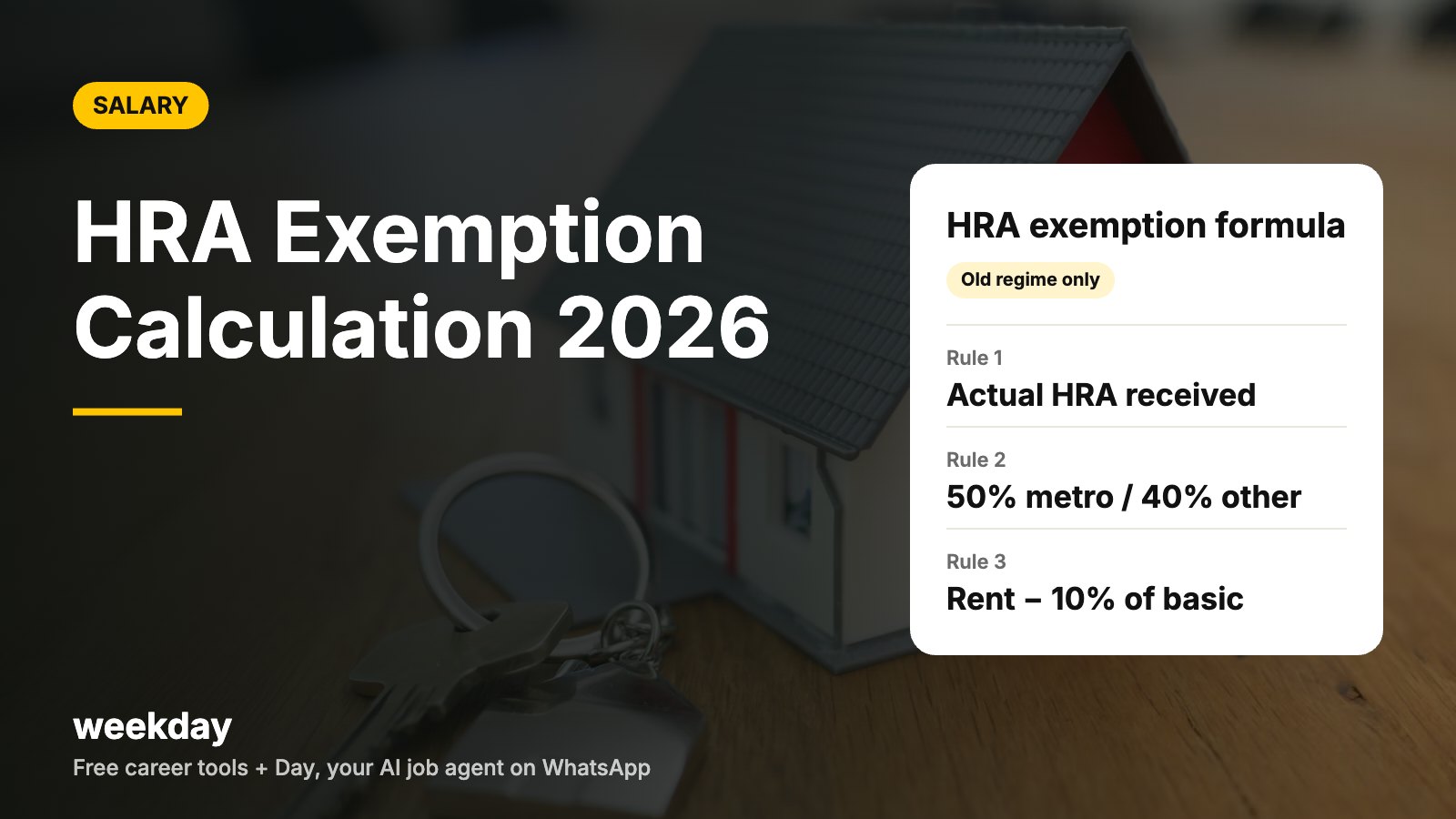
House Rent Allowance is the part of your salary meant to cover rent. The tax law doesn't make all of it tax-free. It takes three numbers for the year and exempts only the smallest one.
The formula
Tax-free HRA = LOWEST of:
  (a) Actual HRA received
  (b) 50% of (Basic + DA) for metro cities, 40% for other cities
  (c) Rent paid − 10% of (Basic + DA)

Taxable HRA = Actual HRA − Tax-free HRA
| Term | What it means | Tip |
|---|---|---|
| Basic + DA | Basic pay plus dearness allowance, where DA counts for retirement benefits. Commission fixed as a % of sales can also count. | Use the figures on your payslip, not your CTC |
| Actual HRA | The HRA component paid to you for the months you rented | If you rented for 8 months, use 8 months of HRA |
| Rent paid | Rent you actually paid, not maintenance or electricity unless included in rent | Keep bank transfer records |
| Metro / non-metro | Based on the city where you live and pay rent, not where your office is | Gurugram, Noida and Navi Mumbai have traditionally been treated as non-metro |
Which cities count as metro?
For decades, only four cities got the 50% rate: Delhi, Mumbai, Kolkata and Chennai. Bengaluru, Hyderabad, Pune and Ahmedabad were treated as non-metro (40%), even though rents there are just as high.
Draft rules under the new Income-tax Act, 2025 proposed adding Bengaluru, Hyderabad, Pune and Ahmedabad to the 50% list. Check the final notified rules and your employer's payroll declaration for FY 2026-27 before you rely on 50% in those cities. The examples below use the traditional four-city list.
4 worked examples
Example 1: Metro city (Mumbai)
Riya, software engineer in Mumbai
Monthly basic + DA: ₹50,000   → yearly ₹6,00,000
Monthly HRA:        ₹25,000   → yearly ₹3,00,000
Monthly rent:       ₹25,000   → yearly ₹3,00,000

(a) Actual HRA                    = ₹3,00,000
(b) 50% of basic + DA             = ₹3,00,000
(c) Rent − 10% of basic + DA      = 3,00,000 − 60,000 = ₹2,40,000

Tax-free HRA = ₹2,40,000
Taxable HRA  = 3,00,000 − 2,40,000 = ₹60,000

Tax saved at 30% slab + 4% cess: 2,40,000 × 31.2% ≈ ₹74,880
Rule (c) wins here. Riya could raise her exemption only by paying more rent, not by asking for more HRA.
Example 2: Non-metro city (Pune)
Aman, analyst in Pune
Monthly basic + DA: ₹40,000   → yearly ₹4,80,000
Monthly HRA:        ₹20,000   → yearly ₹2,40,000
Monthly rent:       ₹18,000   → yearly ₹2,16,000

(a) Actual HRA                    = ₹2,40,000
(b) 40% of basic + DA             = ₹1,92,000
(c) Rent − 10% of basic + DA      = 2,16,000 − 48,000 = ₹1,68,000

Tax-free HRA = ₹1,68,000
Taxable HRA  = 2,40,000 − 1,68,000 = ₹72,000
If Pune moves to the 50% list, rule (b) becomes ₹2,40,000, but rule (c) is still ₹1,68,000, so Aman's exemption doesn't change. The 50% change helps only people whose rent is high relative to basic.
Example 3: Paying rent to parents (Delhi)
Neha, living with her parents
Monthly basic + DA: ₹35,000   → yearly ₹4,20,000
Monthly HRA:        ₹14,000   → yearly ₹1,68,000
Rent paid to mother (owner of the flat): ₹15,000 a month → ₹1,80,000 a year

(a) Actual HRA                    = ₹1,68,000
(b) 50% of basic + DA             = ₹2,10,000
(c) Rent − 10% of basic + DA      = 1,80,000 − 42,000 = ₹1,38,000

Tax-free HRA = ₹1,38,000

Mother's side: rental income ₹1,80,000, less 30% standard deduction = ₹1,26,000 taxable.
If her total income is below the tax-free limit, she pays no tax.
Rent is above ₹1 lakh, so her PAN must be given to the employer.
This is legal when it's genuine. The parent must own the house, the money must actually move (bank transfer is best), there should be a rent agreement, and the parent must show the rent in their income tax return. Paying rent to your spouse is usually questioned by the tax department, so avoid it.
Example 4: No rent receipt
Kunal, sales executive in Jaipur
Monthly basic + DA: ₹45,000   → yearly ₹5,40,000
Monthly HRA:        ₹15,000   → yearly ₹1,80,000
Rent: ₹20,000 a month, paid in cash, no receipts, no agreement

Employer's view: no proof → entire ₹1,80,000 HRA is taxed in TDS.
Extra tax at 20% slab + 4% cess: 1,80,000 × 20.8% = ₹37,440

With proof (receipts + agreement + landlord PAN):
(c) Rent − 10% = 2,40,000 − 54,000 = ₹1,86,000
(b) 40%        = ₹2,16,000
(a) Actual     = ₹1,80,000
Tax-free HRA = ₹1,80,000 → the ₹37,440 is saved.
If you missed the employer's proof deadline but have proof, you can still claim HRA when you file your ITR under the old regime and get a refund. Keep the documents for at least six years in case of a notice. If you have no proof at all, don't claim it: HRA claims are a common reason for tax notices.
Quick reference: exemption at common salaries
| Monthly basic + DA | Monthly HRA | Monthly rent | City | Yearly tax-free HRA |
|---|---|---|---|---|
| ₹20,000 | ₹8,000 | ₹10,000 | Non-metro | ₹96,000 |
| ₹30,000 | ₹15,000 | ₹15,000 | Metro | ₹1,44,000 |
| ₹40,000 | ₹16,000 | ₹22,000 | Non-metro | ₹1,92,000 |
| ₹60,000 | ₹30,000 | ₹35,000 | Metro | ₹3,48,000 |
| ₹80,000 | ₹32,000 | ₹30,000 | Non-metro | ₹2,64,000 |
| ₹1,00,000 | ₹50,000 | ₹60,000 | Metro | ₹6,00,000 |
Each row takes the lowest of the three rules for 12 months. For example, row 4: actual HRA ₹3,60,000; 50% ₹3,60,000; rent minus 10% ₹4,20,000 − ₹72,000 = ₹3,48,000.
Rent receipts and the landlord PAN rule
| Your yearly rent | What your employer will usually ask for |
|---|---|
| Up to ₹36,000 (₹3,000 a month) | A self-declaration is often enough |
| ₹36,001 to ₹1,00,000 | Rent receipts (monthly or quarterly) and often the rent agreement |
| Above ₹1,00,000 | Rent receipts plus the landlord's PAN. If the landlord has no PAN, a signed declaration from them saying so |
| Above ₹50,000 a month | You (the tenant) must also deduct TDS on rent and file Form 26QC; check the current rate before paying |
Rent receipt format (copy-ready)
RENT RECEIPT

Received from Mr Kunal Sharma the sum of ₹20,000 (Rupees Twenty Thousand only) as rent for the month of October 2026 for the residential property at Flat 204, Shanti Apartments, Malviya Nagar, Jaipur – 302017.

Payment mode: Bank transfer (UPI ref 6281XXXX4410) on 3 October 2026

Landlord: Ramesh Gupta
Landlord PAN: ABCPG1234K
Signature: ____________
Date: 3 October 2026

(Affix a revenue stamp if paid in cash above ₹5,000)
HRA in the old vs new tax regime
| Old regime | New regime (default) | |
|---|---|---|
| HRA exemption | Yes, lowest of three rules | No. All HRA is taxable |
| Section 80GG (no HRA in salary) | Yes | No |
| Standard deduction | ₹50,000 | ₹75,000 |
| Other deductions (80C, 80D, home loan interest on self-occupied house) | Yes | Mostly no |
| Who it suits | People with high rent plus 80C, 80D and home loan claims | Most people with few deductions |
Under the new regime, salaried income up to about ₹12.75 lakh is effectively tax-free after the standard deduction and rebate, so many people under that level gain nothing from HRA. Above it, add up your HRA exemption and other deductions and compare both regimes before you declare one to payroll. Check your monthly take-home on either regime with the in-hand salary calculator.
No HRA in your salary? Claim Section 80GG
Self-employed people and employees whose salary has no HRA component can claim rent under Section 80GG in the old regime, if neither they nor their spouse or minor child own a house in the city where they live. You file Form 10BA with your return.
Section 80GG formula
Deduction = LOWEST of:
  (a) ₹5,000 a month (₹60,000 a year)
  (b) 25% of adjusted total income
  (c) Rent paid − 10% of adjusted total income

Example: income ₹6,00,000, rent ₹1,20,000
(a) ₹60,000  (b) ₹1,50,000  (c) 1,20,000 − 60,000 = ₹60,000
Deduction = ₹60,000
Special cases
| Situation | How HRA works |
|---|---|
| You changed cities mid-year | Calculate month by month. Use 50% for metro months and 40% for others, then add up |
| Rent changed mid-year | Use the actual rent for each month, not an average |
| Home loan and HRA together | Both are allowed if you live in a rented home and your own house is in another city, or is let out or under construction |
| Sharing a flat | Each person claims only the rent they personally pay, with receipts in their own name |
| Living in your own house | No HRA exemption. All HRA is taxable |
| Paying rent to spouse | Usually rejected by the tax department; avoid |
Mistakes that get HRA claims rejected
- Using CTC or gross salary instead of basic + DA in the formula.
- Claiming 50% for Bengaluru, Pune or Hyderabad without checking the current notified rules.
- Rent paid in cash with no receipts or agreement.
- Missing landlord PAN when rent is above ₹1 lakh a year.
- Fake receipts from a relative who doesn't own the house or doesn't declare the income.
- Choosing the new regime and still expecting HRA to be exempt.
HRA shows up on your salary slip every month and is summarised in Form 16 at year end, so check both match what you declared.
FAQs
How is HRA exemption calculated?
It's the lowest of: actual HRA received, 50% of basic + DA (40% in non-metro cities), and rent paid minus 10% of basic + DA.
Which cities get 50% HRA exemption?
Traditionally Delhi, Mumbai, Kolkata and Chennai. Draft rules under the Income-tax Act, 2025 proposed adding Bengaluru, Hyderabad, Pune and Ahmedabad; check the final rules for FY 2026-27.
Can I claim HRA in the new tax regime?
No. HRA exemption is available only under the old regime. In the new regime, all HRA is taxable.
Is landlord PAN mandatory for HRA?
Yes, if annual rent is above ₹1 lakh. If the landlord has no PAN, they can give a signed declaration.
Can I claim HRA if I pay rent to my parents?
Yes, if the parent owns the house, you actually pay the rent, there is a rent agreement, and the parent declares it as income.
Can I claim HRA without rent receipts?
Employers usually need receipts above ₹3,000 a month. Without any proof, you shouldn't claim it. If you have proof but missed the payroll deadline, claim it in your ITR.
Can I claim HRA and home loan benefits together?
Yes, in some cases, such as when your own house is in another city or is let out, and you rent where you work.
What if my salary doesn't include HRA?
You may be able to claim up to ₹60,000 a year under Section 80GG in the old regime, by filing Form 10BA.
Is HRA calculated on CTC?
No. The 40%/50% and 10% rules use basic + DA only.
Do I need to pay TDS on rent?
Only if your rent is above ₹50,000 a month. Then you deduct TDS and file Form 26QC; check the current rate.