Last updated: 9 November 2026
- What Form 16 is, and who gets one
- Part A vs Part B in one table
- How to read Form 16: a line-by-line annotated example
- When it's issued and how to download it
- Two Form 16s after a job switch: a worked example
- Form 16 vs 16A vs 26AS vs AIS
- Mistakes to check before you file
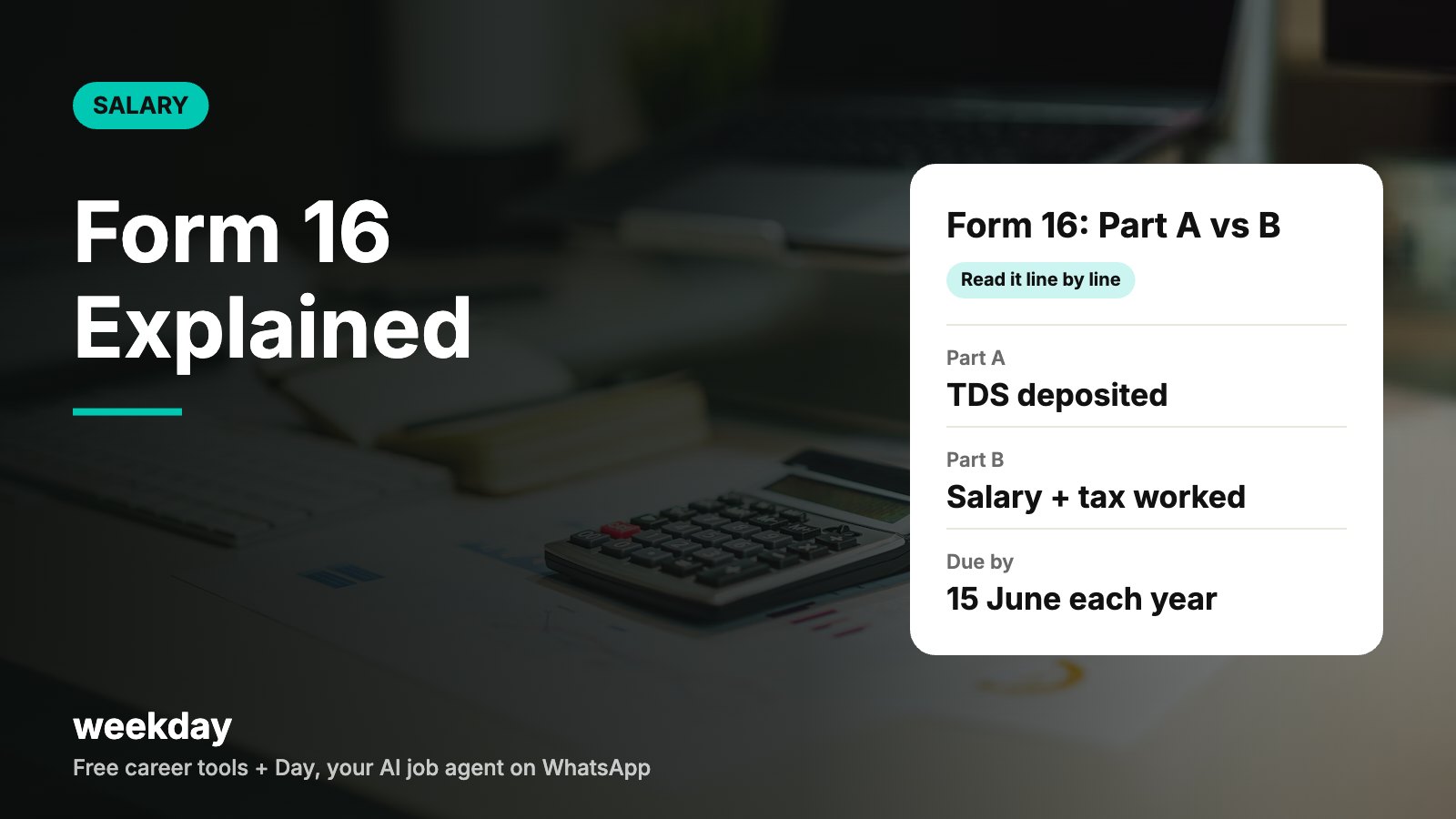
- Issued by your employer (the deductor) once a year, by 15 June after the financial year. For FY 2025-26, that was 15 June 2026.
- Part A is generated and downloaded by the employer from TRACES; employees can't download Form 16 from TRACES themselves.
- New tax regime: ₹75,000 standard deduction; no tax up to ₹12 lakh taxable income because of the Section 87A rebate.
- The usual ITR due date for salaried people is 31 July (check for extensions each year).
- The new Income-tax Act, 2025 applies from 1 April 2026. Forms are being renumbered under the new rules, so the certificate for FY 2026-27 may carry a new form number. Check with your employer or CA.
Sources: Income Tax Act, 1961, Sections 192 and 203, Rule 31; Income-tax Act, 2025; TRACES; Income Tax Department e-filing portal.
Day, Weekday's free AI job agent, finds jobs that match your skills and pay, and applies when you say yes. On WhatsApp.
Say hi to Day on WhatsAppHow Day works →What Form 16 is, and who gets one
If your employer deducted tax from your salary during the year, it must give you a Form 16. It is your proof that the tax was deducted and deposited with the government in your name. When you file your return, the numbers in Form 16 should match what the tax department shows in your Form 26AS and AIS.
If no tax was deducted (for example, your taxable income was under ₹12 lakh in the new regime), many employers still issue a Form 16 Part B or a salary statement. It isn't strictly required when there's no TDS, but it's useful. Ask for it.
Part A vs Part B
| Part A | Part B | |
|---|---|---|
| What it shows | Employer and employee details, TDS deducted and deposited each quarter | Full salary breakup and how your tax was calculated |
| Key items | Employer TAN and PAN, your PAN, assessment year, period of employment, receipt numbers of quarterly TDS returns | Gross salary, exemptions (Section 10), standard deduction, Chapter VI-A deductions, taxable income, tax, rebate, cess |
| Who creates it | Generated on TRACES by the employer | Prepared by the employer (payroll software); an annexure to Part A |
| Has a unique certificate number? | Yes, from TRACES | No |
| Use it to | Check TDS against Form 26AS | Fill the salary schedule of your ITR |
Some employers also attach Form 12BA, which lists perquisites such as a company car, ESOPs or interest-free loans. If you have perks, check that they appear there and in Part B.
How to read Form 16: a line-by-line example
Here is Part B for an employee on a ₹9 LPA package for FY 2025-26 (basic ₹4,50,000, HRA ₹1,80,000, special allowance ₹1,36,755, variable pay ₹90,000 paid in full) under the new tax regime. Employer PF and gratuity are not part of taxable salary here.
Sample Form 16 Part B: ₹9 LPA, new regime
PART B (Annexure) – FY 2025-26, AY 2026-27
Whether opting out of taxation u/s 115BAC(1A)? ......... NO

1. Gross salary
   (a) Salary as per section 17(1) ................. 8,56,755
   (b) Value of perquisites u/s 17(2) ...................... 0
   (c) Profits in lieu of salary u/s 17(3) ................. 0
   (d) Total ..................................... 8,56,755
2. Less: allowances exempt u/s 10 ......................... 0
3. Total salary received from current employer ..... 8,56,755
4. Deductions u/s 16
   (a) Standard deduction u/s 16(ia) ................ 75,000
   (c) Tax on employment (professional tax) ............. 0
5. Total deductions u/s 16 .......................... 75,000
6. Income chargeable under 'Salaries' ........... 7,81,755
9. Gross total income ........................... 7,81,755
10. Deductions under Chapter VI-A ........................ 0
12. Total taxable income (rounded) .............. 7,81,760
13. Tax on total income ............................ 19,088
14. Rebate u/s 87A ................................. 19,088
16. Health and education cess ............................ 0
19. Net tax payable ...................................... 0
| Line | What it means | What to check |
|---|---|---|
| Opting out of 115BAC(1A)? NO | You stayed in the new (default) regime | Matches the regime you told payroll |
| 1(a) Salary u/s 17(1) | Basic + HRA + allowances + bonus paid in the year | Sum of 12 payslips' gross + any bonus/arrears |
| 2. Exempt allowances | HRA, LTA exemptions (old regime only) | Zero in the new regime; filled in the old regime if you claimed them |
| 4(a) Standard deduction | Flat ₹75,000 (new regime) or ₹50,000 (old regime) | Claimed once, even with two employers |
| 4(c) Professional tax | Deductible only in the old regime | Shows 0 in the new regime even though ₹2,400 was deducted |
| 10. Chapter VI-A | 80C, 80D etc. (old regime); 80CCD(2) employer NPS (both) | Only proofs you submitted appear |
| 13–14. Tax and rebate | ₹3,81,760 above ₹4 lakh × 5% = ₹19,088, fully rebated | Rebate applies up to ₹12 lakh taxable income |
| 19. Net tax payable | Tax your employer should have deducted | Matches total TDS in Part A |
Part A for a ₹15 LPA employee
For a ₹15 LPA package with ₹1,50,000 variable pay, taxable income is about ₹13,67,325 and tax with cess is about ₹88,503. Part A would show TDS spread across the four quarters:
| Quarter | Months | TDS deducted and deposited (₹) |
|---|---|---|
| Q1 | April–June | 22,125 |
| Q2 | July–September | 22,125 |
| Q3 | October–December | 22,125 |
| Q4 | January–March | 22,128 |
| Total | 88,503 |
Each quarter also lists a receipt number for the employer's TDS return (Form 24Q). If a quarter is missing or lower than your payslips show, your employer may not have deposited or reported it. Raise it with payroll before you file.
When Form 16 is issued, and how to get it
| Question | Answer |
|---|---|
| Deadline | 15 June after the financial year (e.g. 15 June 2026 for FY 2025-26) |
| Where you get it | Your HR/payroll portal, or by email as a PDF (often password-protected with PAN + date of birth) |
| Can I download it from TRACES? | No. TRACES is for employers (deductors). You can see your TDS in Form 26AS on the e-filing portal |
| Left the company? | Your old employer still issues it for the months you worked. Email HR; use the ex-employee portal if there is one |
| Digitally signed? | Usually yes; a digital signature is valid, no stamp needed |
| Employer won't issue it | File using Form 26AS, AIS and payslips; employers can be penalised for not issuing it |
Email to request Form 16 from a previous employer
Subject: Request for Form 16 – FY 2025-26 – Rohan Mehta (PAN ABCPM1234K)

Dear HR / Payroll team,

I worked at ABC Technologies from 1 April 2025 to 31 August 2025. Could you please share my Form 16 (Part A and Part B) for FY 2025-26? I need it to file my income tax return before 31 July.

PAN: ABCPM1234K
Employee ID: ABC1042

Thank you,
Rohan Mehta
Two Form 16s after a job switch
If you changed jobs during the year, you'll get one Form 16 from each employer. The trap: each employer calculates tax as if its salary were your only income. Each gives you the ₹75,000 standard deduction and, at lower salaries, the full 87A rebate. Together, you can end up owing tax.
Worked example: why two Form 16s can mean a tax bill
Employer A (Apr–Sep): ₹1,00,000 × 6 = ₹6,00,000
  Taxable after std deduction: ₹5,25,000 → tax ₹6,250 → rebated → TDS ₹0

Employer B (Oct–Mar): ₹1,40,000 × 6 = ₹8,40,000
  (not told about previous salary)
  Taxable after std deduction: ₹7,65,000 → tax ₹18,250 → rebated → TDS ₹0

Actual total: ₹14,40,000 − ₹75,000 (once) = ₹13,65,000 taxable
  Tax: 20,000 + 40,000 + (1,65,000 × 15%) = ₹84,750
  Plus 4% cess = ₹88,140
  TDS already paid: ₹0
  You owe: ₹88,140 (plus interest if paid late)
- Tell your new employer about your previous salary and TDS using Form 12B (or their portal's previous-employment section) as soon as you join.
- In your ITR, add the salaries from both Form 16s and claim the standard deduction once.
- Pay any balance as self-assessment tax before filing.
- Check that total TDS in your ITR matches Form 26AS for both employers' TANs.
Leaving mid-year? Your Form 16 sits alongside your full and final settlement, and leave encashment or notice pay in the final month will show up in salary under 17(1).
Form 16 vs Form 16A vs Form 26AS vs AIS
| Document | Who issues it | What it covers | How often |
|---|---|---|---|
| Form 16 | Employer | TDS on salary | Yearly, by 15 June |
| Form 16A | Bank, client, tenant company or any non-salary deductor | TDS on interest, professional fees, rent, commission | Quarterly |
| Form 16B / 16C | Buyer of property / tenant (individual) | TDS on property purchase / high rent | Per transaction / yearly |
| Form 26AS | Income Tax Department | All TDS/TCS against your PAN, advance tax, refunds | Updated continuously |
| AIS | Income Tax Department | Wider view: TDS plus interest, dividends, securities trades, high-value transactions | Updated continuously |
| TIS | Income Tax Department | Summary of AIS by income type, used to pre-fill the ITR | Updated continuously |
Simple rule: Form 16 is what your employer says; 26AS and AIS are what the tax department sees. Before filing, all three should agree. If they don't, the tax department's records usually win, so get your employer to correct its TDS return.
Mistakes to check before you file
| Mistake | How to spot it | Fix |
|---|---|---|
| Wrong PAN on Form 16 | TDS missing in 26AS | Ask employer to file a correction statement |
| TDS in Part A ≠ 26AS | Compare quarter by quarter | Employer corrects its Form 24Q |
| Regime differs from what you chose | Check the 115BAC line | You can choose the regime in your ITR (rules differ if you have business income) |
| HRA/80C missing in old regime | Part B lines 2 and 10 are zero | Claim in your ITR if you have proof; keep rent receipts |
| Standard deduction claimed twice | Two Form 16s | Claim once in your ITR |
| Perquisites not shown | No Form 12BA despite ESOPs or a car | Ask payroll; include them in your ITR |
For how HRA exemption is worked out in the old regime, see our HRA exemption calculation guide. To see how monthly payslips build up to the Form 16 total, read the salary slip format guide.
FAQs
What is Form 16?
An annual certificate from your employer showing the tax deducted from your salary and deposited with the government, plus how that tax was calculated.
What is the difference between Part A and Part B of Form 16?
Part A has employer and employee details and quarterly TDS deposits, generated on TRACES. Part B has your salary breakup, exemptions, deductions and tax calculation.
When is Form 16 issued?
By 15 June after the end of the financial year. For FY 2025-26, the deadline was 15 June 2026.
Can I download Form 16 myself from TRACES?
No. Only employers download it from TRACES. You get it from your employer; you can see your TDS in Form 26AS on the e-filing portal.
Can I file ITR without Form 16?
Yes. Use your payslips, Form 26AS and AIS to report salary and TDS correctly.
What if I have two Form 16s?
Add both salaries in your ITR, claim the standard deduction once, and pay any extra tax due as self-assessment tax before filing.
Will I get Form 16 if no tax was deducted?
It isn't strictly required when there's no TDS, but many employers still issue Part B or a salary statement. Ask HR.
What is the difference between Form 16 and Form 16A?
Form 16 is for TDS on salary. Form 16A is for TDS on other income, such as bank interest or professional fees.
Is Form 16 the same as Form 26AS?
No. Form 16 comes from your employer. Form 26AS is the tax department's statement of all tax credited against your PAN.
Will Form 16 change under the new Income-tax Act?
The Income-tax Act, 2025 applies from 1 April 2026 and forms are being renumbered, so the certificate for FY 2026-27 may have a new number. The purpose stays the same; check with your employer or CA.