Last updated: 20 November 2026
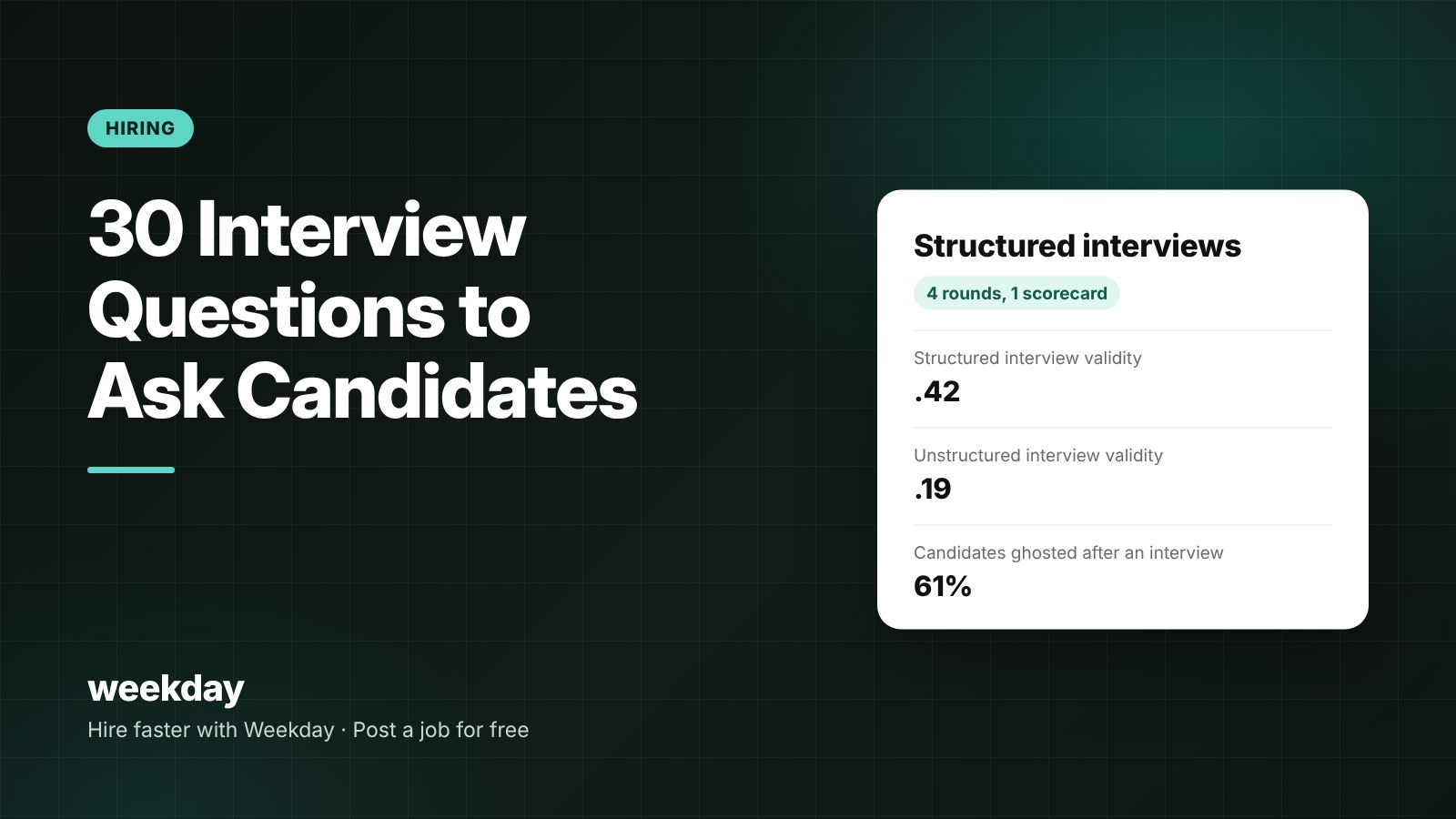
Quick answer: Ask every candidate the same core questions, mix behavioural questions ("Tell me about a time...") with practical ones ("How would you..."), and score answers on a simple 1–4 scale. Research backs this: in a 2022 meta-analysis, structured interviews predicted job performance better than any other common hiring method (validity .42, against .19 for unstructured interviews). Below are 30 questions by round, with what a good answer sounds like, and the questions you should not ask.
Most hiring mistakes start in the interview. Interviewers ask whatever comes to mind, each candidate gets different questions, and the decision comes down to who "felt right". A short list of good questions, asked the same way every time, fixes most of that.
Why the same questions matter
A large 2022 meta-analysis by Sackett and colleagues found structured interviews had the highest average validity of common selection methods, at .42, compared with .19 for unstructured interviews and .31 for cognitive ability tests (SIOP summary of Sackett et al., 2022).
Google, which uses structured interviews, says pre-made questions and rubrics save interviewers an average of 40 minutes per interview, and that rejected candidates who had a structured interview were 35% happier than those who did not (Google re:Work).
Round 1: Screening questions (phone or video, 20–30 minutes)
| # | Question | A good answer sounds like |
|---|---|---|
| 1 | What made you apply for this role? | Specific reasons linked to the work, not just "growth" |
| 2 | Walk me through your current role in two minutes. | Clear scope, real outcomes, numbers where possible |
| 3 | What are you looking for in your next job that you do not have now? | Honest and matches what you offer |
| 4 | What salary range are you expecting? | A range that fits your band (share yours first if you can) |
| 5 | What is your notice period, and when could you start? | A clear date; mentions buyout options if relevant |
| 6 | Which parts of this job description excite you, and which worry you? | Self-aware; names real gaps |
Round 2: Behavioural questions (past behaviour, 45 minutes)
Ask for one real example each time. Follow up with "What did you do?" and "What happened next?"
| # | Question | A good answer sounds like |
|---|---|---|
| 7 | Tell me about a project you are proud of. What was your part? | Uses "I" for their own work, not only "we" |
| 8 | Tell me about a time you missed a deadline. | Owns the miss, explains what changed afterwards |
| 9 | Describe a disagreement with a manager or teammate. | Respectful, focused on the problem, clear outcome |
| 10 | Tell me about a time you got tough feedback. | Specific feedback and a specific change |
| 11 | Tell me about a time your behaviour had a positive impact on your team. | Concrete action and result (a Google example question) |
| 12 | Describe a time you had to learn something fast. | A clear method, not "I just figured it out" |
| 13 | Tell me about a decision you made with incomplete information. | Explains trade-offs and how they reduced risk |
| 14 | Tell me about a mistake that reached a customer. | Honest, shows how they fixed it and prevented a repeat |
| 15 | Describe a time you improved a process nobody asked you to fix. | Initiative with a measurable result |
| 16 | Tell me about the hardest problem you solved in the last year. | Depth, clear reasoning, real constraints |
Round 3: Role and skill questions (practical, 45–60 minutes)
Adapt these to the job. Pair them with a short work sample where you can.
| # | Question | A good answer sounds like |
|---|---|---|
| 17 | If you joined next Monday, what would you do in your first 30 days? | Listens and learns first, then a small early win |
| 18 | How would you approach [a real problem your team has now]? | Asks clarifying questions before solving |
| 19 | How do you decide what to work on when everything is urgent? | A clear way to prioritise and say no |
| 20 | How do you check that your work is correct before you ship it? | Concrete checks, tests or reviews |
| 21 | Explain [a core concept in the role] to someone outside your field. | Simple, accurate, uses an example |
| 22 | What would you measure to know you are doing well in this role? | Sensible metrics tied to the business |
| 23 | Here is a piece of work with problems. What would you change? | Spots the important issues first, not just style |
| 24 | What tools or methods have you stopped using, and why? | Shows judgement and learning |
Role-specific question banks help here. For engineering roles, see our guides on hiring Python, React and data science talent.
Round 4: Motivation and closing questions (15 minutes)
| # | Question | A good answer sounds like |
|---|---|---|
| 25 | What kind of manager helps you do your best work? | Specific and realistic |
| 26 | What would make you leave a job within six months? | Honest; tells you about fit |
| 27 | Where do you want to be in two to three years? | A direction this role can support |
| 28 | What other roles are you considering? | Open about the competition and timeline |
| 29 | Is there anything that would stop you from accepting an offer? | Surfaces blockers (pay, location, notice) early |
| 30 | What questions do you have for us? | Thoughtful questions about the work and team |
How to score answers
Use one simple scale for every question:
- 4 – Strong: specific example, clear actions, good result, would raise the bar
- 3 – Good: solid example with minor gaps
- 2 – Weak: vague, general or mostly "we"
- 1 – Concern: no example, or a red flag
Each interviewer scores on their own before discussing. Weekday's free interview scorecard generator builds a scorecard for your role, and our structured interview guide explains the full process.
Questions you should not ask
In the US, the EEOC says information about race, sex, national origin, age and religion is irrelevant to hiring decisions, that employers are explicitly prohibited from asking about disability before an offer, and that employers should not ask for a photograph (EEOC). Questions about marital status, number of children, pregnancy or child care can be used as evidence of discrimination (EEOC).
| Avoid | Ask instead |
|---|---|
| "How old are you?" | Nothing; age is not relevant to the job |
| "Are you married? Do you have kids?" | "This role needs travel twice a month. Is that workable?" |
| "Do you have any health issues?" | "Can you perform the essential duties of this job, with or without accommodation?" |
| "Where are you originally from?" | "Are you legally allowed to work in this country?" |
In India, the labour codes in force since November 2025 prohibit gender discrimination in recruitment (PIB). Keep every question about the job.
Do not lose good candidates after the interview
In a Greenhouse survey of 2,500 workers in the US, UK and Germany, 61% said they had been ghosted after an interview (Greenhouse, December 2024). Tell every candidate when they will hear back, and keep that promise. Faster decisions also help: see our time to hire benchmarks.
Need more good candidates to interview?
Post your role on Weekday for free. Our AI sourcing agent scans 400M+ profiles, picks the best matches and reaches out on email and WhatsApp until they reply. Your first role includes 200 reach-outs, with no credit card.
Post a free jobFAQ
What are good interview questions to ask candidates?
Mix screening questions (motivation, pay, notice), behavioural questions that ask for real past examples, practical questions about how they would handle your actual problems, and closing questions about what could stop them accepting an offer.
How many questions should I ask in an interview?
Around 6–10 well-chosen questions per 45-minute round, with follow-ups. Depth on a few real examples tells you more than many quick answers.
Why should every candidate get the same questions?
It makes answers comparable and reduces bias. A 2022 meta-analysis found structured interviews had a validity of .42 for predicting job performance, against .19 for unstructured interviews.
What questions are illegal to ask in an interview?
In the US, avoid questions about race, religion, national origin, age, disability before an offer, pregnancy, marital status and children. Ask only about the job and whether the candidate can do it.
How do I score interview answers?
Use a simple 1–4 scale for each question, from concern to strong, and have each interviewer score independently before the group discusses.
Sources
- SIOP: summary of Sackett et al. (2022), Journal of Applied Psychology
- Google re:Work: guide to structured interviewing
- EEOC: prohibited employment policies and practices and pre-employment inquiries on marital status and children
- PIB: labour codes and non-discrimination (December 2025)
- Greenhouse candidate survey (December 2024)