
Last updated: 18 November 2026
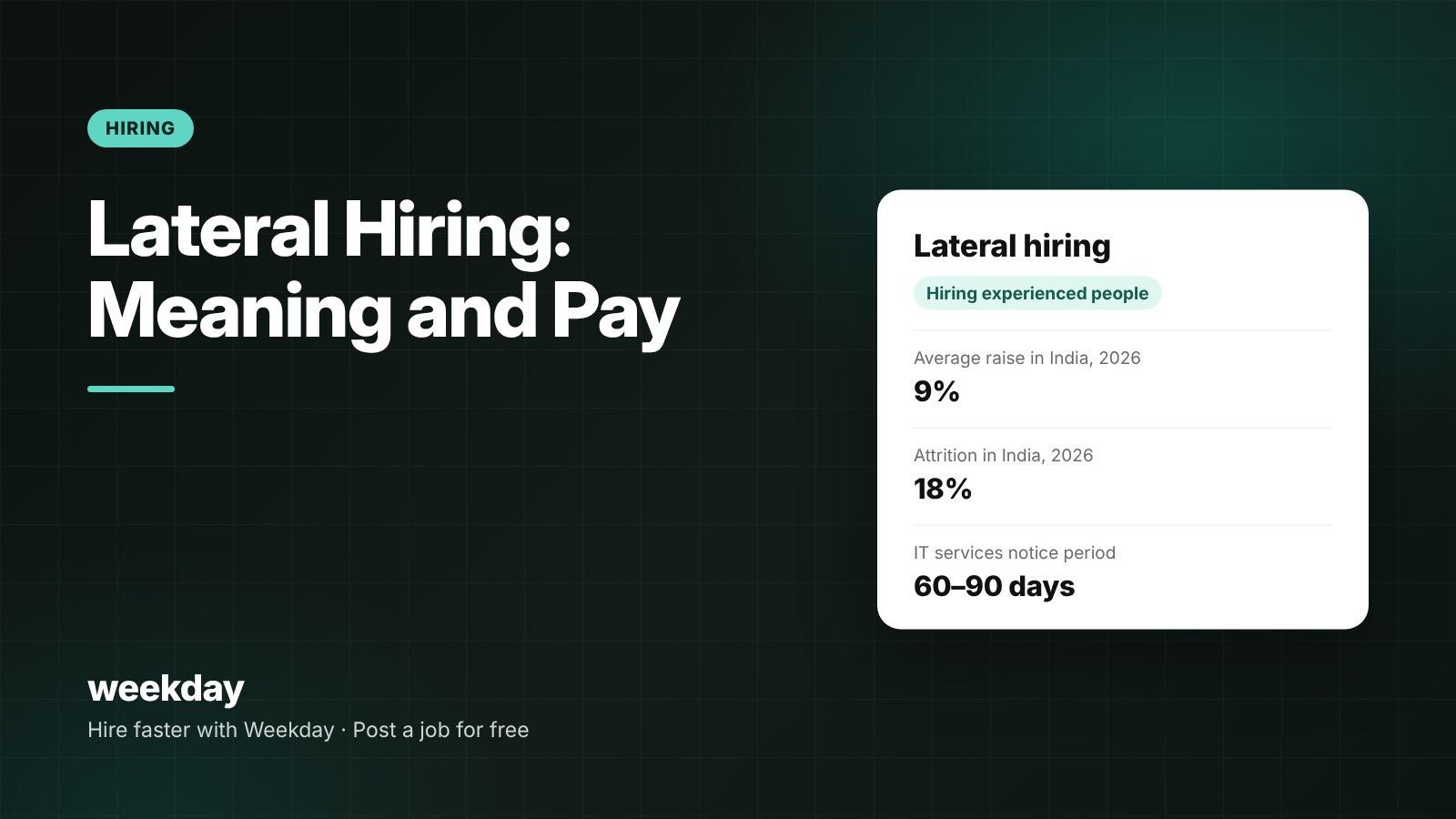
Quick answer: Lateral hiring means hiring experienced professionals who already work at another company, usually into a similar or slightly bigger role, instead of training freshers from campus. Example: a Bengaluru startup hires a backend engineer with five years at an IT services firm. Plan for three things: an offer that clearly beats staying put (Aon reports a 9% average raise in India in 2026), a notice period of 30–90 days, and outreach to people who are not actively applying.
Most growing companies hire laterally all the time, even if they don't use the word. Every time you replace someone who left, open a senior role or start a new team, you are making a lateral hire. Here is what the term means, how it differs from campus hiring, what to pay and a process that works.
What is lateral hiring?
A lateral hire is someone who joins from another company with relevant work experience. "Lateral" means sideways: the person moves across from a peer company into a role at roughly their level, rather than starting at entry level.
- Lateral hire: a product manager with 6 years at a fintech joins your company as a senior PM.
- Not a lateral hire: a final-year student who joins through a campus drive.
- Also not a lateral hire: an internal employee who moves to a new team. That is an internal move. Our guide to internal vs external candidates covers when to promote from within instead.
In law firms and consulting, "lateral" often refers to partners or senior staff moving between firms. In tech and startups, it simply means any experienced hire from outside.
Lateral hiring vs campus hiring
| Lateral hiring | Campus hiring | |
|---|---|---|
| Who | Experienced professionals working elsewhere | Final-year students and fresh graduates |
| Best for | Senior roles, urgent work, niche skills, replacing leavers | Building a pipeline, entry-level roles, long-term culture |
| Time to join | Weeks to months (notice periods) | Fixed by the academic calendar |
| Time to impact | Faster: they have done the job before | Slower: needs training |
| Cost | Higher pay, possible buyout or agency fee | Lower pay, plus training time |
| Main risk | Counter-offers and drop-offs during notice period | Skill gaps and early attrition |
Most teams need both. A common mix is lateral hires for leads and senior engineers, and freshers who learn from them.
When lateral hiring makes sense
- Replacing leavers. Aon's 2026-27 India survey of more than 1,200 organisations found overall attrition rose to 18% in 2026, from 16.2% in 2025 (Aon). Most of those seats are filled laterally.
- Starting a new function. Your first data, DevOps or sales leader should have done it before.
- Deadlines. If a launch depends on the role, you can't wait months for a fresher to ramp up.
- Niche skills. AI, security or payments experience is rare among freshers.
Pay benchmarks for lateral hires
Lateral candidates compare your offer with two things: their current CTC and the raise they would get by staying. Aon reports an average salary increase of 9% in India in 2026 and projects 9.1% for 2027. Technology platform and product companies gave 9.5% on average in 2026, against 6.6% at technology consulting and services firms (Aon). Your offer has to beat staying by a clear margin, or the candidate's manager will match it.
Pay by experience at large employers shows where many lateral candidates start from. Median fixed pay on Weekday's salary data (November 2026):
| Experience | TCS | Infosys | Accenture |
|---|---|---|---|
| 0–1 years | ₹4.3 LPA | ₹5 LPA | ₹4.5 LPA |
| 2–3 years | ₹4.5 LPA | ₹5 LPA | ₹5.5 LPA |
| 4–6 years | ₹5 LPA | ₹6 LPA | ₹7 LPA |
| 7–9 years | ₹8 LPA | ₹9.8 LPA | ₹11 LPA |
| 10+ years | ₹14 LPA | ₹15 LPA | ₹16.5 LPA |
Read this table as a starting point, not a cap. Pay rises slowly in the early years at large services firms, which is one reason strong engineers with 3–6 years look for lateral moves. Benchmark the role you are hiring for, not just the person's current CTC. For a role-level view, Weekday's salary pages show, for example, that DevOps engineers at TCS earn a median of ₹6.5 LPA fixed, while Weekday's DevOps guide puts 2–4 years of experience at ₹12–22 LPA across the market (TCS DevOps, DevOps salary guide).
To show a candidate what your offer means against their current pay, use Weekday's free salary hike calculator.
A 6-step lateral hiring process
- Define the role and level. Write down the three outcomes you expect in the first six months. This decides the level, and the level decides the pay band.
- Set the pay band before sourcing. Use the benchmarks above and your own data. Fix fixed pay, variable pay and any joining bonus range up front.
- Source actively. The best lateral candidates are usually employed and not applying. Use referrals, targeted outreach and searches built with a tool like Weekday's Boolean string builder.
- Assess with real work. Use structured rounds and a work sample close to the job. Experienced people should be judged on what they built and decided, not on textbook questions.
- Make a clear offer. Ask for current CTC, expected CTC and notice period early. Explain the full CTC breakup and the monthly in-hand figure.
- Manage the notice period. This is where most lateral hires are lost. Stay in touch every week, share onboarding plans and be ready for a counter-offer conversation.
Notice periods: plan for the wait
Typical notice periods in India, from Weekday's notice period guide:
| Current employer | Typical notice | Buyout allowed? |
|---|---|---|
| Early-stage startup | 15–30 days | Sometimes |
| Product company / SaaS | 30–60 days | Often |
| Large IT services | 60–90 days | Varies by company and level |
| MNC / GCC | 60–90 days | Sometimes |
| Director / VP and above | 90–180 days | Rarely |
If you need someone sooner, discuss a notice buyout or early release. Candidates can check their last working day with Weekday's notice period calculator.
Risks and how to reduce them
- Counter-offers. Ask early: "If your manager offers more, what would you do?" Sell the role, not just the money.
- Title inflation. A "Senior Engineer" at one company may be mid-level at another. Assess the work, not the title.
- Skipping onboarding. Experienced hires still need context on your product, people and codebase. Give them a 30-60-90 day plan.
- Overpaying one hire. A lateral offer far above your team's band creates problems later. Fix the band first.
Where Weekday fits
Lateral hiring is mostly an outreach problem: the right people exist but are not looking. Weekday's subscription gives you access to 80% of India's white-collar workforce (Weekday subscription), and its AI sourcing agent reaches candidates over email, WhatsApp and phone with a 50%+ response rate reported across the platform (Weekday). Lyric, for example, hired 60% of its 2025 team through Weekday.
Hiring experienced people who aren't on job boards?
See how Weekday finds lateral candidates, gets them interested and puts them on your calendar.
Book a demoFrequently asked questions
What is the meaning of lateral hiring?
Lateral hiring means hiring experienced professionals from other companies into a role at a similar or slightly higher level, instead of hiring freshers.
What is the difference between lateral hiring and campus hiring?
Lateral hiring brings in people with work experience who can contribute quickly. Campus hiring brings in students and fresh graduates who need training but cost less and can grow with you.
How much hike should a lateral hire get?
There is no fixed number. Benchmark the role, then make sure the offer clearly beats the raise the person would get by staying. Aon reports an average increase of 9% in India in 2026.
What is the notice period for lateral hires in India?
Usually 30–60 days from product companies and 60–90 days from large IT services firms and GCCs, per Weekday's notice period guide. Senior leaders can have 90–180 days.
Is lateral hiring good for startups?
Yes, for senior and specialist roles where experience matters more than cost. Pair it with fresher hiring to keep your pay structure and culture balanced.





