
Last updated: 25 November 2026
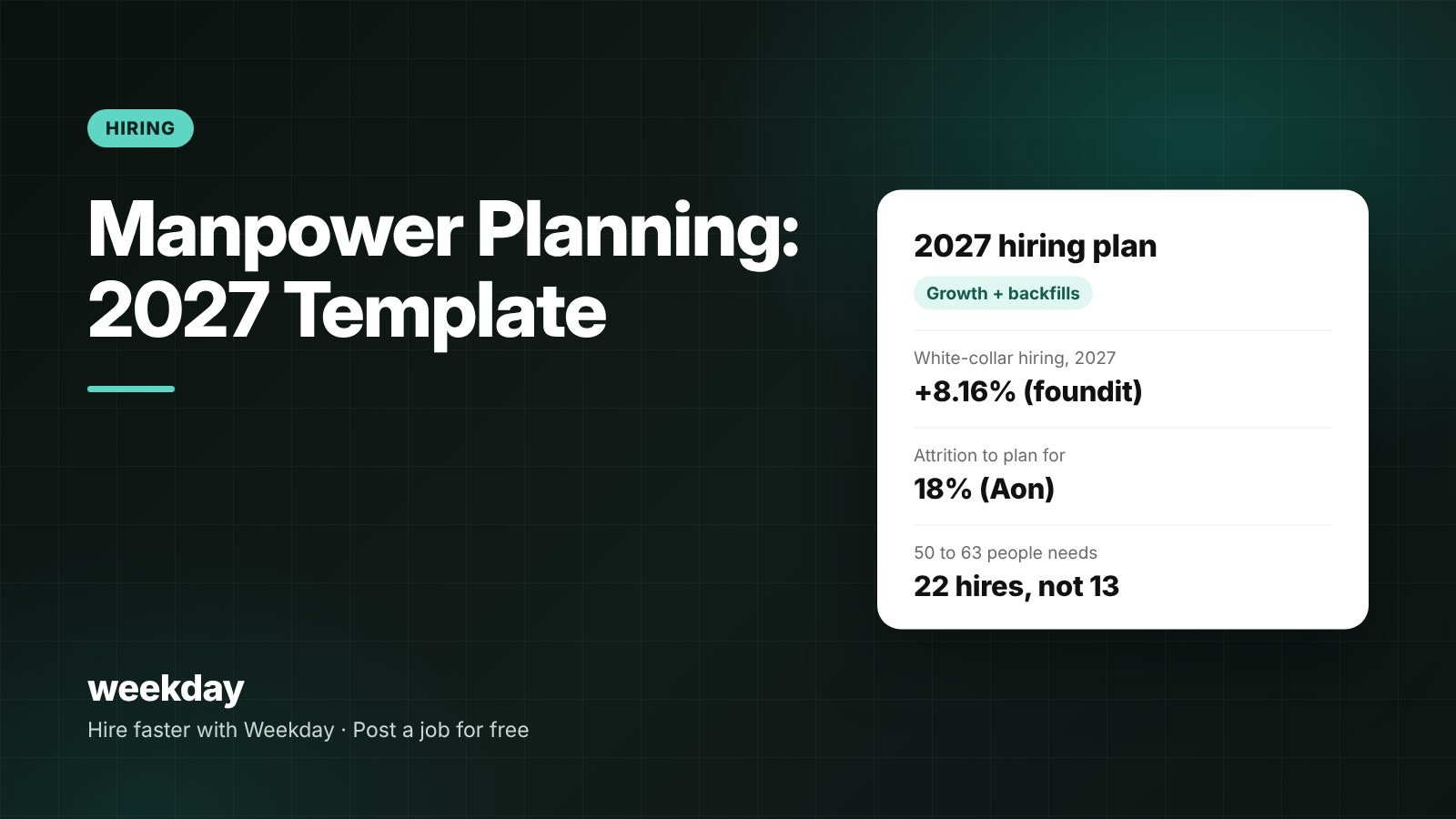
Quick answer: Manpower planning means working out how many people you need, with which skills, by when, and at what cost. The core formula: hires needed = growth hires + expected leavers. That second part is the one most plans miss. India's attrition was 18% in 2026 (Aon), and foundit expects white-collar hiring to grow 8.16% in 2027. So a 50-person startup planning to reach 63 people needs about 22 hires next year, not 13.
Manpower planning is the bridge between your business plan and your hiring plan. Revenue targets, product launches and new cities all turn into a simple question: who do we need, and when do they need to start?
Get it wrong in one direction and you over-hire, then cut. Get it wrong in the other and your best people burn out covering empty seats. This guide gives you a process, three formulas, a worked 2027 plan for a 50-person startup, and a template you can copy.
What is manpower planning?
Manpower planning (also called HR planning or workforce planning) has four parts:
- Demand: how many people, and which roles, the business will need.
- Supply: who you have today, and who you'll lose through attrition.
- Gap: the difference between the two.
- Action: how you'll close the gap. Hire, train, move people internally, or use contractors.
Large companies run this with a planning team and software. A startup can do it in one spreadsheet, as long as it's updated every quarter.
The 2027 numbers to plan around
| Number | What it means for your plan | Source |
|---|---|---|
| White-collar hiring to grow 8.16% in 2027 (3.30% in 2026) | More companies will compete for the same people | foundit, via Business Standard |
| IT roles growing 20.28% a year | Tech hiring will take longer and cost more | foundit |
| 2027 city growth: Coimbatore +12.52%, Bengaluru +11.29%, Hyderabad +10.33% | Expect the most competition in these cities | foundit |
| Attrition 18% in 2026 (16.2% in 2025) | Plan backfills, not just growth hires | Aon |
| Average increment 9.1% projected for 2027 | Your current payroll grows even with zero new hires | Aon |
Sources: Business Standard on the foundit Insights Tracker and Aon's salary and turnover survey.
The manpower planning process in 6 steps
- Start with the business plan. Write the 2027 goals in numbers: revenue, customers, product launches, new cities.
- List who you have. Every person by team, role, level and CTC. Mark anyone likely to move internally.
- Forecast demand. For each team, how many people does the 2027 goal need? Use the workload or ratio methods below.
- Forecast supply. Apply your attrition rate to each team to estimate who will leave.
- Find the gap and pick a channel. For each role: hire full-time, promote, train, or use a contractor. Then pick a hiring channel: referral, free job post, sourcing tool or agency.
- Budget and review. Add salaries, increments and recruiting costs. Review every quarter against actual hiring and exits.
Manpower planning formulas
1. Hires needed
Don't know your attrition rate? Our attrition meaning guide shows how to calculate it. If you have no history, use Aon's 18% as a starting point.
2. Workload method
Sample: your support team expects 6,000 tickets a month at 20 minutes each. That's 2,000 hours. If one agent has about 120 productive hours a month, you need 2,000 ÷ 120 = 16.7, so 17 agents.
3. Ratio method
Use a ratio from your own history. Sample: if one customer success manager handles 25 accounts well, and you expect 250 accounts by December, you need 10 CSMs.
Worked example: a 50-person startup plans 2027
Sample numbers. The startup has 50 people today and wants 63 by December 2027. It uses 18% attrition for every team (Aon's 2026 average), rounded to whole people.
| Team | Today | Target, Dec 2027 | Growth hires | Backfills (18%) | Total hires |
|---|---|---|---|---|---|
| Engineering | 22 | 28 | 6 | 4 | 10 |
| Sales | 10 | 14 | 4 | 2 | 6 |
| Customer success | 8 | 10 | 2 | 1 | 3 |
| Product and design | 4 | 5 | 1 | 1 | 2 |
| Ops, HR and finance | 6 | 6 | 0 | 1 | 1 |
| Total | 50 | 63 | 13 | 9 | 22 |
Backfills are 41% of the hiring plan here (9 of 22). A plan that only counts growth hires would be short by 9 people, and those gaps would show up as missed targets in the second half of the year.
Phase it by quarter
| Quarter | Hires | Why |
|---|---|---|
| Q1 2027 | 7 | Sales and engineering first, so they're productive by mid-year |
| Q2 2027 | 6 | Backfills after the April appraisal cycle, plus customer success |
| Q3 2027 | 5 | Remaining engineering and product roles |
| Q4 2027 | 4 | Backfills and any role pulled forward from 2028 |
Start each search well before you need the person. Notice periods in India are usually 30 days at startups and 60–90 days at large IT firms and MNCs (Weekday notice period guide). A role you need filled on 1 April should be open by early January.
Add the cost
Sample: at an average CTC of ₹15 lakh, the current payroll is ₹7.5 crore. A 9.1% increment adds about ₹68 lakh before a single new hire. The 13 growth hires add about ₹1.95 crore a year once all are in seat. Then add recruiting costs per role; our recruitment budget guide has a template for that.
2027 manpower planning template
Copy these columns into a sheet. One row per role.
| Column | Sample entry |
|---|---|
| Team | Engineering |
| Role and level | Backend engineer, SDE-2 |
| Today's headcount | 8 |
| Target headcount (Dec 2027) | 10 |
| Growth hires | 2 |
| Expected leavers (headcount × attrition) | 8 × 18% = 1.4, round to 1 |
| Total hires | 3 |
| Quarter needed by | Q1: 2, Q3: 1 |
| Budgeted CTC per hire | ₹18–24 lakh (sample) |
| Channel | Referral first, then free job post with AI sourcing |
| Owner | Engineering manager + HR |
| Status | Open / interviewing / offer / joined |
Common manpower planning mistakes
- Only planning growth. Backfills are a big part of the year's hiring. Count them.
- One attrition rate for everyone. Some teams lose people faster than others. Use each team's own history once you have it.
- Ignoring lead time. Search time plus notice period can run a quarter or more.
- Planning once a year. Review every quarter. Funding, revenue and exits move faster than an annual plan.
- No channel per role. Not every role needs an agency. Referrals and free posts can fill many seats; our referral bonus guide covers how to set up the first.
Free tool: Working out when a new hire can actually join? Weekday's notice period calculator gives the last working day in seconds.
Turn your 2027 plan into hires
Post your first role for free and let Weekday's AI agents reach the best-fit candidates for you, or book a demo to plan a bigger hiring push. Post a free job.
Frequently asked questions
What is manpower planning in HRM?
Manpower planning is how a company works out how many people it needs, with which skills, by when and at what cost, and then plans how to get them through hiring, training, internal moves or contractors.
What is the formula for manpower planning?
A simple version: hires needed = (target headcount minus current headcount) + expected leavers. Expected leavers = current headcount × your attrition rate. For a 50-person team growing to 63 at 18% attrition, that's 13 + 9 = 22 hires.
What is the difference between manpower planning and workforce planning?
They mean almost the same thing. Manpower planning is the older term and often focuses on numbers and roles. Workforce planning usually adds skills, costs and options like contractors or automation. For a startup, treat them as one exercise.
How often should a startup update its manpower plan?
Build it once a year and review it every quarter. Update it sooner if revenue, funding or attrition moves a lot, because each of those changes how many people you need.
Sources
- Business Standard: India to see 1.38 crore white-collar jobs in 2027 as hiring growth hits 8.16% (foundit, 23 November 2026)
- India Business & Trade: White-collar hiring set to grow 8.16% in 2027
- Aon: Annual Salary Increase and Turnover Survey India 2026–27 (14 October 2026)
- People Matters: Indian companies project 9.1% salary hikes in 2027
- Weekday: notice period guide
- Weekday: recruitment budget guide





