Last updated: 13 November 2026
- Live MIS and back-office jobs on Weekday
- MIS executive meaning
- Day-to-day work
- Skills table: Excel, Sheets, Power BI, SQL
- Salary by experience
- Sample resume bullets
- 5 Excel formulas every MIS executive uses
- 10 interview questions with answers
- Career path
- Back office jobs (where most MIS roles sit): 15,061 open, 4,132 new this week.
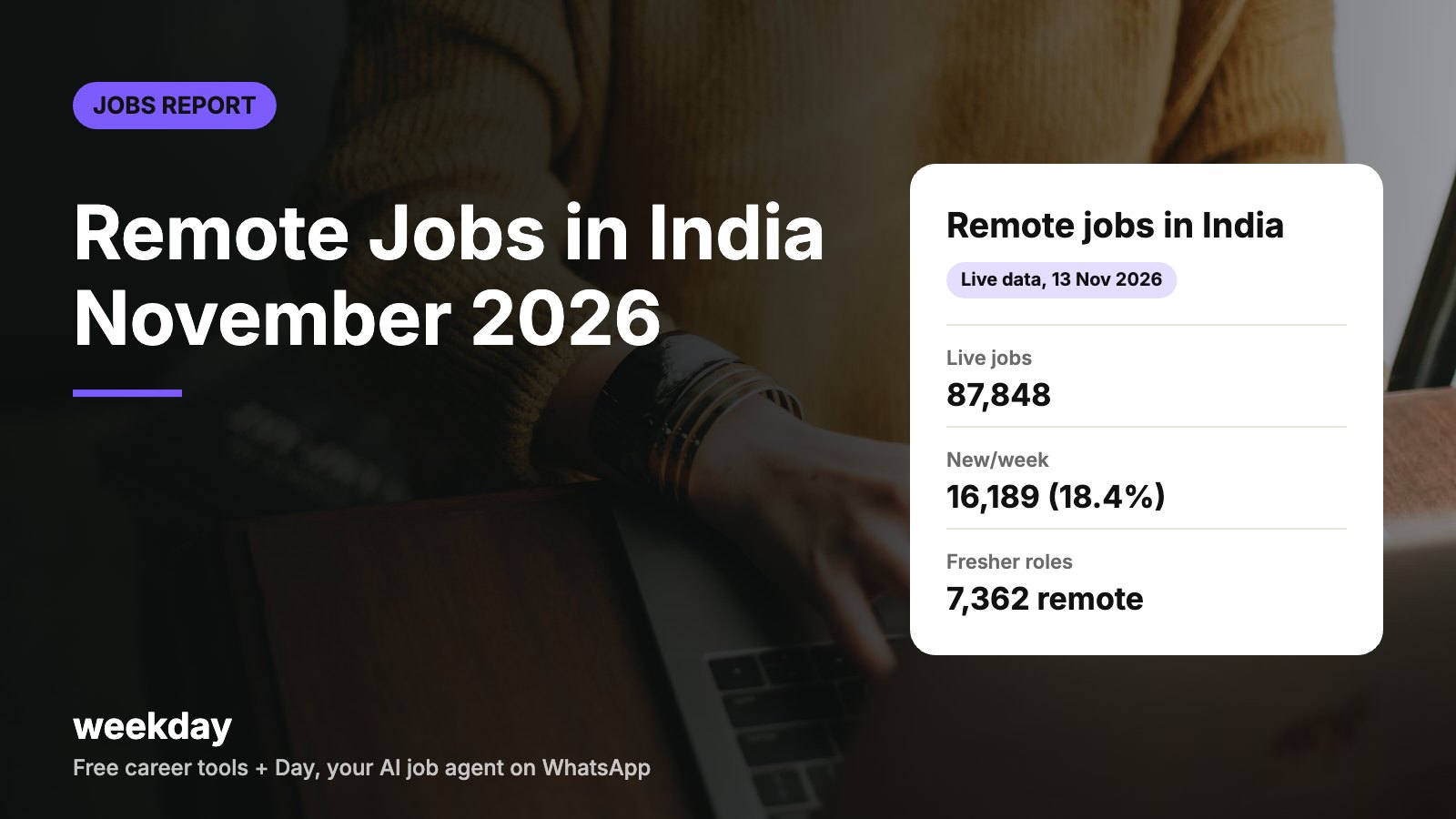
- Remote back office jobs: 1,126 open, 208 new this week.
- Remote Power BI jobs: 255 open, 45 new this week.
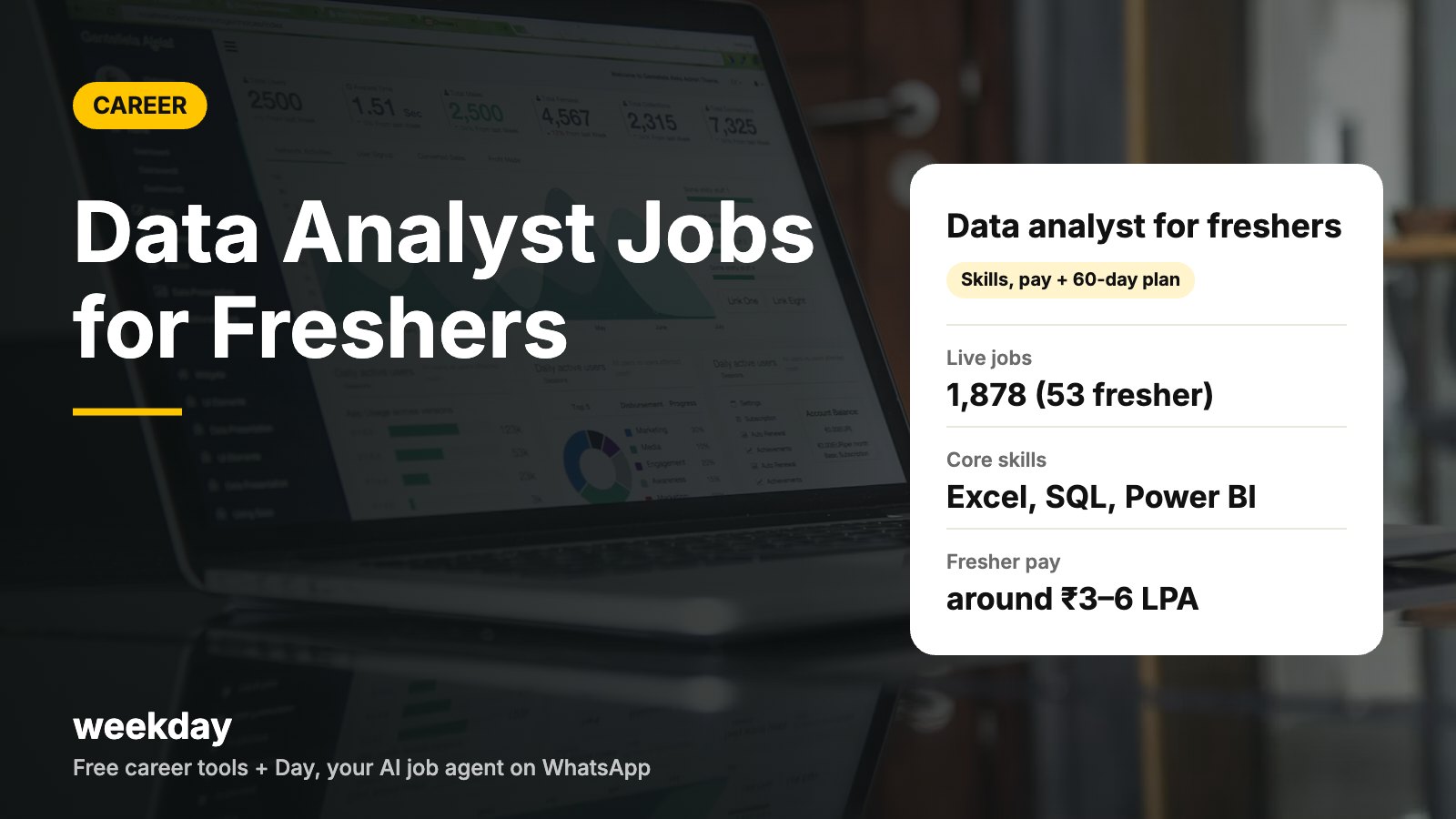
- Data analyst jobs (the next step up): 1,878 open, 443 new this week.
Sources: Weekday job listings (jobs.weekday.works), counted on 13 November 2026. Counts change daily.
- Open ChatGPT and go to Plugins.
- Search Weekday Jobs and tap Try in chat (or open Weekday Jobs in ChatGPT).
- Ask in plain words, for example:
- “Find MIS executive jobs in Pune for 1–3 years experience with Excel and Power BI”
- “Show remote MIS or back office reporting jobs for freshers posted this week”
- “Find MIS executive jobs paying above ₹4 LPA in Delhi NCR”
Day, Weekday's free AI job agent, finds jobs that match your skills and pay, and applies when you say yes. On WhatsApp.
Say hi to Day on WhatsAppHow Day works →MIS executive meaning
MIS stands for Management Information System. An MIS executive is the person who makes sure managers get the right numbers on time. You pull data from sources such as an ERP, CRM, call-centre dialler, HR system or plain spreadsheets, clean it, and turn it into reports that answer questions like: How many orders did we ship yesterday? Which branch missed its target? How many tickets are older than 48 hours?
The role exists in almost every industry: BPOs and call centres, banks and NBFCs, logistics, retail, manufacturing, hospitals, insurance and ed-tech. In smaller companies one MIS executive covers everything; in large ones there are MIS teams per department (sales MIS, HR MIS, operations MIS).
Day-to-day work
| Time | Typical task |
|---|---|
| 9:30–10:30 | Download yesterday's data from the CRM, ERP or dialler; check row counts against the source |
| 10:30–11:30 | Update the daily report (DSR/DPR) and send it to managers before the morning meeting |
| 11:30–1:00 | Fix data issues: duplicates, missing IDs, wrong dates; follow up with teams |
| 2:00–4:00 | Work on the weekly or monthly MIS: trends, targets vs actuals, pivot summaries |
| 4:00–5:30 | Ad hoc requests: “Can you pull the region-wise numbers for last quarter?” |
| 5:30–6:30 | Update the Power BI or Sheets dashboard; automate one manual step |
The job rewards two things: accuracy and speed. A report that is right but late is useless at a 10 am meeting. A report that is fast but wrong damages trust in you for months. Most good MIS executives build checks into their files, such as a total that must match the source system.
Skills table
| Skill | Level needed | What you use it for | How to prove it |
|---|---|---|---|
| Excel | Advanced | XLOOKUP/VLOOKUP, SUMIFS, pivots, conditional formatting, data validation | Test in interview; a sample report |
| Google Sheets | Intermediate–advanced | Shared trackers, QUERY, IMPORTRANGE, live team inputs | A shared sample dashboard |
| Power BI | Basic–intermediate (rising) | Dashboards, Power Query cleaning, scheduled refresh, simple DAX | A published practice dashboard |
| SQL | Basic | SELECT, WHERE, GROUP BY, JOIN to pull data yourself | Solve 3–4 queries live |
| Macros / VBA or Apps Script | Nice to have | Automating repeated steps | One automation you built |
| Business sense | Essential | Knowing which number matters and why | Explaining a past report's impact |
| Communication | Essential | Clear emails, flagging issues early | Clear answers in the interview |
Power BI is the skill that moves pay the most for MIS staff in 2026. Weekday currently lists 255 remote Power BI jobs, and many on-site MIS posts now list it as preferred.
Salary by experience
These are indicative ranges for India in 2026. Metro cities, BFSI and IT/ITES companies usually pay at the top end; smaller cities and small firms at the lower end.
| Role / experience | Usual salary range | What changes |
|---|---|---|
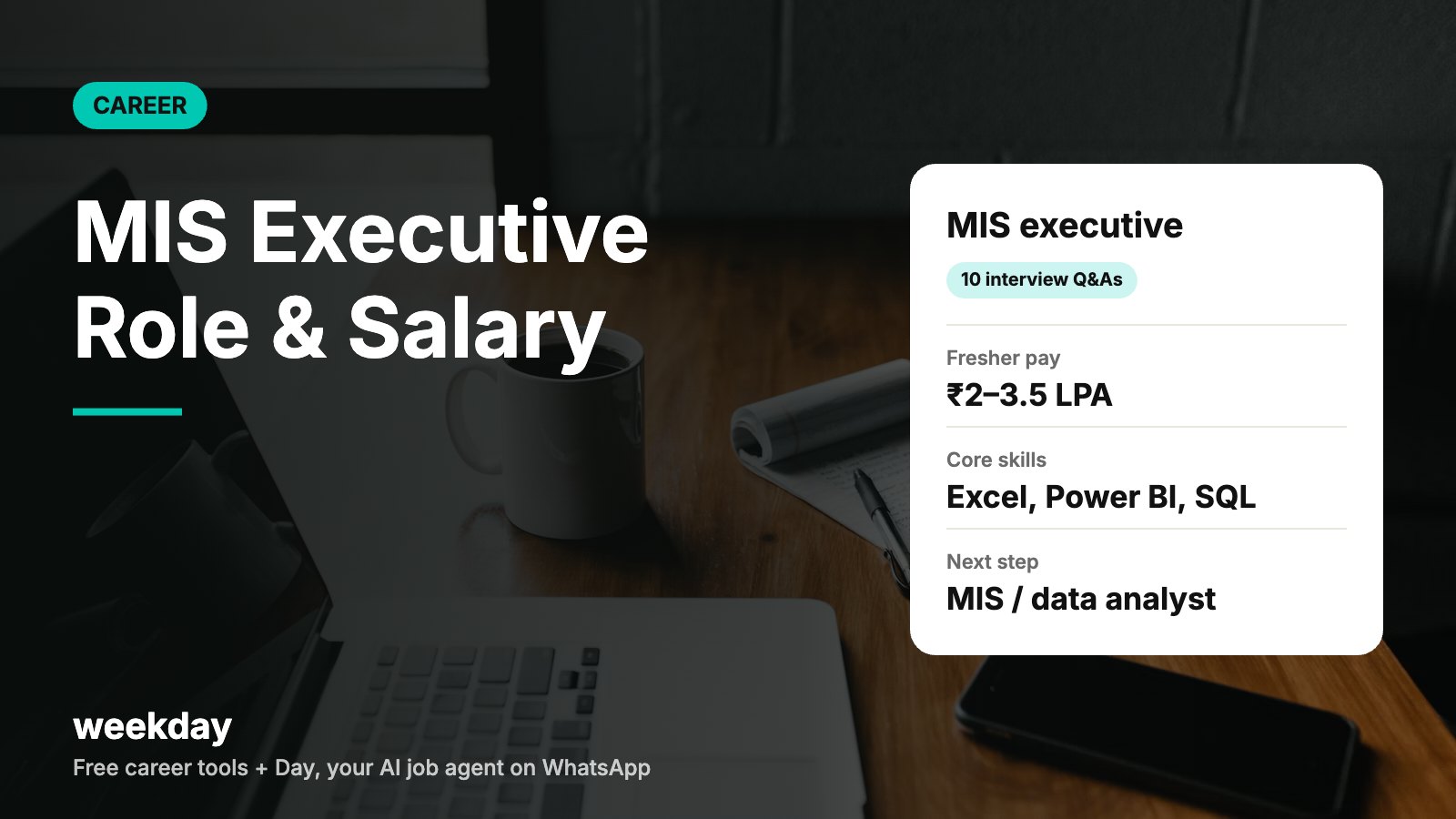
| MIS executive, fresher (0–1 yr) | ₹2–3.5 LPA | Excel and accuracy |
| MIS executive (1–3 yrs) | ₹3–5 LPA | Owns daily and weekly reports |
| Senior MIS executive / MIS analyst (3–6 yrs) | ₹4.5–8 LPA | Power BI, SQL, automation |
| MIS lead / assistant manager (6–9 yrs) | ₹7–12 LPA | Team handling, stakeholder management |
| MIS manager (9+ yrs) | ₹10–18 LPA | Owns reporting for a business unit |
Worked example: an MIS executive on ₹3.6 LPA who adds Power BI and SQL and moves to an MIS analyst role at ₹5.4 LPA gets a 50% jump. Monthly gross goes from ₹30,000 to ₹45,000. Check the take-home on the in-hand salary calculator before you accept.
Sample resume bullets
Sample MIS executive resume bullets (adapt with your real numbers)
• Prepared and sent the daily sales report for 14 branches by 10 am, with zero missed days in 11 months.
• Built a Power BI dashboard for collections, cutting manual reporting time from 3 hours to 20 minutes a day.
• Automated monthly incentive calculation for 120 agents using SUMIFS and XLOOKUP, reducing payout errors from about 6 a month to 0.
• Wrote SQL queries to pull ticket ageing data directly from the CRM database, ending a 2-day wait on the IT team.
• Created a data-validation template that cut duplicate entries in the lead tracker by roughly 80%.
• Trained 5 team leads to read and filter the weekly dashboard themselves.
Each bullet starts with a verb, names the tool and ends with a number. Use real figures from your work; interviewers will ask about them. Our skills for resume guide shows how to list Excel and Power BI so applicant tracking systems pick them up.
5 Excel formulas every MIS executive uses
| Formula | Example | What it does |
|---|---|---|
| XLOOKUP (or VLOOKUP) | =XLOOKUP(A2, Agents!A:A, Agents!C:C, "Not found") | Finds the agent's team for each ID in A2; shows “Not found” instead of an error |
| SUMIFS | =SUMIFS(D:D, B:B, "North", C:C, ">="&DATE(2026,11,1)) | Totals sales in column D for the North region from 1 Nov 2026 |
| COUNTIFS | =COUNTIFS(E:E, "Open", F:F, ">2") | Counts open tickets older than 2 days |
| IFERROR with IF | =IFERROR(IF(D2/E2>=1, "Met", "Missed"), "No target") | Labels target status; handles divide-by-zero when no target is set |
| INDEX + MATCH | =INDEX(C:C, MATCH(A2, B:B, 0)) | Looks up a value to the left of the search column; works in older Excel |
Also learn pivot tables (summaries in seconds), TEXT for date formatting, UNIQUE and FILTER in Excel 365, and conditional formatting for red/green targets. In Google Sheets, QUERY and IMPORTRANGE do much of the same work.
10 interview questions with answers
Sample answers you can adapt
1. What does an MIS executive do?
"I collect data from systems and teams, clean it, and turn it into accurate daily, weekly and monthly reports and dashboards so managers can make decisions on time."

2. VLOOKUP vs XLOOKUP?
"VLOOKUP only looks to the right and breaks if columns are inserted. XLOOKUP can look in any direction, has a built-in not-found value and defaults to exact match. I use XLOOKUP where Excel 365 is available and INDEX-MATCH otherwise."

3. How do you check that a report is accurate?
"I match row counts and totals to the source system, check for duplicates and blanks, compare with yesterday's numbers for unusual jumps, and keep a check cell that turns red if totals don't match."

4. What is a pivot table and when do you use it?
"It summarises large data by rows and columns without formulas. I use it for region-wise or agent-wise totals and to spot outliers fast."

5. How do you remove duplicates?
"Remove Duplicates under the Data tab for a quick fix, or COUNTIF to flag them first so I can check why they appeared."

6. Have you used Power BI?
"Yes. I've built a collections dashboard: Power Query to clean the data, a few DAX measures like total collected and % of target, and slicers for region and month. It refreshes daily."

7. Write a SQL query for total sales by region.
"SELECT region, SUM(amount) AS total_sales FROM orders GROUP BY region ORDER BY total_sales DESC;"

8. A manager needs a report in 30 minutes and the data has errors. What do you do?
"I tell the manager straight away, fix what I can in the time, send the report with the issue clearly marked, and send a corrected version once fixed. I don't hide the error."

9. How have you automated a task?
"Our daily report took 2 hours of copy-paste. I built a template with XLOOKUP and a pivot that refreshes from the raw dump, and recorded a macro for formatting. It now takes 15 minutes."

10. Why MIS?
"I like work where accuracy matters and results are visible every day. MIS also lets me grow into data analysis, which is where I want to be in three years."
Expect an Excel test as well: usually a raw data file and 20–40 minutes to build a pivot, a lookup and a summary. For the general round, see our HR interview questions guide.
Common mistakes and fixes
| Mistake | Fix |
|---|---|
| Hard-coding numbers inside formulas | Keep targets and dates in separate input cells |
| Sending reports without checking totals | Add a check cell that compares with the source |
| Merged cells in raw data | Never merge in data sheets; it breaks sorting and pivots |
| Listing “MS Office” as a skill | Name the real skills: XLOOKUP, pivots, Power BI, SQL |
Career path
MIS is a strong entry point into data careers. Most people move along one of three tracks after 2–4 years.
| Track | Next roles | Skills to add | Usual pay range |
|---|---|---|---|
| Reporting depth | Senior MIS executive → MIS lead → MIS manager | Team handling, process design | ₹5–18 LPA |
| Analytics | MIS analyst → data analyst → business analyst | SQL, Power BI/Tableau, Python basics, statistics | ₹5–12 LPA |
| Business operations | Operations analyst → operations manager | Process knowledge, stakeholder management | ₹5–15 LPA |
If you want to move into analytics, our data analyst jobs for freshers guide covers projects and tests. When you're ready to move, browse back office jobs or remote back office jobs on Weekday, or let Day apply to MIS roles you approve while you keep working.
FAQs
What is the full form of MIS?
Management Information System: the people, processes and tools that turn business data into reports for managers.
What does an MIS executive do?
Collects data from systems and teams, cleans it, and prepares daily, weekly and monthly reports and dashboards for managers.
What skills does an MIS executive need?
Advanced Excel or Google Sheets, attention to detail and clear communication; Power BI and basic SQL are increasingly asked for.
What is the salary of an MIS executive in India?
Freshers usually earn around ₹2–3.5 LPA. With 3–6 years and Power BI or SQL skills, around ₹4.5–8 LPA. MIS managers can earn ₹10–18 LPA.
Can a fresher become an MIS executive?
Yes. Many companies hire graduates with strong Excel skills and train them on their systems.
Which Excel formulas are most used in MIS?
XLOOKUP or VLOOKUP, SUMIFS, COUNTIFS, IF with IFERROR, and INDEX-MATCH, plus pivot tables.
Is MIS executive a good career?
Yes, as an entry point. It leads to MIS manager, data analyst, business analyst or operations roles.
Is an MIS executive the same as a data analyst?
No. MIS focuses on regular reports and accuracy; data analysts dig into why numbers change. Many data analysts start in MIS.
Are there remote MIS executive jobs?
Yes. On 13 November 2026 Weekday listed 1,126 remote back office jobs and 255 remote Power BI jobs, which include MIS and reporting roles.