
Last updated: November 2026 · Includes the new ₹25,000 wage ceiling
PF stands for Provident Fund. In a salary slip it almost always means the Employees' Provident Fund (EPF), a retirement savings account that you and your company both pay into every month. The account is managed by the EPFO, the Employees' Provident Fund Organisation.
Think of it as forced savings. A small part of your salary goes into PF every month, your company adds money too, and the balance earns interest until you withdraw it.
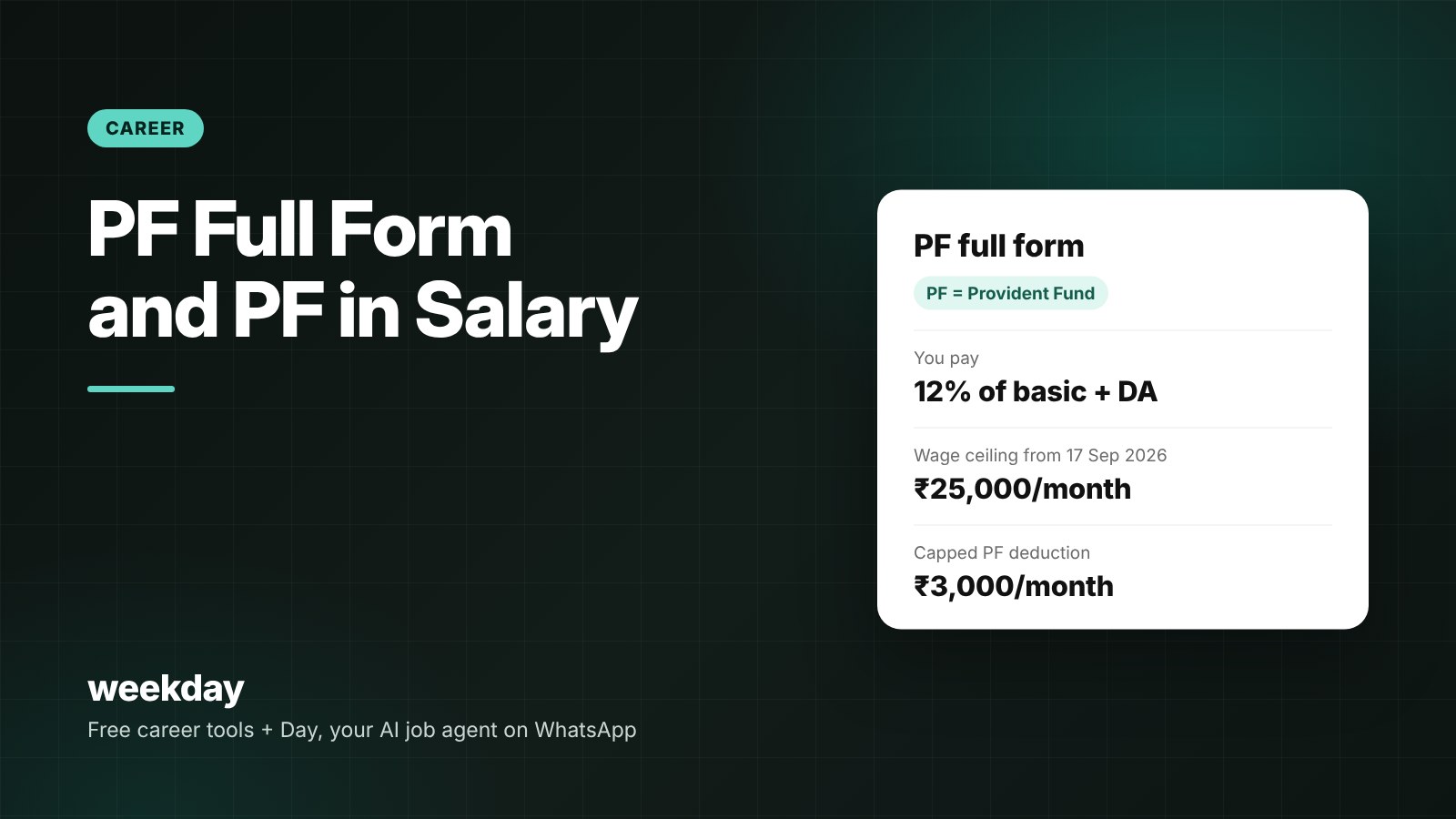
Short answer: PF full form = Provident Fund. EPF = Employees' Provident Fund. You pay 12% of your basic pay plus DA, and your company pays 12% too. Part of the company's share goes to your pension (EPS). From 17 September 2026, the PF wage ceiling went up from ₹15,000 to ₹25,000 a month, so the capped PF deduction rose from ₹1,800 to ₹3,000 a month (BDO).
PF-related full forms in one place
| Short form | Full form | What it means for you |
|---|---|---|
| PF | Provident Fund | The general name for this savings scheme |
| EPF | Employees' Provident Fund | Your PF account as a salaried employee |
| EPFO | Employees' Provident Fund Organisation | The government body that runs EPF |
| EPS | Employees' Pension Scheme | The pension part, funded from your company's share |
| UAN | Universal Account Number | Your one PF number for life, across jobs (see how to find your UAN) |
| VPF | Voluntary Provident Fund | Extra PF you choose to pay above 12% |
| PPF | Public Provident Fund | A separate savings scheme you open yourself at a bank or post office. Not linked to your job. |
How much PF is deducted from salary?
PF is worked out on your "PF wages", which is mainly basic pay plus dearness allowance (DA).
- Your share: 12% of PF wages, cut from your salary every month.
- Your company's share: another 12%. Of this, 8.33% goes to your pension (EPS), counted on wages up to the ceiling. The rest goes to your PF account (BDO).
The wage ceiling is the salary level up to which PF is compulsory. It was raised from ₹15,000 to ₹25,000 a month from 17 September 2026 (Business Today). Companies can take PF on your full basic, or cap it at the ceiling. That is why two people with the same salary can see different PF amounts on their payslips.
Worked example (made-up numbers)
Aman's basic pay is ₹30,000 a month.
| PF on full basic | PF capped at ₹25,000 | |
|---|---|---|
| Aman's PF (12%) | ₹3,600 | ₹3,000 |
| Company's PF (12%) | ₹3,600 | ₹3,000 |
| Of which to pension (8.33% of ₹25,000) | ₹2,083 | ₹2,083 |
| Of which to Aman's PF account | ₹1,517 | ₹917 |
| Total going to PF + pension each month | ₹7,200 | ₹6,000 |
The ₹2,083 pension figure matches the one in our PF new rules 2026 guide. Check which column matches your payslip: the PF line will show either 12% of your full basic or ₹3,000.
Is PF part of CTC?
In most Indian offers, yes. Your CTC usually includes the company's PF contribution. So it is counted in your package but never reaches your monthly bank credit. Your own 12% is then cut from your gross salary as well.
That is why in-hand pay is lower than CTC divided by 12. Read CTC meaning for the full breakup, or try the in-hand salary calculator.
What did the ₹25,000 ceiling change?
| Item | Before 17 Sep 2026 | From 17 Sep 2026 |
|---|---|---|
| EPF wage ceiling | ₹15,000 a month | ₹25,000 a month |
| Maximum PF if capped at the ceiling | ₹1,800 a month | ₹3,000 a month |
| Who must be covered | Wages up to ₹15,000 | Wages up to ₹25,000 |
Source: BDO. If only your own share changes, take-home falls by up to ₹1,200 a month (Corporate Professionals). That money is not lost. It sits in your PF and pension accounts.
How much interest does PF earn?
The EPF interest rate was 8.25% for both FY 2023-24 and FY 2024-25, according to Weekday's EPF interest rate guide. Interest is worked out on your monthly balance and credited once a year. The pension (EPS) part does not earn interest in your account; it pays a pension later.
Interest is tax-free up to a limit. The same guide notes that interest on your own contributions above ₹2.5 lakh a year is taxable.
Can you withdraw PF?
Yes, but the rules changed in 2026:
- After losing your job: you can take 75% of your PF at once and the rest after 12 months (Business Today).
- Partial withdrawal while working: the earlier 13 separate purposes were folded into 3 groups (Business Today), and 12 months of service is the common minimum (IANS).
- Changing jobs: you do not need to withdraw. Your UAN stays the same, and your old balance can be transferred to the new employer's account.
Step-by-step instructions are in our PF withdrawal guide.
PF on your payslip: what to check
- Employee PF line: 12% of basic, or ₹3,000 if capped.
- Employer PF in CTC: check your offer letter's annexure.
- UAN: printed on most payslips. Activate it on the EPFO member portal so you can see your passbook.
- Passbook every few months: make sure both contributions actually reached your account.
PF questions to ask before you accept an offer
- Is the employer's PF inside my CTC or paid on top? Inside CTC is common, and it lowers your in-hand pay.
- Is PF taken on my full basic or capped at ₹25,000? On a high basic, this can change your take-home by a few thousand rupees a month.
- Can I opt for VPF? If you want to save more, VPF lets you put in more than 12%.
- Will my old PF move with my UAN? Ask HR to link your existing UAN instead of creating a new one.
Comparing two offers? Look at the PF line in both salary annexures before you compare in-hand pay. Our guide to basic salary explains why a higher basic means a bigger PF cut.
Common PF mistakes
- Not activating your UAN. Without it, you cannot see your passbook or transfer old balances easily.
- Keeping two UANs. If a new employer creates a fresh UAN, merge it with the old one through the EPFO portal.
- Withdrawing on every job change. You lose years of interest. Transfer the balance instead.
- Never checking the passbook. Check every few months that both your share and your company's share actually arrived.
Is a higher PF deduction good or bad?
| Good for you | Watch out for |
|---|---|
| Forced savings that earn steady interest | Lower monthly in-hand pay |
| A bigger pension base | Money is locked in, with rules for withdrawal |
| Interest is tax-free up to a limit | If PF is inside CTC, a bigger company share can lower your gross pay |
For most people early in their career, PF is a good habit. Just know your real in-hand number before you accept an offer.
What will you actually get each month?
Enter your CTC in Weekday's free in-hand salary calculator. It shows your monthly take-home after PF, professional tax and income tax.
Frequently asked questions
What is the full form of PF?
PF stands for Provident Fund. In salary, it usually means the Employees' Provident Fund (EPF), run by the EPFO.
How much PF is deducted from salary?
12% of your basic pay plus DA. If your company caps PF at the ₹25,000 wage ceiling, the deduction is ₹3,000 a month.
What is the difference between PF and EPF?
PF is the general term. EPF is the specific provident fund for salaried employees that you and your employer pay into.
Is employer PF part of my CTC?
Usually yes. The employer's PF is counted in CTC, so it does not reach your monthly bank credit.
What is the EPF interest rate?
8.25% for FY 2023-24 and FY 2024-25. Check the EPFO website for the latest declared rate.





