
Last updated: November 2026 · Not tax advice; check your own case with a CA
RSU stands for Restricted Stock Unit. It is a promise from your company to give you its shares in the future, for free, as long as you stay for a set time. The "restricted" part means you cannot touch the shares until they vest, that is, until you have earned them.
Example: your offer letter from a listed tech company says "₹30 LPA fixed + RSUs worth ₹20 lakh over 4 years". The ₹20 lakh is not cash. It turns into real shares bit by bit as you complete each vesting period.
This guide covers how RSUs vest, how they are taxed in India, how they differ from ESOPs, and how to value them when you compare job offers.
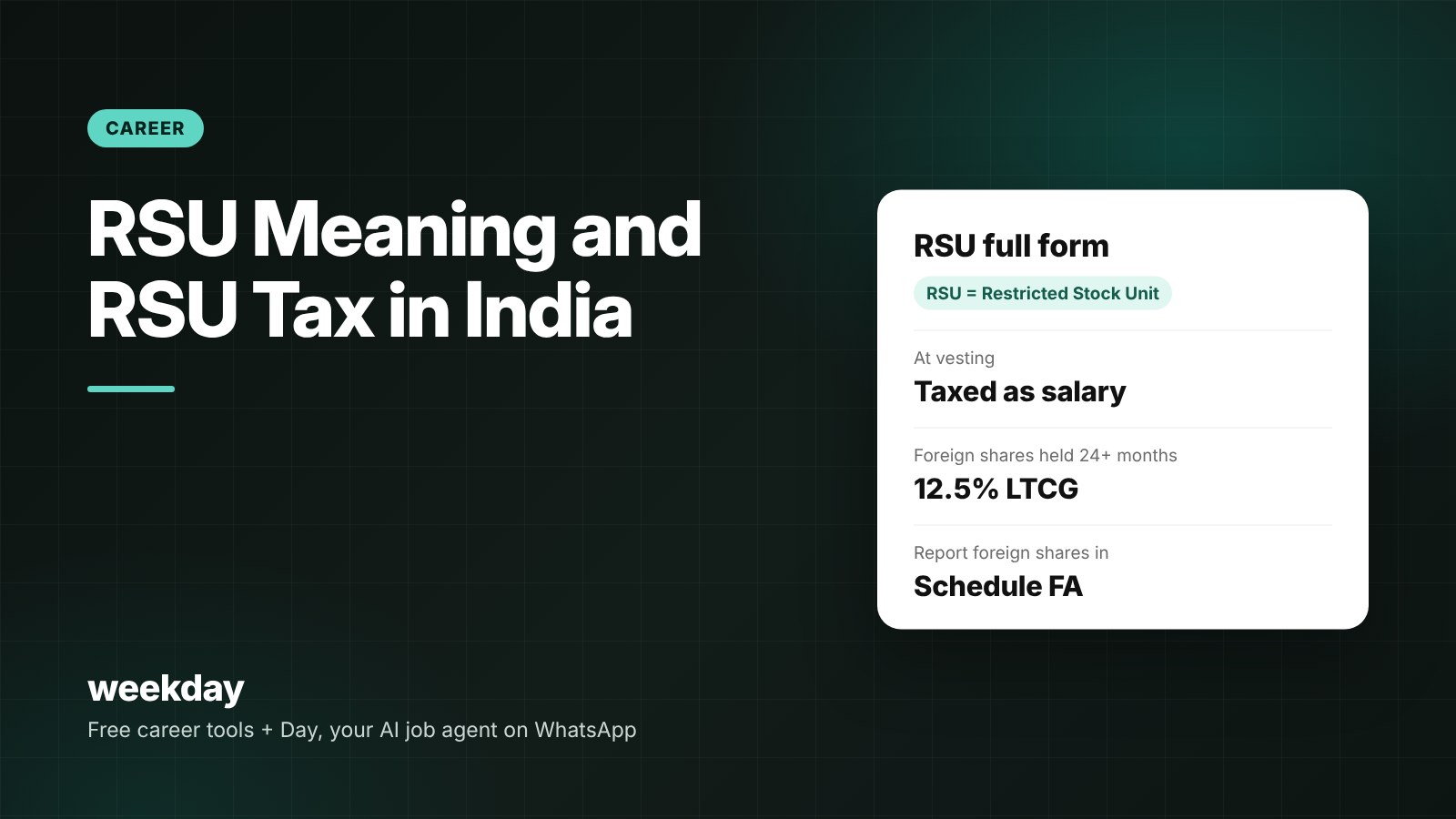
Short answer: RSU full form = Restricted Stock Unit. You pay nothing for RSUs. When they vest, their market value is added to your salary and taxed at your slab rate. When you later sell the shares, the gain after vesting is taxed as capital gains. Shares of a foreign company, such as a US-listed employer, must also be reported in Schedule FA of your income tax return.
Key RSU terms in plain words
| Term | Meaning |
|---|---|
| Grant | The day the company promises you a number of RSUs. Nothing is yours yet, and no tax is due (EquityList). |
| Vesting | The day a batch of RSUs turns into real shares in your account. |
| Vesting schedule | The timetable, for example a quarter of the grant every year for 4 years. |
| Cliff | A first waiting period, often a year, before anything vests at all. |
| FMV | Fair Market Value: the share price on the vesting date. |
| Sell-to-cover | The company sells part of your vested shares to pay the tax on them. |
| Refresher | A new RSU grant given later, often after a performance review. |
How RSU vesting works
Vesting can be based on time, on milestones, or on both. ClearTax gives the example of 3,000 RSUs vesting at 1,000 a year for three years, with conditions attached (ClearTax).
Here is a simple example with made-up numbers. You are granted 400 RSUs over 4 years with a one-year cliff:
| When | RSUs that vest | Total you own |
|---|---|---|
| Month 12 (cliff) | 100 | 100 |
| Month 24 | 100 | 200 |
| Month 36 | 100 | 300 |
| Month 48 | 100 | 400 |
If you leave after 18 months, you keep the 100 shares that already vested. The other 300 RSUs usually lapse. Check your own plan document, because schedules differ: some companies vest monthly or quarterly after the cliff, and some front-load or back-load the grant.
RSU vs ESOP vs ESPP
| RSU | ESOP | ESPP | |
|---|---|---|---|
| What you get | Shares, on vesting | Option to buy shares at a fixed price | Right to buy shares at a discount |
| Do you pay? | No | Yes, the exercise price | Yes, the discounted price |
| Taxed as salary when | Shares vest | You exercise | You buy (on the discount) |
| Risk | Value can fall, but rarely to zero at a large listed company | Can be worth nothing if the share price stays below your exercise price | Low; you choose whether to buy |
| Common at | Listed tech companies and MNCs | Startups | Listed MNCs |
For the startup side, read our full guide on ESOP meaning and tax.
How RSUs are taxed in India
RSUs are taxed twice: once when they vest, and again when you sell the shares.
1. At vesting: taxed as salary
- The FMV of the shares on the vesting date is added to your salary as a perquisite under Section 17(2)(vi), and taxed at your slab rate (EquityList).
- For shares of a foreign company, the FMV is converted to rupees at the SBI telegraphic transfer buying rate on the vesting date (Treelife).
- Your employer deducts TDS on this amount, usually by selling some shares (sell-to-cover), by selling all of them on the same day, or by asking you to pay the tax in cash (EquityList).
- From tax year 2026-27, the new Income-tax Act, 2025 moves this rule to Section 17(1)(d). The idea stays the same (Treelife).
2. At sale: taxed as capital gains
Your cost for capital gains is the FMV on the vesting date, not zero (EquityList). So you are only taxed on the rise after vesting. The rate depends on where the shares are listed and how long you hold them:
| Shares of | Short term | Long term |
|---|---|---|
| A foreign company (for example, US-listed) | Held 24 months or less: your slab rate | Held more than 24 months: 12.5%, with no indexation |
| An Indian listed company | Held 12 months or less: 20% | Held more than 12 months: 12.5% on gains above ₹1.25 lakh a year |
Sources: EquityList and ClearTax. The 12.5% long-term rate has applied since 23 July 2024 (EquityList). Foreign shares are treated as unlisted in India, which is why they need 24 months, not 12, to count as long term.
Worked example (made-up numbers)
- 100 RSUs of a US-listed employer vest. The FMV in rupees is ₹15,000 a share, so ₹15 lakh is added to your salary.
- If you are in the 30% slab (income above ₹24 lakh under the new regime), tax plus the 4% health and education cess is 31.2% before any surcharge (Income Tax Department). That is ₹4,68,000.
- Under sell-to-cover, the company sells about 32 shares to pay this, and you keep about 68.
- Thirty months later you sell the 68 shares at ₹20,000 each. Your gain is ₹5,000 a share, or ₹3,40,000. Since you held them more than 24 months, long-term tax at 12.5% is ₹42,500, plus cess.
- Had you sold within 24 months, the same ₹3,40,000 would be added to your income and taxed at your slab rate.
3. Reporting: do not skip this
- Shares of a foreign company are foreign assets. Report them in Schedule FA of your income tax return, which means filing ITR-2 or ITR-3 (EquityList).
- Schedule FA follows the calendar year (January to December), not the April to March financial year (EquityList).
- Missing it can attract a penalty of ₹10 lakh a year under the Black Money Act, 2015 (Treelife).
- If tax was also withheld abroad, you can claim a foreign tax credit by filing the required form (Form 67 under the old rules) before your return (EquityList).
- Your Form 16 and Form 12BA may show the total vested shares, not the shares left after sell-to-cover (ClearTax). Match them with your broker statement.
How to value RSUs in a job offer
Recruiters often quote "total compensation" with RSUs included. Before you compare offers, ask these five questions:
- How many RSUs, and at what share price was the rupee value calculated?
- What is the vesting schedule, and is there a cliff?
- Is the grant front-loaded or back-loaded? A back-loaded grant pays little in year one.
- Are refreshers given every year, and how big are they usually?
- Is there a joining bonus to cover the gap before the first vest?
Then compare fixed pay first, because RSUs move with the share price and the rupee-dollar rate. Weekday's salary pages report fixed pay only (CTC excluding bonus and stock). Here is the engineering median at well-known listed tech companies, read on 20 November 2026:
| Company | Engineering median (fixed, stock excluded) |
|---|---|
| Atlassian | ₹47.5 LPA |
| Uber | ₹44 LPA |
| Microsoft | ₹35 LPA |
| Salesforce | ₹34 LPA |
| Intuit | ₹33 LPA |
| Adobe | ₹32 LPA |
| ₹30 LPA | |
| ServiceNow | ₹27 LPA |
| NVIDIA | ₹25 LPA |
| Amazon | ₹20 LPA |
If two offers are close on fixed pay, the RSUs can decide it. If one offer has much lower fixed pay and "makes it up" with RSUs, treat that as a risk. Use our salary negotiation guide to ask for more fixed pay or a joining bonus, and the in-hand salary calculator to see your monthly take-home.
Common RSU mistakes
- Counting the full grant as yearly pay. ₹20 lakh over 4 years is about ₹5 lakh a year, before tax.
- Forgetting the vesting tax. Vesting raises your taxable salary even if you never sell.
- Skipping Schedule FA. Foreign shares must be reported, even if their value is small.
- Selling just before 24 months. For foreign shares, waiting a little longer can move the gain from your slab rate to 12.5%.
- Keeping everything in one stock. Your salary and your savings both depend on the same company. Many people sell some shares after each vest.
Comparing offers with RSUs?
Tell Day, Weekday's free AI recruiter on WhatsApp, what you want. For example: "Backend dev, 6 yrs, want 40+ LPA fixed at a product company". Day finds roles that match your pay and skills and applies when you say yes.
Frequently asked questions
What is the full form of RSU?
RSU stands for Restricted Stock Unit. It is a company's promise to give you its shares once you complete a vesting period.
Are RSUs taxed at grant in India?
No. There is no tax at grant. RSUs are taxed as salary when they vest, on the market value of the shares on the vesting date.
How are RSUs of US companies taxed in India when sold?
The gain over the vesting-date value is capital gains. If you held the shares more than 24 months, it is taxed at 12.5% without indexation. If 24 months or less, it is added to your income and taxed at your slab rate.
Do I need to report RSUs in my ITR?
Yes. RSU shares of a foreign company must be reported in Schedule FA, which means filing ITR-2 or ITR-3. The vesting value already appears in your salary through Form 16.
What happens to RSUs when I resign?
Shares that have already vested are yours to keep. Unvested RSUs usually lapse on your last working day. Check your company's plan document for the exact rule.





