
Last updated: 25 November 2026
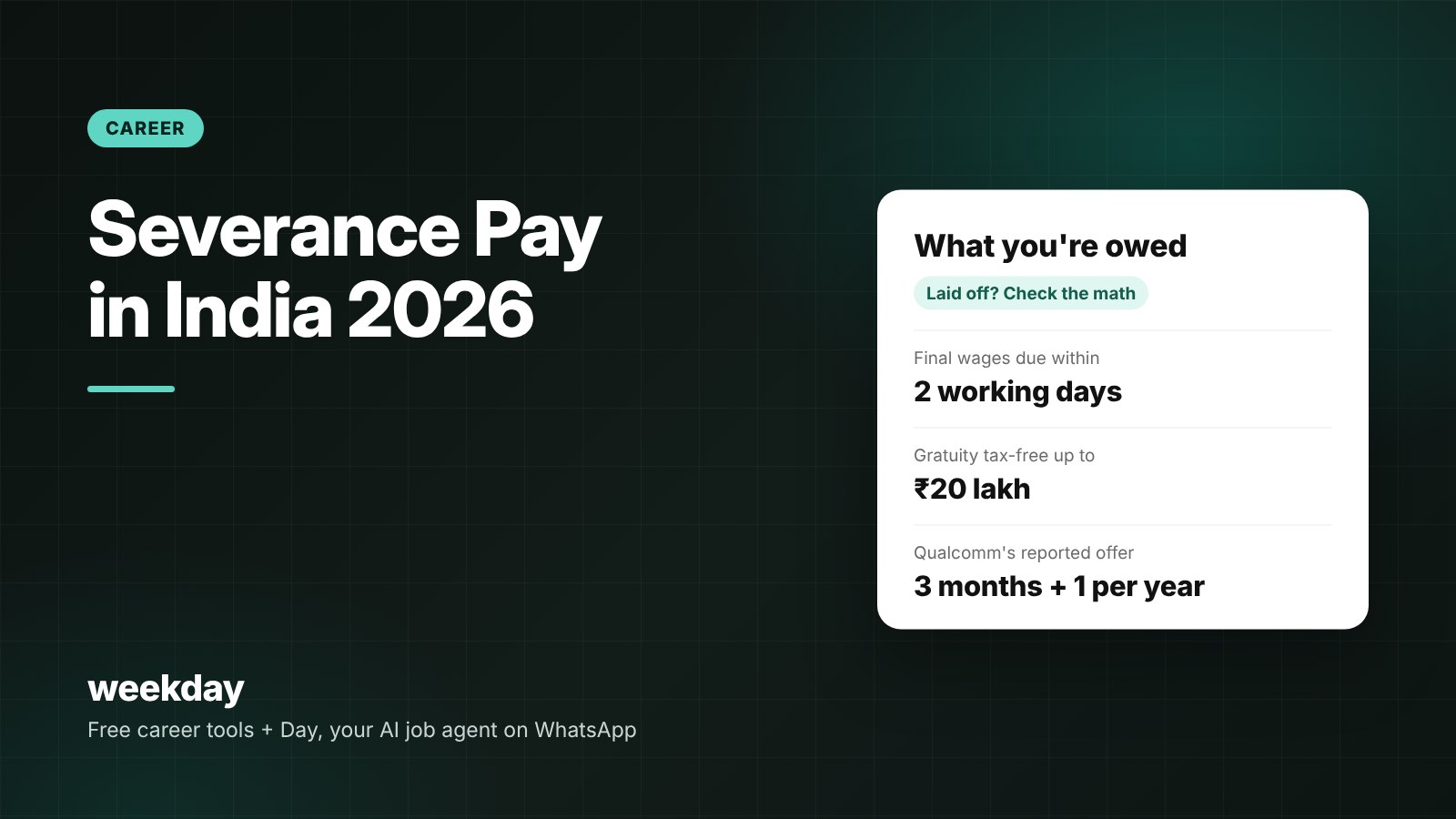
Short answer: India's law doesn't make most private companies pay a fixed "severance". What you get depends on your contract, company policy and the labour codes. Big tech packages in 2026 are generous by Indian standards: Qualcomm India's reported offer is 3 months' salary plus 1 month per year of service (not confirmed by Qualcomm). On top of that, you're usually owed notice pay, gratuity (after 5 years, or 1 year on a fixed-term contract), unused leave, any pending bonus and your PF. Your final wages must be paid within 2 working days of exit under the Code on Wages. Severance is taxed as salary, but gratuity is tax-free up to ₹20 lakh and leave encashment up to ₹25 lakh.
Layoff worry is high this year. On Blind, 21% of users in India searched for layoffs or severance in the past year, up from 16% a year earlier (Blind). Qualcomm began cutting jobs in Bengaluru on 9 November, with 1,000+ roles at risk. Microsoft offered voluntary exits to about 60,000 eligible staff across the US, UK, Canada and India, where it employs about 23,000 people.
We saw the same thing in our own data. In a Weekday analysis of 400 top Reddit posts, 420 LinkedIn posts and 400 X posts from the last 30 days (Nov 2026), layoffs, firing and buyouts was the top Reddit theme: 67 of 400 posts, with over 20,000 comments. Here's what you're owed, and how to check the math.
Is severance pay mandatory in India?
Not in the way most people think. There are two different things:
- Retrenchment compensation (the law). Under Section 70 of the Industrial Relations Code, a "worker" with at least one year of service who is retrenched gets one month's notice or pay in lieu, plus 15 days' average pay for every completed year (a part year over six months counts as a full year). The employer must also pay 15 days' wages into a Worker Re-skilling Fund within 45 days.
- Severance (company policy). Anything above that, like "3 months plus 1 month per year", comes from your company's policy or your contract. It's common at MNCs and GCCs, but not guaranteed.
One catch: the legal definition of "worker" leaves out people employed mainly in managerial or administrative roles, and supervisors earning more than ₹18,000 a month (SCC Online). If you manage a team, your package mostly depends on what the company offers and what you negotiate.
What you're owed when you're laid off
Say you earn ₹1,20,000 a month fixed, your "wages" (basic plus DA) are ₹60,000, you've worked 6 years and 3 months, your notice period is 2 months, and you have 20 days of unused earned leave.
| What you're owed | Who gets it | How it's calculated | Example |
|---|---|---|---|
| Notice pay | Everyone asked to leave before the notice period ends | Monthly pay × notice months not served, as per your contract | 2 × ₹1,20,000 = ₹2,40,000 |
| Severance | Depends on company policy | Often a set number of months plus extra per year of service | A "3 + 1 per year" policy: 9 × ₹1,20,000 = ₹10,80,000 |
| Retrenchment compensation | Legal "workers" with 1+ year of service | 15 days' average pay × completed years | (₹60,000 ÷ 26 × 15) × 6 = ₹2,07,692 |
| Gratuity | 5+ years of service, or 1+ year on a fixed-term contract | Last wages × 15 ÷ 26 × completed years | ₹60,000 × 15 ÷ 26 × 6 = ₹2,07,692 |
| Leave encashment | Anyone with unused earned leave, as per policy | Usually basic ÷ 30 (or ÷ 26) × unused days | 20 × ₹2,000 = ₹40,000 |
| Bonus or variable pay | As per your bonus policy | Pro-rata for the months worked, if the policy allows | Check your offer letter |
| PF | Everyone with an EPF account | Your balance: transfer it, or withdraw 75% now and the rest after 12 months without a job | Your full EPF balance |
Two things changed with the labour codes that started on 21 November 2025. First, "wages" now have to be at least 50% of your total pay: if allowances go above half, the extra is added back for gratuity and other statutory math (Labour Ministry FAQs). That can push your gratuity up. Second, fixed-term employees now get gratuity after one year instead of five.
Want to check your own number? Use our gratuity calculator, and read the gratuity formula guide and our leave encashment guide.
Close to 5 years? Count the days
Gratuity normally needs 5 years of continuous service. Some High Courts have counted 4 years plus 240 days worked in the fifth year as five years, but it isn't settled everywhere (LiveLaw). A r/developersIndia thread with 512 upvotes shows why this matters: someone with 4.5 years at Microsoft was weighing a ₹22 lakh voluntary exit offer and wasn't sure gratuity would apply. They later found they had crossed their company's cut-off by four days (thread). Ask HR for your exact service date before you sign.
When will you get the money?
Since 21 November 2025, Section 17(2) of the Code on Wages says wages must be paid within two working days when you're removed, dismissed, retrenched or resign (LiveLaw). That covers your final salary. Gratuity, PF and some bonuses follow their own timelines, so they can come later. Our full and final settlement guide explains each part.
Some companies put you on garden leave: you stay on the payroll and get paid, but you don't work. Read our garden leave explainer if your letter mentions it.
Real layoff packages in India, 2026
Treat these as reports, not promises.
| Company | What was reported | Confirmed? |
|---|---|---|
| Qualcomm India (Nov 2026) | 3 months' salary plus 1 month per year of service; reports of one more month for signing within a few days | No. Qualcomm hasn't confirmed the terms |
| Salesforce India (Nov 2026) | About two months of garden leave plus tenure-based severance; one employee on garden leave till 1 February 2027; some packages around 21 weeks | No. Based on Blind posts |
| Microsoft (Oct 2026) | Voluntary exit offer to about 60,000 eligible staff in the US, UK, Canada and India; decision due by early December | Yes, the offer is official; terms vary by person |
For a running list of who's cutting jobs, see our India layoffs tracker 2026 and the Microsoft layoffs 2026 page.
How severance is taxed in India
| Payment | Tax treatment |
|---|---|
| Severance, ex gratia, notice pay | Taxed as salary ("profits in lieu of salary") at your slab rate |
| Gratuity | Tax-free up to ₹20 lakh across your working life (private sector); the rest is taxed |
| Leave encashment | Tax-free up to ₹25 lakh across your working life (non-government), within the "least of" rule |
| Voluntary retirement scheme payout | Up to ₹5 lakh tax-free, only if the scheme meets the tax rules |
A big lump sum can push you into a higher slab; you may be able to claim relief by filing Form 10E. The Income-tax Act, 2025 applies from 1 April 2026, so some section and form numbers have changed. Check your settlement breakup with a CA.
What to do in the first 48 hours
- Don't sign on the spot. Ask for the full settlement in writing: notice pay, severance, gratuity, leave, bonus and the date for each.
- Check your service date. A few days can decide gratuity.
- Negotiate what you can. Ask for extra months, unvested stock that vests during garden leave, health insurance till you find a job, and a clean relieving letter.
- Get your documents. Relieving letter, experience letter, last three payslips and Form 16.
- Sort your PF. Transfer it to your next employer, or withdraw what you need. See PF new rules 2026.
- Start looking in week one. Hiring takes weeks.
These are general points, not legal advice. For your case, check with your HR or a lawyer.
Free tool: work out your gratuity in a minute with Weekday's gratuity calculator. Enter your last basic pay and years of service.
Laid off? Let Day line up your next interviews
Day is Weekday's free AI recruiter on WhatsApp. Tell Day your role, experience and the pay you want, like "backend dev, 6 yrs, Bangalore, 30+ LPA, can join now". Day finds matching roles and applies when you say yes.
Frequently asked questions
Is severance pay mandatory in India?
Not for everyone. The law requires retrenchment compensation of 15 days' average pay per year of service for legal "workers" with at least a year of service. Severance above that depends on your company's policy and your contract.
How much severance pay will I get for 5 years of service?
It depends on the policy. Under a "3 months plus 1 month per year" package like the one reported at Qualcomm India, 5 years would mean 8 months of salary. You would also get gratuity, unused leave and notice pay where they apply.
Is severance pay taxable in India?
Yes. Severance and notice pay are taxed as salary at your slab rate. Gratuity is tax-free up to ₹20 lakh and leave encashment up to ₹25 lakh for private sector employees.
When should my full and final settlement be paid?
Under the Code on Wages, your wages must be paid within two working days of your exit. Gratuity and PF follow separate timelines.
Can I get gratuity before 5 years?
Yes, if you're on a fixed-term contract and complete one year. Some courts have also counted 4 years and 240 days as five years, but this isn't settled everywhere, so check with HR.
Sources
- Blind: 1 in 3 Indian tech workers got no hike or a pay cut this year (Oct 2026)
- Deccan Herald: Qualcomm begins layoffs in India and Business Today: severance details (11 Nov 2026)
- YourStory: Microsoft voluntary exit offer and People Matters (Oct–Nov 2026)
- People Matters: Salesforce India garden leave (Nov 2026)
- Taxmann: retrenchment under the Industrial Relations Code and Angel One: Re-skilling Fund
- SCC Online: ₹18,000 supervisory wage ceiling (Feb 2026)
- LiveLaw: two working days under the Code on Wages
- Labour Ministry press release on the four labour codes (gratuity after one year for fixed-term staff) and FAQs on the 50% wages rule
- LiveLaw: the 4 years and 240 days question
- Outlook Money: how severance is taxed (Sep 2026)
- Motilal Oswal: ₹20 lakh gratuity tax limit and Business Standard: ₹25 lakh leave encashment limit
- TaxGuru: Income-tax Act, 2025 applies from 1 April 2026
- Business Standard: 75% PF withdrawal after job loss, rest after 12 months
- Weekday analysis of 400 top Reddit posts, 420 LinkedIn posts and 400 X posts from the last 30 days (Nov 2026), plus the r/developersIndia thread linked above (paraphrased)





