
Last updated: 23 November 2026
Quick answer: A counter offer is when a candidate's current employer offers them more money or a better role to stop them leaving. It is one of the two big reasons candidates accept your offer and then don't join. The other is a better offer from another company during their notice period. You can't stop every drop-out, but you can cut them: ask about counter-offer risk in the first call, pay at the market rate, make the offer fast, shorten the gap to joining, and stay in touch every week until day one.
Every recruiter has the story. The candidate cleared four rounds, said yes, signed the offer letter, and then sent a message two days before joining: "My manager made me an offer I couldn't refuse." The role is open again, and the team is back to square one.
This guide is for founders, hiring managers and recruiters who want fewer of those messages.
What a counter offer is (and what it isn't)
A counter offer comes from the candidate's current employer, after the candidate resigns or says they have an offer. It can be a raise, a promotion, a new team, a retention bonus or a promise of remote work.
It is different from a competing offer, which comes from another company that is also hiring the person. Both lead to the same result for you: an accepted offer that never turns into a joining.
| Type of drop-out | Who causes it | Typical timing | Best defence |
|---|---|---|---|
| Counter offer | Current employer | Right after resignation, or late in the notice period | Understand why they want to leave, early |
| Competing offer | Another hiring company | Anywhere in the notice period | Speed, a fair offer, regular contact |
| Cold feet or ghosting | Candidate, often after poor communication | Last week before joining | Pre-boarding and a named point of contact |
Why offer drop-outs hit harder in India
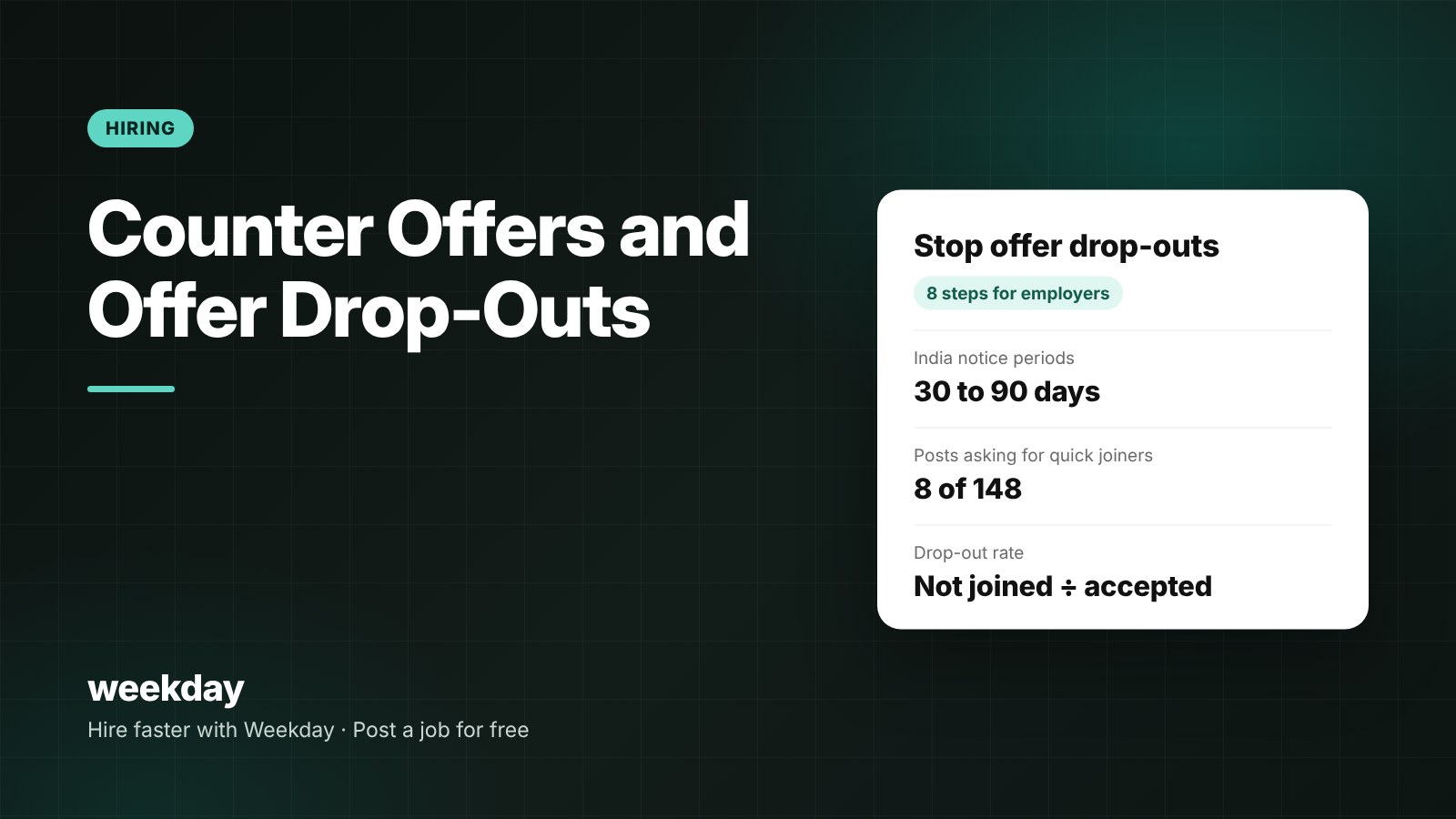
It comes down to the notice period. In India, notice is usually 30 days at startups and 60 to 90 days at large IT services firms and MNCs (Weekday notice period guide). That is two or three months in which the current employer can counter and other companies can keep interviewing your candidate.
Employers know this. In a Weekday analysis of 148 LinkedIn hiring posts from 14 to 23 November 2026, 8 posts asked for immediate joiners or capped the notice period, with lines like "notice 30 days or less" or "immediate joiners preferred". All 8 were for roles in India. We counted posts whose job details mentioned an immediate joiner or a notice limit. Shorter notice means a shorter window for a counter offer.
In the US, most jobs are at-will and notice is much shorter, so the window is smaller. But US recruiters still lose people at the last minute.
What recruiters on Reddit say causes it
In one r/recruiting thread, a recruiter who hires experienced bankers across five US states described new hires backing out the day before they start, or midway through onboarding. The reasons were counter offers from their current employer or offers from other banks, even though the candidates had said they weren't interviewing elsewhere.
The most upvoted replies were blunt. If it keeps happening, the offer is failing the "better" test, so look at pay and benefits for that market. Others said to publish the salary in the job post, speed up the process because candidates get other offers while they wait, keep a backup list of second-choice candidates, and consider a sign-on bonus. One person pointed out that candidates will just say what the recruiter wants to hear about their motivation.
In another thread on candidates who ghost after accepting, the top answer was simply "they got a better offer". Another person said they walked away because communication was poor and the offer came late on a Friday through an e-signature tool, with no call, no welcome and no start details.
The pattern is clear. Most drop-outs are about money, speed and silence. You control all three.
8 ways to reduce offer drop-outs
1. Ask about counter-offer risk in the first call
Don't ask "Are you interviewing elsewhere?" People will say no. Ask questions that get a real answer:
- "If your manager offered you a big raise tomorrow, would you stay? Why or why not?"
- "What would have to change at your current job for you to not look at all?"
- "Have you resigned before and been asked to stay? What happened?"
If the only reason they are leaving is money, the counter-offer risk is high. If the reason is the work, the manager or growth, it is lower.
2. Price the offer at the market rate
Ask for expected CTC early and check it against your band before the final round. A lowball offer that the candidate "accepts" is the easiest one for their current company to beat. Our guide on building a CTC breakup helps you show fixed pay, variable pay and benefits clearly, so the candidate compares the right numbers.
3. Make the offer fast
Every day between the final round and the written offer is a day for someone else to call. Book the debrief for the same day as the last interview, and send the written offer within a day or two. If your process is slow, measure it first with our time to hire guide.
4. Shorten the gap to joining
If the candidate's company allows a notice buyout, offer to cover it. A joining bonus sized to the buyout can bring the start date forward by weeks. Fewer weeks means fewer chances for a counter offer.
5. Prepare them for the counter offer before they resign
Say it out loud: "When you resign, your manager will probably try to keep you. That is normal. Remember the reasons you told us you wanted to move." It sounds simple. It works because the candidate has already thought it through before the pressure comes.
6. Stay in touch every week of the notice period
Silence is where drop-outs grow. A simple plan:
| When | What | Who |
|---|---|---|
| Day 1 after acceptance | Welcome call and written start details | Recruiter |
| Week 1 | Intro call with the hiring manager | Manager |
| Week 2 | Share the first 30-day plan | Manager |
| Every week after | Short check-in: "How is the notice going?" | Recruiter |
| Last week | Laptop, access, day-one schedule, team lunch invite | HR and manager |
7. Keep a backup candidate warm
Don't close out your second-best candidate on the day the first one accepts. Tell them the role is filled for now and you'd like to stay in touch. Close them out only after your hire joins.
8. Track your offer drop-out rate
Example: 20 accepted offers last quarter and 3 people didn't join. Your drop-out rate is 3 ÷ 20 × 100 = 15%. Track it by role, team and recruiter. If one team is much higher, look at its pay, speed and communication first.
What to say when a candidate gets a counter offer
Stay calm and curious. Don't bargain on the first call. Try this:
"Thanks for telling me. Before we talk numbers, can we go back to why you started looking? You told me it was about [reason]. Does the counter offer fix that? If it does, I understand. If it doesn't, let's talk about what would make this an easy decision."
Then decide on one final move, if any, and stick to it. Matching counter after counter turns hiring into an auction.
Should you match a counter offer?
Rarely. If you priced the offer correctly, a bidding war mostly tests who wants the person more. Re-check your offer against the market. If you were low, fix it once. If you weren't, let them go and call your backup candidate.
Lost a candidate to a counter offer?
Refill the pipeline today. Paste your job description and Weekday's AI agents scan 400M+ profiles, check each person's salary expectations and notice period, and reach out on email and WhatsApp until they reply. Your first role is free, with 200 reach-outs and no credit card.
Post a free jobFrequently asked questions
What is a counter offer?
It is when an employee's current company offers more money, a new title or other changes to stop them leaving after they resign or mention another offer.
What is an offer drop-out?
It is when a candidate accepts your offer but doesn't join. The two most common reasons are a counter offer and a better offer from another company during the notice period.
How do you stop candidates backing out after accepting an offer?
Ask about counter-offer risk early, pay at the market rate, make the offer fast, shorten the gap to joining, and stay in touch every week. Keep a backup candidate warm until the person joins.
How do you calculate offer drop-out rate?
Offers accepted but not joined, divided by offers accepted, times 100. Review it every quarter.
Should employers match a counter offer?
Rarely. Re-check your offer against the market, make one final move if it was low, and otherwise move to your backup candidate.
Sources
- r/recruiting: candidates withdrawing the day before they start
- r/recruiting: why candidates ghost after accepting an offer
- Weekday analysis of 148 LinkedIn hiring posts, Nov 2026 (posts dated 14 to 23 November 2026)
- Weekday: notice period guide, joining bonus guide





