
Last updated: 20 November 2026
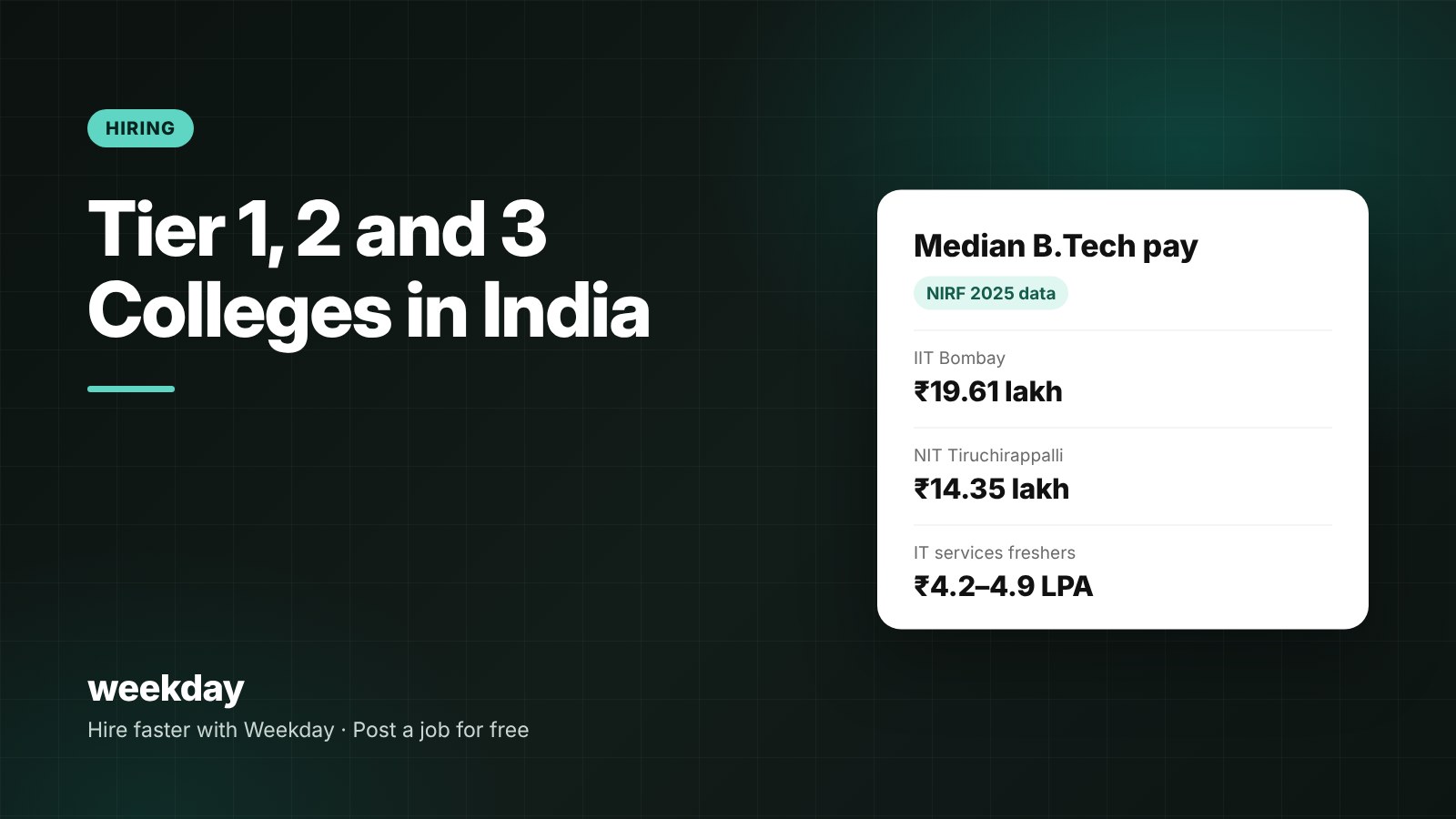
Quick answer: "Tier 1, 2 and 3" is an informal way to group Indian colleges. Tier 1 usually means IITs, IISc, top IIMs and BITS Pilani; tier 2 means NITs and strong state or private institutes; tier 3 means most other colleges. There is no official government list: NIRF publishes ranks, not tiers. Pay follows the label: in NIRF 2025 data, the median salary for placed B.Tech graduates was ₹17.5–19.6 lakh at the top IITs and ₹14–14.35 lakh at the top NITs, while large IT services firms pay freshers ₹4.2–4.9 LPA (Weekday data).
Recruiters, founders and students use "tier 1 college" all the time, but few agree on what it means. This guide explains the labels, shows real placement numbers by college, and gives employers a practical way to hire well from every tier.
What do tier 1, tier 2 and tier 3 mean?
| Tier | Usually includes | What recruiters mean by it |
|---|---|---|
| Tier 1 | IITs, IISc, top IIMs, BITS Pilani | Very selective entry, high packages, heavy competition for students |
| Tier 2 | NITs, DTU, Jadavpur University and similar institutes | Strong students, good placements, more room for smaller employers |
| Tier 3 | Other state and private colleges and universities | Most of India's graduates; quality varies widely from student to student |
This grouping follows the definitions Blind used in its 2025 survey of Indian tech professionals (Blind). Other people draw the lines a little differently. For example, some count IIITs or the top private universities as tier 1.
Is there an official list of tier 1 colleges?
No. The government ranks institutions through the National Institutional Ranking Framework (NIRF), which publishes numbered ranks and rank bands, not tiers (NIRF 2025 engineering ranking). Recruiters often use NIRF ranks to decide which colleges they call tier 1 or tier 2.
For scale: India has 23 IITs (PIB, June 2025) and 31 NITs (Lok Sabha reply, July 2025), while AICTE-approved B.Tech intake was 14.90 lakh seats in 2024–25 (Education Post). Most engineers you will ever hire studied outside tier 1.
Top 10 engineering colleges in NIRF 2025
NIRF 2025 was released on 4 September 2025 (Business Today). As of October 2026, the 2026 rankings had been delayed with no new date announced (Education Bytes), so the 2025 list is still the latest.
| Rank | Institute | NIRF score |
|---|---|---|
| 1 | IIT Madras | 88.72 |
| 2 | IIT Delhi | 85.74 |
| 3 | IIT Bombay | 83.65 |
| 4 | IIT Kanpur | 81.82 |
| 5 | IIT Kharagpur | 78.69 |
| 6 | IIT Roorkee | 75.44 |
| 7 | IIT Hyderabad | 72.31 |
| 8 | IIT Guwahati | 72.24 |
| 9 | NIT Tiruchirappalli | 68.14 |
| 10 | IIT (BHU) Varanasi | 67.24 |
Source: NIRF 2025. Further down: BITS Pilani is 11, SRM 14, VIT 16, NITK Surathkal 17 and NIT Warangal 28.
What freshers get paid, by tier
Institutes that take part in NIRF submit placement data, including the median salary of placed graduates. These figures are for the four-year B.Tech batch that graduated in 2023–24, from each institute's NIRF 2025 data file.
| Institute | Usually called | Median salary (placed B.Tech graduates) |
|---|---|---|
| IIT Bombay | Tier 1 | ₹19.61 lakh |
| IIT Kanpur | Tier 1 | ₹19.40 lakh |
| IIT Delhi | Tier 1 | ₹19.08 lakh |
| IIT Madras | Tier 1 | ₹17.50 lakh |
| NIT Tiruchirappalli | Tier 2 | ₹14.35 lakh |
| NIT Warangal | Tier 2 | ₹14.20 lakh |
| NITK Surathkal | Tier 2 | ₹14.00 lakh |
| COEP Technological University (state) | Tier 2 | ₹10.50 lakh |
| VIT Vellore (private) | Tier 2 or 3, depending on who you ask | ₹8.99 lakh |
| SRM (private) | Tier 2 or 3, depending on who you ask | ₹6.20 lakh |
Now compare that with what most freshers actually start on. On Weekday's salary data, the median fixed pay for freshers (0–1 year) is ₹4.2 LPA at TCS, ₹4.5 LPA at Wipro and Accenture, and ₹4.9 LPA at Infosys (updated November 2026). These companies hire heavily from tier 2 and tier 3 campuses. See our IT fresher salary guide for more companies.
Two cautions. First, a median for placed students leaves out those who were not placed. At IIT Bombay, nearly 70% of students who took part in the 2024–25 placement process got job offers, down from 75% the year before, while the median rose to ₹20 lakh (Free Press Journal, NewsX). Second, a high median at a top college does not mean every student there is a fit for your role.
Does the tier predict job performance?
Less than most people think. A few data points:
- The India Skills Report 2026 puts employability at 70.15% for B.E./B.Tech graduates, 80% for computer science and 78% for IT engineers (Careers360). That is across all colleges, not just tier 1.
- In a Blind survey of 1,602 Indian tech professionals, 41% said they studied at a tier 1 college, 30% at tier 2 and 25% at tier 3. At Zoho, Apple, NVIDIA, SAP and PayPal, tier 3 graduates made up 34% of respondents (People Matters). These are self-reported answers on an anonymous app, so treat them as a signal, not a census.
- TeamLease EdTech's survey of 1,051 employers for January–June 2026 found 73% fresher hiring intent and a gradual shift from degree-based screening to skills-based hiring (The Hans India).
The tier tells you how hard it will be to win a student, and roughly what they will expect to be paid. It does not tell you how good a particular student is.
How employers can hire well from every tier
1. Match your budget to the tier
Example: a startup has ₹8 LPA for a fresher backend developer. At a top IIT, where the median is above ₹17 lakh, that offer will rarely win. At a strong tier 2 or tier 3 college, ₹8 LPA beats the ₹4.2–4.9 LPA IT services medians and sits close to VIT's ₹8.99 lakh median. The same money buys a much better shot. Our fresher salary guide by role and city helps you set the number.
2. Screen on skills, not college names
Use a short coding test or work sample, then review one project in depth. Ask the student to explain what they built, what broke and what they would change. This finds the strong tier 3 student and filters the weak tier 1 one.
3. Go where you can win a good slot
Early placement days at top campuses go to big recruiters. A small company often gets better attention at tier 2 colleges. Our campus hiring playbook covers college shortlists and the placement calendar.
4. Use off-campus hiring and internships
Many good students never get a campus slot with you. Run an open fresher role, or hire interns and convert the best through a pre-placement offer. Set a fair stipend first (internship stipend guide).
5. Train them as a batch
If you hire five or more freshers a year, a graduate trainee program makes onboarding faster and more consistent.
Want strong freshers from any college?
Post your role on Weekday for free. Our AI sourcing agent scans 400M+ profiles, picks the best matches for your skills and budget, and reaches out on email and WhatsApp until they reply. Your first role includes 200 reach-outs, with no credit card.
Post a free jobFAQ
What is a tier 1 college in India?
An informal label for India's most selective institutes, usually the IITs, IISc, top IIMs and BITS Pilani. There is no official government list; NIRF publishes ranks, not tiers.
Which are tier 2 colleges in India?
Usually the NITs and strong state or private institutes such as DTU and Jadavpur University. Some people also put the top IIITs and large private universities in tier 2.
What is a tier 3 college?
Most other state and private engineering colleges. They produce most of India's graduates, and student quality varies widely, so skills tests matter more than the college name.
What is the average package at tier 1 colleges?
In NIRF 2025 data, the median salary for placed B.Tech graduates was ₹19.61 lakh at IIT Bombay, ₹19.40 lakh at IIT Kanpur, ₹19.08 lakh at IIT Delhi and ₹17.50 lakh at IIT Madras.
Should startups hire only from tier 1 colleges?
No. Tier 1 students are expensive and in high demand. Most startups get better value by testing skills and hiring strong students from tier 2 and tier 3 colleges, often through internships and off-campus roles.
Sources
- NIRF India Rankings 2025: Engineering and the institute data files linked in the salary table
- Business Today: NIRF 2025 released; Education Bytes: NIRF 2026 delayed
- PIB: number of IITs; Lok Sabha reply on IITs and NITs; Education Post: AICTE B.Tech intake
- Free Press Journal: IIT Bombay placements 2024–25
- Careers360: India Skills Report 2026
- Blind survey via People Matters
- The Hans India: TeamLease EdTech Career Outlook H1 2026
- Weekday salary pages for TCS, Infosys, Wipro and Accenture (November 2026)





