
Last updated: 20 November 2026
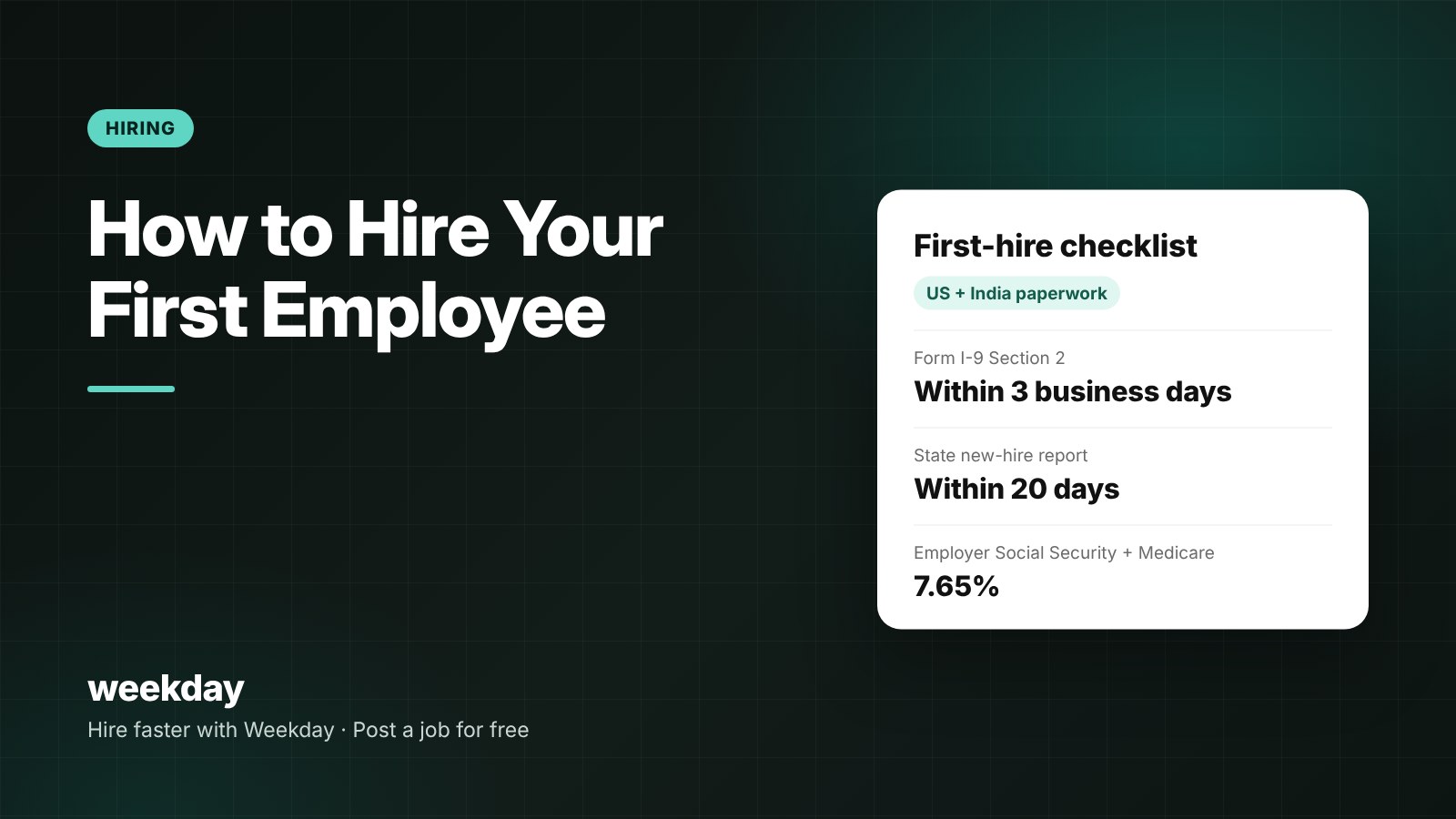
Quick answer: To hire your first employee, (1) decide the one job you most need done, (2) set a fair pay range, (3) write a clear job post, (4) source and screen candidates, (5) run a short structured interview, (6) send a written offer and (7) finish the paperwork. In the US that means an EIN, Form I-9 within 3 business days, Form W-4, a state new-hire report within 20 days, payroll taxes and, in most states, workers' compensation. In India, check Shops and Establishments registration, and remember that appointment letters are now mandatory for every worker.
Your first hire is a big step. Of the 36.2 million small businesses in the US, only 17.7% have paid employees; the other 82.3% are run by the owner alone (SBA Office of Advocacy, 2026). Hiring one person changes how you work, what you owe the government and how fast you can grow. This guide walks through it in order, with simple examples.
Step 1: Decide what this person will own
Do not hire "help". Hire for one outcome you can describe in a sentence.
- Good: "Answer every customer ticket within 4 hours and turn common questions into help articles."
- Too vague: "Someone to help with operations and growth."
A simple test: list the tasks that took most of your week last month. Your first hire should take the biggest block that someone else can do well, so you can spend time on what only you can do.
Also decide: employee or contractor? A contractor suits a short, well-defined project. An employee suits ongoing work you direct day to day. The legal line differs by country, so check the rules before you decide. The IRS hiring employees page is a good starting point in the US.
Step 2: Set the pay range before you post
Founders often skip this and lose good candidates at the offer stage. Look at what the market pays for the role and the city, then pick a range you can afford for at least a year.
Remember that salary is not the full cost. In the US, the employer pays 6.2% Social Security and 1.45% Medicare on wages, with Social Security applying up to $184,500 of earnings in 2026 (IRS). Federal unemployment tax (FUTA) is 6.0% on the first $7,000 of wages, or 0.6% after the full 5.4% state credit (IRS).
Example: a $60,000 salary in the US adds about $4,590 in employer Social Security and Medicare (7.65%) and $42 in FUTA (0.6% of $7,000). That is roughly $4,632 in federal payroll taxes before state unemployment tax, workers' compensation and benefits.
For India pay data, see Weekday's fresher salary guide by role and city and our guide on how to benchmark salaries.
Step 3: Write a short, honest job post
Your first job post is also your first employer brand. Keep it simple:
- What the person will do in the first 90 days
- 3 to 5 must-have skills, not 15
- The pay range, location and work mode
- Why someone would want to join a small company now
Need a starting draft? Weekday has free JD templates, such as the backend engineer JD generator, and a JD bias checker that flags wording that can put people off.
Step 4: Find candidates
Use more than one channel:
- Your network. Ask people you trust who the best person they have worked with is.
- Free job posts. Many sites let you post for free with limits. LinkedIn, for example, allows one free job post open at a time (LinkedIn).
- Direct outreach. The best candidates are often employed and not applying. Reach them with a short, personal message that says what the role is and what it pays.
Step 5: Run a short, structured interview
A first hire is hard to undo, so be careful, but do not be slow. SHRM's 2026 benchmarking puts median time to fill at 39 calendar days for non-executive roles (SHRM). A small company can and should move faster.
| Round | Time | What you check |
|---|---|---|
| Screening call | 20–30 minutes | Motivation, pay fit, availability |
| Work sample | 60–90 minutes | A small, real task from the actual job |
| Deep-dive interview | 45–60 minutes | Past work, how they solve problems, how they handle feedback |
| Reference calls | 2 × 15 minutes | How they work with others and what support they need |
Ask every candidate the same core questions and score them on the same scale. Our structured interview guide and free interview scorecard generator help with this.
Step 6: Make a written offer
Put the role, start date, pay, benefits, probation period (if any) and notice terms in writing. In India, this is now a legal requirement: the labour codes that took effect on 21 November 2025 made appointment letters mandatory for all workers (PIB). Our offer letter format guide has samples.
Step 7: Finish the paperwork
United States checklist
| Task | Rule | Source |
|---|---|---|
| Get an EIN | Free from the IRS, online or with Form SS-4 | IRS |
| Form I-9 | Section 1 by the first day of work; Section 2 within 3 business days | USCIS |
| E-Verify | Voluntary for most employers; required for some federal contractors and by some states | E-Verify |
| Form W-4 | Employee fills it in; keep it for at least 4 years | IRS |
| New-hire report | Report to your state within 20 days of hire (some states require sooner) | HHS |
| Minimum wage and overtime | Federal minimum $7.25 an hour; 1.5 times pay after 40 hours a week for non-exempt staff | DOL |
| Workers' compensation | Mandatory for most employers in every state except Texas | NAIC |
| Unemployment insurance | Register with your state workforce agency | SBA |
State minimum wages are often higher than the federal one, so check your state's rate too.
India checklist
- Shops and Establishments registration is a state law. In Maharashtra, for example, establishments with 10 or more workers apply online for registration, and smaller ones send an intimation (Maharashtra Labour Department).
- EPF applies to notified establishments with 20 or more employees (EPFO). The EPF wage ceiling rose from ₹15,000 to ₹25,000 a month from 17 September 2026 (PIB).
- ESIC applies to non-seasonal factories employing 10 or more people, with a wage limit of ₹21,000 a month (ESIC). Check whether your state has extended it to your type of business.
- Appointment letter for every employee, as covered in Step 6.
For the salary structure itself, see our CTC breakup guide under the labour codes.
Step 8: Plan the first 30 days
- Day 1: laptop, accounts and a written list of what "good" looks like in month one.
- Week 1: one small task they can finish and ship.
- Week 2–4: a weekly 30-minute check-in. Ask what is unclear and what is slowing them down.
Your first employee will shape how future hires are treated. Give them clear goals, honest feedback and room to own their work.
Hiring your first employee?
Post your role on Weekday for free. Our AI sourcing agent scans 400M+ profiles, picks the best matches and reaches out on email and WhatsApp until they reply. Your first role includes 200 reach-outs, with no credit card.
Post a free jobFAQ
What do I need before hiring my first employee in the US?
An EIN from the IRS (free), a payroll setup for federal and state taxes, workers' compensation insurance in most states, and registration with your state for unemployment insurance. On the first days of work you also need Form I-9 and Form W-4, and you must report the new hire to your state within 20 days.
How much does a first employee really cost?
More than the salary. In the US, the employer pays 7.65% for Social Security and Medicare plus federal unemployment tax of up to $42 a year per employee after the state credit, then state unemployment tax, workers' compensation and any benefits.
Should my first hire be an employee or a contractor?
A contractor suits a short, well-defined project. An employee suits ongoing work you direct. The legal test differs by country and state, so check the rules before you decide.
How long should hiring my first employee take?
SHRM's 2026 benchmark median time to fill is 39 days for non-executive roles. A small company with a clear role, a pay range and a short structured process can often move faster.
Is an appointment letter mandatory in India?
Yes. Under the labour codes in force from 21 November 2025, employers must give appointment letters to all workers.
Sources
- SBA Office of Advocacy: Frequently Asked Questions About Small Business (2026)
- IRS: hiring employees, EIN, Social Security and Medicare, FUTA, Form W-4
- USCIS: Form I-9 Section 2 and E-Verify overview
- HHS: new hire reporting, DOL: FLSA, NAIC: workers' compensation, SBA: hire and manage employees
- SHRM: recruiting benchmarks (2026)
- India: PIB: labour codes in force, PIB: EPF wage ceiling, EPFO, ESIC, Maharashtra Shops and Establishments Act





