Last updated: 27 November 2026
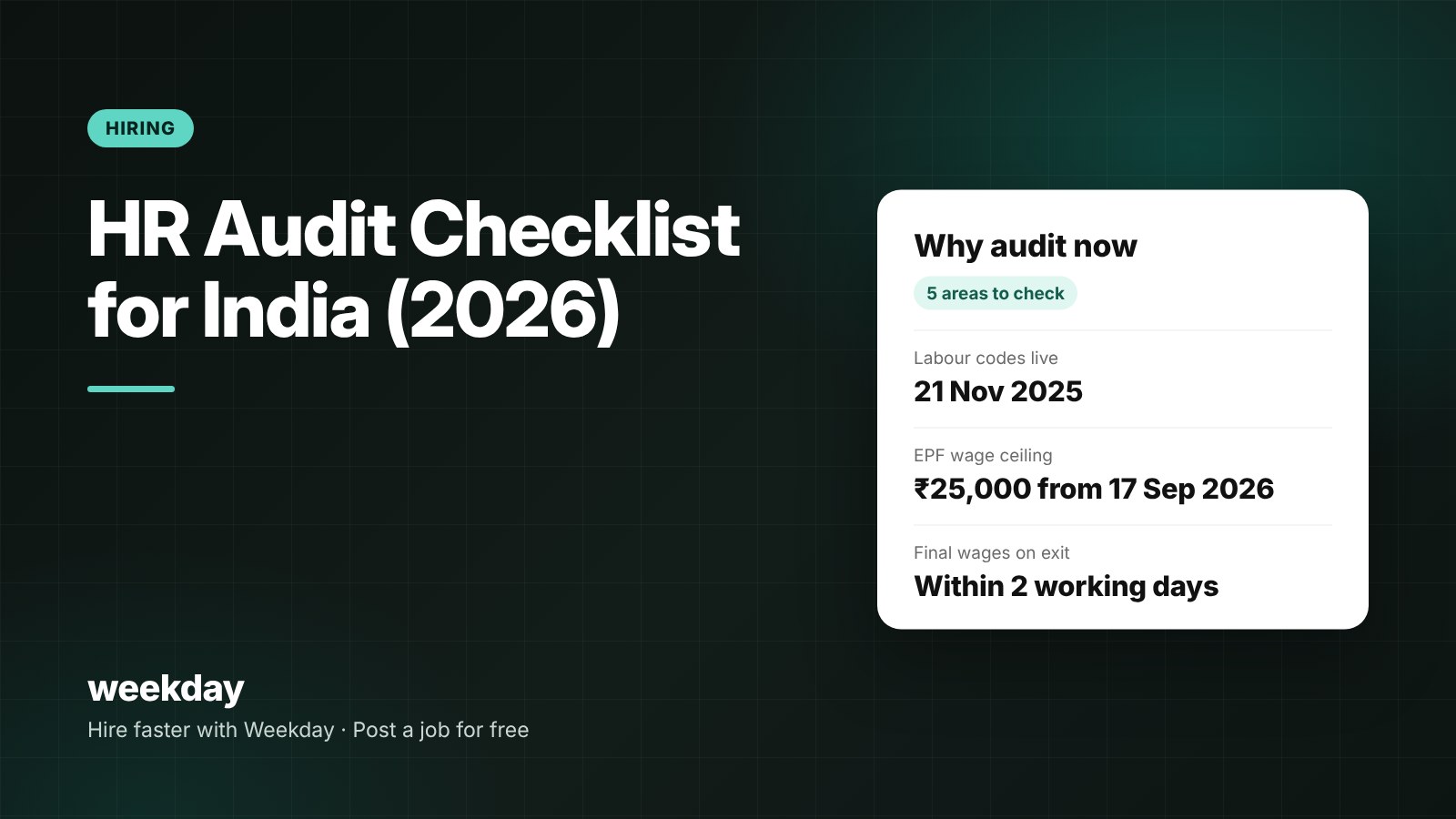
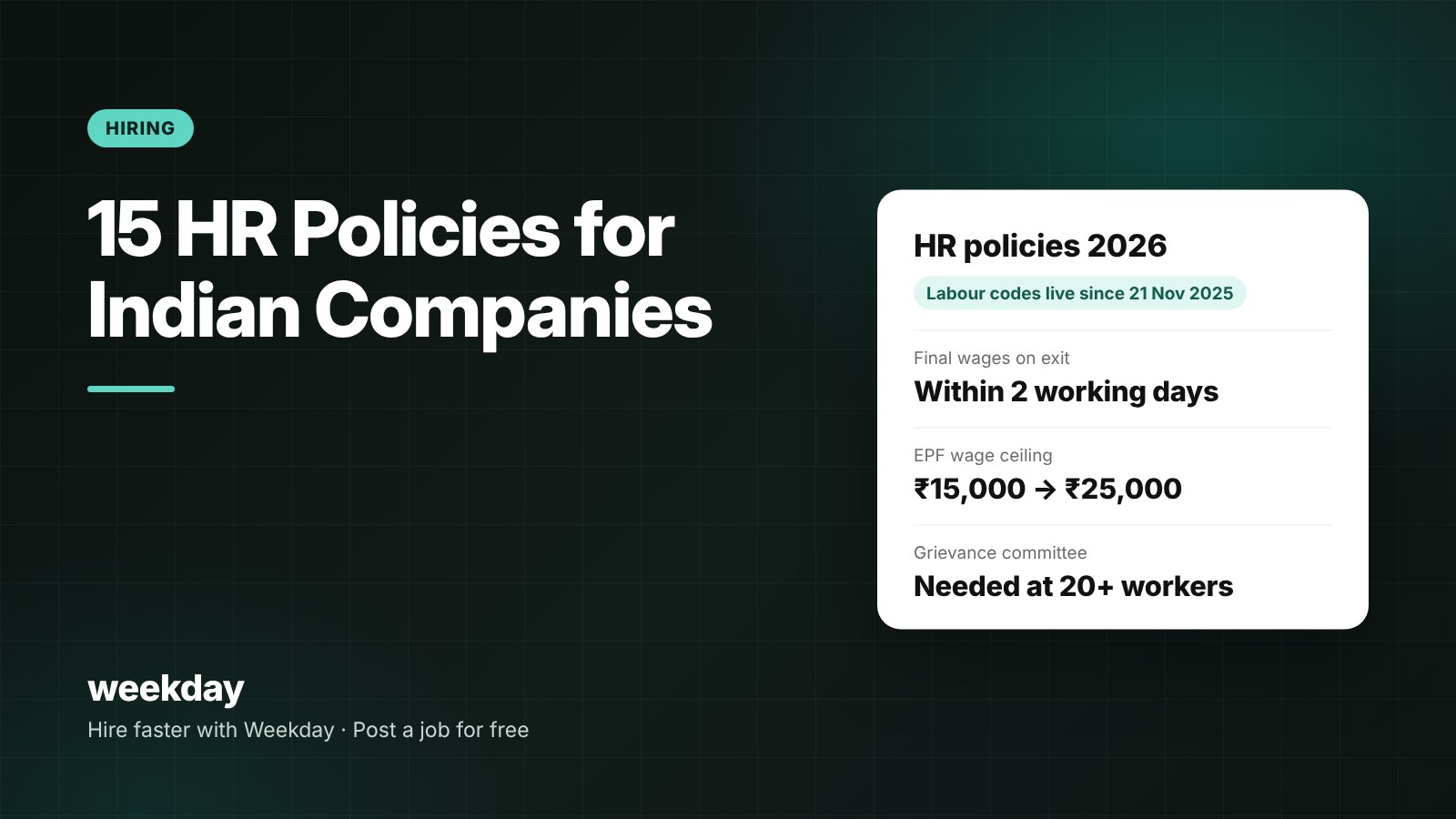
Quick answer: India's four labour codes have been in force since 21 November 2025, replacing 29 older laws (PIB). They make appointment letters mandatory for all workers and give fixed-term staff gratuity after one year. On top of that, the EPF wage ceiling went up from ₹15,000 to ₹25,000 a month from 17 September 2026. So if your HR policies were written before late 2025, they're out of date. Below are the 15 policies most Indian companies need: about half are legal musts (POSH, leave, hours, pay, grievances, equal opportunity), the rest are good practice that prevents disputes.
HR policies are the written rules for how your company hires, pays, manages and lets people go. A small startup doesn't need a thick handbook. It needs a few clear pages that match the law and that managers actually follow.
Labour law depends on your state, headcount and whether staff count as "workers", so treat this as a starting point and check with your lawyer before you publish.
What changed for HR policies since November 2025
| Change | Policy to update | Source |
|---|---|---|
| Four labour codes in force from 21 Nov 2025; appointment letters mandatory for all workers | Offer and appointment letter | PIB |
| Fixed-term employees get the same benefits as permanent staff, and gratuity after 1 year instead of 5 | Contract and fixed-term staff, gratuity | PIB |
| IT and ITES companies must release salary by the 7th of every month | Payroll | PIB |
| Wages due on exit must be paid within 2 working days | Exit and full and final settlement | LiveLaw |
| Women can work night shifts in all establishments, with consent and safety measures | Shifts and transport | PIB |
| Work beyond 8 hours a day or 48 a week is overtime, paid at twice the wage rate | Working hours and overtime | PRS India |
| EPF wage ceiling ₹15,000 → ₹25,000 from 17 Sep 2026; maximum employee PF ₹1,800 → ₹3,000 a month | Pay and statutory deductions | Keka |
| Standing orders now apply from 300 workers (up from 100) | Code of conduct and discipline | Legal 500 |
One more thing to know. Many code protections apply to "workers", and managers, along with supervisors earning over ₹18,000 a month, fall outside that word (SCC Online). Most companies still apply the same policy to everyone. It's simpler and fairer.
The 15 HR policies at a glance
| # | Policy | Legal must or good practice | What it must cover |
|---|---|---|---|
| 1 | Appointment and employment terms | Legal must | Role, pay, probation, notice, work location |
| 2 | POSH (prevention of sexual harassment) | Legal must; Internal Committee at 10+ employees | Committee, how to complain, timelines |
| 3 | Leave and holidays | Legal must (labour codes plus your state's shops act) | Earned, sick, casual, festival, maternity leave |
| 4 | Working hours, attendance and overtime | Legal must | Hours, weekly off, overtime pay and consent |
| 5 | Pay, payroll and statutory deductions | Legal must | Salary date, PF, ESIC, TDS, payslips |
| 6 | Code of conduct and discipline | Legal must at 300+ workers (standing orders); good practice below | Misconduct, warnings, inquiry steps |
| 7 | Grievance redressal | Legal must at 20+ workers | Committee, how to raise an issue, 30-day decision |
| 8 | Equal opportunity and anti-discrimination | Legal must (disability law covers every establishment) | Fair hiring and pay, accessibility, who to contact |
| 9 | Employee data privacy | Legal must; main DPDP duties from 13 May 2027 | What data you keep, why, for how long, who sees it |
| 10 | Whistleblower (vigil mechanism) | Legal must for listed companies and some others; good practice for all | How to report wrongdoing safely |
| 11 | Notice period, resignation and exit | Good practice; the 2-working-day wage rule is law | Notice, buyout, handover, final dues |
| 12 | Performance and appraisal | Good practice | Review cycle, ratings, PIP |
| 13 | Remote and hybrid work | Good practice | Who can work remotely, hours, equipment, security |
| 14 | Moonlighting and conflict of interest | Good practice | Side work allowed, disclosure, IP |
| 15 | Travel and expenses | Good practice | Limits, approvals, claim deadline |
The legal-must policies, briefly
POSH. Every employer with 10 or more employees needs an Internal Committee led by a senior woman, with half its members women and one outside member. Our POSH Act checklist covers the committee, the 90-day inquiry rule and the ₹50,000 penalty.
Leave. The OSH Code gives workers 1 day of annual leave for every 20 days worked, once they've worked 180 days in a year, and your state shops act adds sick leave and festival holidays. Maternity leave is 26 weeks for the first two children (PIB). Our leave policy template has the full table, so we won't repeat it here.
Grievance redressal. Industrial establishments with 20 or more workers need a Grievance Redressal Committee of up to 10 members, with employer and worker members, fair representation for women, and 30 days to complete each case (IR Code, section 4).
Equal opportunity. Under the disability law, every establishment must publish an equal opportunity policy, preferably on its website, and register a copy with the Chief or State Commissioner for Persons with Disabilities (CCPD).
Data privacy. The DPDP Rules were notified on 13 November 2025, and the main duties (notice, security safeguards, breach reporting) apply from 13 May 2027 (Hogan Lovells). Employee records, ID proofs and background checks are personal data, so start now.
Whistleblower. Listed companies, companies that take public deposits, and companies that have borrowed over ₹50 crore from banks and financial institutions must run a vigil mechanism (Lakshmikumaran & Sridharan).
Short templates you can copy
Fill in the [brackets].
Working hours and overtime
"Our working week is [5] days, [Monday to Friday], with a normal day of [9] hours including a [1]-hour break, within a limit of 48 hours a week. Overtime is voluntary. Where it applies, we pay it at twice the ordinary rate of wages. Managers may not expect replies to messages after [7 pm] or on weekly offs, except for agreed on-call duty."
Pay and statutory deductions
"Salary is credited by the [7th] of each month for the previous month. We deduct PF at 12% of PF wages [up to the ₹25,000 ceiling / on full basic], ESIC where gross pay is ₹21,000 or less, professional tax as per state rules, and income tax (TDS). Payslips are shared on [portal] by the [10th]."
Not sure how the new ceiling changes take-home pay? Our PF new rules guide has the tables, including the rule that adds allowances back into PF wages when they're more than half of total pay.
Grievance redressal
"Raise any work grievance in writing to [email] or your manager. We acknowledge it within [3] working days. If it isn't resolved, it goes to the Grievance Redressal Committee, which aims to decide within 30 days. Nobody will face any action for raising a grievance in good faith. Sexual harassment complaints go to the Internal Committee under our POSH policy."
Remote and hybrid work
"Roles marked [remote / hybrid] may work from home. Core hours are [11 am to 4 pm IST]. We provide a laptop and [₹X] once for home setup. Keep company data on company devices and use [VPN / MFA]. Remote work is a working arrangement, not a right, and may be reviewed with [30] days' notice."
Moonlighting and conflict of interest
"You may take up paid work outside [Company] only with written approval, and never for a competitor or a client. Disclose any business interest that could conflict with your role. Work you create using company time, data or devices belongs to [Company]." More on this in our moonlighting guide.
Notice period and exit
"After confirmation, the notice period is [60] days on either side. [Company] may waive or buy out notice. Salary dues are paid within 2 working days of your last day; leave encashment, gratuity (if eligible) and reimbursements follow in the full and final settlement by [date]." See our guides to the notice period and full and final settlement.
For discipline, use our warning letter and show cause notice formats instead of writing new ones. For reviews, see our performance appraisal guide.
Free tool: Policy 1 starts with the offer. Weekday's offer letter generator gives you a clean letter with role, pay, probation and notice in a few minutes.
How to roll out HR policies
- Start with the legal musts. Appointment terms, POSH, leave, hours, pay and grievances come first.
- Write for a new joiner. Short sentences, one page per policy, real examples.
- Get a legal review once, then reuse the structure for future updates.
- Collect acknowledgments. A signed or clicked "I have read this" for every employee, stored with their file.
- Date every policy and review it yearly, plus whenever the law changes, as it did on 21 November 2025 and 17 September 2026.
A common gap in startup handbooks: the policy says one thing and managers do another. Train managers on the five policies that come up every week: leave, hours, pay, discipline and exits.
Hiring while you fix your policies?
Post your open roles for free. Weekday's AI agents find matching candidates, including people who aren't actively applying, and reach out for you.
Frequently asked questions
Which HR policies are mandatory in India?
Appointment terms, POSH (with an Internal Committee at 10+ employees), leave and holidays, working hours, pay and statutory deductions, an equal opportunity policy and, at 20+ workers, a grievance redressal committee. Standing orders apply at 300+ workers, and a whistleblower mechanism applies to listed and some other companies.
Do the new labour codes apply to IT companies?
Yes. The government's note on the codes lists IT and ITES specifically: salary must be released by the 7th of every month, appointment letters are mandatory and women can work night shifts with consent and safety measures.
How often should HR policies be updated?
Review them once a year and whenever the law changes. Policies written before 21 November 2025, when the labour codes came into force, need a review now.
Does a small startup need an HR policy manual?
It needs a short one. A few pages covering the legal musts, signed by every employee, prevents most disputes. Add good-practice policies like remote work and expenses as you grow.
Sources
- PIB / Ministry of Labour: implementation of the four labour codes (21 Nov 2025)
- LiveLaw: two working days for final wages under the Code on Wages
- PRS India: OSH Code rules review (hours and overtime)
- Keka: EPFO wage ceiling increased to ₹25,000
- Legal 500: The Industrial Relations Code
- Indian Kanoon: IR Code, section 4 (Grievance Redressal Committee)
- SCC Online: ₹18,000 wage ceiling for supervisory staff
- PIB: Code on Social Security, 2020
- Chief Commissioner for Persons with Disabilities: equal opportunity policy
- Hogan Lovells: DPDP Act brought into force
- Lakshmikumaran & Sridharan: laws on whistleblowing in India